
David Eichenbaum, MD, FASRS, recalls an early-career case managing bilateral diabetic macular edema with frequent intravitreal triamcinolone injections—leading to severe steroid-induced glaucoma and valve implants.
David Eichenbaum, MD, FASRS, recalls an early-career case managing bilateral diabetic macular edema with frequent intravitreal triamcinolone injections—leading to severe steroid-induced glaucoma and valve implants.
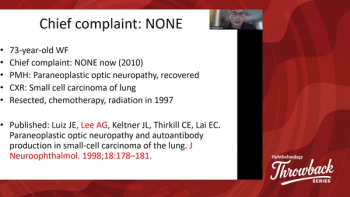
Andrew G. Lee, MD, revisits a 1997 case in which recognizing paraneoplastic optic neuropathy led to the diagnosis—and life-saving treatment—of small cell lung carcinoma.

Neda Shamie, MD, recounts a humbling experience performing cataract surgery in Honduras using older-generation phaco machines, revealing how technology elevates both skill and patient care.

Anat Loewenstein, MD, shared recent research findings which indicate home monitoring is appropriate for atypical and complex pathologies

Their discussion sheds light on the importance of physician advocacy in ophthalmology—from shaping policy and protecting patients to building community.

HELIOS Phase 1 showed consistent reductions in retinal fluid with OTX-TKI, paving the way for pivotal HELIOS-2 and HELIOS-3 trials.


Gildeuretinol has also been evaluated in atrophic age-related macular degeneration, said Philip J. Ferrone, MD

Inder Paul Singh, MD, shares a formative experience in which a patient’s vision loss—and their unexpected gesture of comfort—shaped his approach to high-risk glaucoma care.

Optogenetics shows promise in improving mobility and object recognition for patients with retinitis pigmentosa and Stargardt disease.

SriniVas R. Sadda, MD, FARVO, recalls a residency case that highlights the transformative impact of OCT and OCT angiography.
Sunir J. Garg, MD, explores the nuances of endophthalmitis, distinguishing between infectious and non-infectious responses for effective patient management.

Research reveals significant vision improvements and extended treatment intervals with aflibercept 8 mg for age-related macular degeneration and diabetic edema patients.
Phase 2 STARLIGHT study participants, particularly those with the macular phenotype, experienced meaningful gains in visual acuity at 48 weeks.

Bedrood describes improved visualization of the ciliary body, efficient setup, and favorable postoperative outcomes.

A panelist discusses how interpreting clinical trial data, monitoring disease progression, and maintaining transparent communication help retina specialists make informed decisions about when and how to treat geographic atrophy with emerging therapies.

Innovations in selective laser trabeculoplasty and laser cyclophotocoagulation focus on procedural efficiency, patient comfort, and evolving first-line treatment strategies.

John P. Berdahl, MD, discusses advanced lens options for patients with pseudoexfoliation, highlighting considerations for successful longterm outcomes.

Continued research shows that earlier treatment significantly enhances tissue preservation in patients with geographic atrophy, emphasizing the importance of timely intervention.

In the Phase 2 TEASE 2 trial, gildeuretinol was well tolerated and showed promising trends in slowing ellipsoid zone loss and preserving low-luminance visual acuity in patients with Stargardt disease.

A new study reveals enhanced safety and efficacy in epi-on cross-linking for keratoconus, utilizing oxygen-rich boost goggles during treatment.
Data suggests the candidate can reduce the number of injections and treatment burden for patients

Dr. Singh reported that when technicians understand why they are performing a diagnostic test, they perform better and think critically in patient care situations.

Dr Khanani shared his first-time results talk during an AAO specialty day

The 18-month extension of the GATHER2 trial indicated continued benefit for patients receiving avacincaptad pegol, with efficacy gains increasing over time.
At the 2025 Academy of American Ophthalmology meeting, Prof Stalmans described safety and efficacy benefits of disposable non-contact vitrectomy lenses

Dr Borkar, a vitreoretinal surgeon at Duke University, spoke to the Eye Care Network about her American Academy of Ophthalmology (AAO) presentation
Jean-Francois Korobelnik, MD, shares highlights from the PULSAR extension study showcasing aflibercept 8 mg and its ability to promote fluid resolution

An expert discusses the prevalence and clinical impact of Demodex blepharitis across Japan and Europe, highlighting regional differences in diagnosis and awareness.

Data suggests the candidate can reduce the number of injections and treatment burden for patients