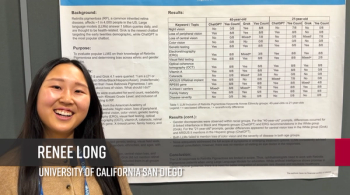
The poster looked into the LLM's potential for biases in gender and race when it came to its knowledge of retinitis pigmentosa.
The poster looked into the LLM's potential for biases in gender and race when it came to its knowledge of retinitis pigmentosa.
Srinivas Sadda, MD, FARVO, immediate past president of ARVO, discusses the impact the organization has had on his career and how he wants to help the next generation.
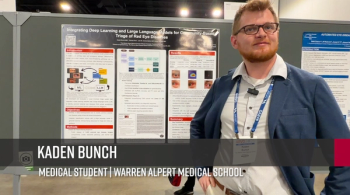
Kaden Bunch, a fourth-year medical student from the Warren Alpert Medical School of Brown University, talked about his poster on large language models and the effectiveness of diagnosing red eye diseases.
At this year's ARVO meeting in Denver, Colorado, Giulia Corradetti spoke on how baseline OCT biomarkers can predict anatomic response in neovascular age-related macular degeneration when treated with faricimab.
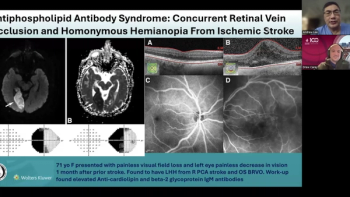
Andrew G. Lee, MD, and Drew Carey, MD, discuss how eye and brain vascular events such as retinal vein occlusion and stroke can signal antiphospholipid syndrome and require further evaluation.
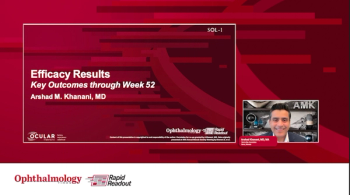
Dr. Khanani reviews 52-week safety outcomes, noting Axpaxli was generally well tolerated with no cases of endophthalmitis or retinal vasculitis.
In this opening segment, Dr. Arshad Khanani highlights the SOL-1 phase 3 trial evaluating Axpaxli (OTX-TKI) in treatment-naïve neovascular AMD.

From role models to open doors, Christina Y. Weng, MD, MBA, FASRS, shares insights on career development, women in ophthalmology, evolving training models, and her work as protocol chair for the DRCR Retina Network’s Protocol AO study.

Christopher E. Starr, MD, FACS, highlights diagnostic gaps in dry eye, emphasizing neuropathic corneal pain and reviewing emerging therapies and pipeline treatments in ocular surface disease.
A tissue-sparing technique using a triple-layer decellularized basement membrane is associated with shorter OR time, rapid recovery, and no reported recurrences in a retrospective series.
Quesada discusses a robotic femtosecond laser platform for LASIK, focusing on flap accuracy, stromal bed precision, and the role of integrated OCT imaging.

Zaman discusses the positive topline results from a phase 1/2 study of the BIM-IOL system, during which it successfully reduced IOP in patients with OAG or OHT.
An analysis of lifitegrast trial subgroups showed that earlier treatment and milder baseline disease were associated with faster and greater symptom improvement.

In the latest episode of The Retina TL;DR with Dr. Weng, host Christina Y. Weng, MD, MBA, FASRS, talks with Drs. Do, Lad, and Munk about the LIGHTSITE III trial data behind photobiomodulation and what it means for retina practice.
Combining peristaltic and Venturi pump technology during phacoemulsification may reduce ultrasound time and support endothelial preservation.
Dan B. Tran, MD, compared refractive accuracy, cylinder correction, and postoperative adjustment rates between femtosecond laser–assisted and manual capsulotomy in Light Adjustable Lens cases.
George O. Waring IV, MD, FACS, discussed how “tolerance” may expand the QRS functional vision model, with new data on IOL performance in residual astigmatism and defocus.
Oluwatosin U. Smith, MD, provides an overview of angle-based techniques, cyclodialysis cleft repair, and minimally invasive approaches to glaucoma surgical complications.
Expanded guidance incorporates advanced diagnostics and reinforces treatment of conditions such as Demodex blepharitis and neuropathic pain, explains Christopher E. Starr, MD, FACS.
Chang described how the ASCRS Functional Vision Working Group is proposing a structured framework centered on visual quality, visual range, and visual symptoms to guide lens classification.
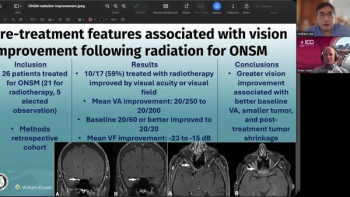
Andrew G. Lee, MD, and Drew Carey, MD, review how clinical and imaging findings relate to vision recovery after radiotherapy for optic nerve sheath meningioma.

Prof. Nanavaty reviews UK treatment practices, emphasizing that the lack of Demodex-specific therapies leads to mismanagement, increased healthcare burden, and complications, while highlighting the need for better diagnosis and targeted treatment.
Prof. Nanavaty outlines Demodex blepharitis, highlights colorette counts as a measure of severity, and emphasizes that despite its high prevalence in patients, it is frequently overlooked and should be routinely assessed during eye exams.
Their discussion touches upon EyeSustain’s global efforts to reduce waste in ophthalmology, strategies for greener cataract surgery, and collaborations with industry and professional societies to promote sustainability.
In the latest episode of The Retina TL;DR with Dr. Weng, host Christina Y. Weng, MD, MBA, FASRS, talks with Dr. Dugel about the novel hydrogel-based tyrosine kinase inhibitor platform designed to extend durability and improve long-term outcomes in neovascular AMD.

Prof. Anat Loewenstein questioned whether treat-and-extend will remain the preferred strategy as longer-acting therapies emerge.
Andrew G. Lee, MD, presents the “no” perspective on whether GLP-1 agonists cause non-arteritic anterior ischemic optic neuropathy, arguing that current evidence shows association but not proven causation.

In this third case, Dr. Maria Berrocal describes a patient with highly cystic diabetic macular edema (DME) in the left eye who had shown minimal response to two prior steroid injections.
Pitha discusses how ophthalmic drug shortages — more frequent and longer-lasting than the national average — are threatening adherence to glaucoma therapy.