

Panelists discuss how aflibercept’s structural design and the higher molar dose of its 8-mg formulation enhance VEGF binding, treatment durability, and clinical predictability.
Panelists discuss how aflibercept’s structural design and the higher molar dose of its 8-mg formulation enhance VEGF binding, treatment durability, and clinical predictability.

Dr. Sharon Fekrat presented a retrospective analysis assessing how antiplatelet and anticoagulant therapy relates to hemorrhage characteristics and outcomes.

Panelists discuss new DED treatments like Miebo and Vevye and how they integrate into treatment algorithms.
Experts highlight management nuances in patients with neuropathic pain, post–refractive surgery complications, or contact lens intolerance.
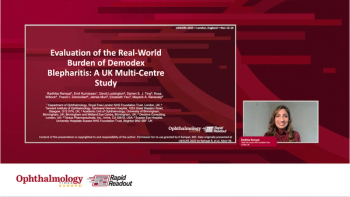
The panel addresses common patient frustrations and therapeutic limitations in today’s dry eye landscape.
Panelists share how they tailor therapy based on patient characteristics, symptoms, and clinical findings.
Panelists discuss how key biologic and clinical distinctions—such as ischemia, leakage patterns, and modality-specific insights—guide tailored treatment strategies for BRVO, CRVO, and DME.
Panelists discuss how differing disease mechanisms, inflammatory drivers, and clinical priorities across AMD, DME, and RVO shape individualized therapeutic goals and the use of newer anti-VEGF agents.
The discussion explores how basal and reflex tears differ and why composition impacts sustained eye comfort.
Experts explain how differentiating these subtypes guides treatment choices and outcomes.

A new treatment is presented that eliminates the root cause of the disease and restores ocular surface health.
Hipsley shares insights into ocular biomechanics and dynamic range of focus, that can help the field to work toward vision restoration and increase eye health.

Discover how RGB technology enhances eye disease diagnosis, improving accuracy and efficiency in clinical practice with advanced imaging techniques.
Advanced imaging technologies like intraoperative OCT and heads-up displays enhance surgical precision and patient outcomes in retina surgery.
A study reveals that cryopreserved amniotic membrane enhances recovery and reduces infection risk in post-corneal cross-linking patients.
A panelist discusses how careful timing, patient education, and bilateral treatment planning strengthen real-world NT-501 management for MacTel type 2.
A panelist discusses how successful NT-501 integration in MacTel care requires both strategic eye selection and overcoming financial and institutional barriers.
A panelist discusses how individualized imaging-based decisions guide when to initiate NT-501 therapy in both early and advanced stages of MacTel type 2.
A panelist discusses how strategic eye selection and proactive patient counseling optimize success and satisfaction with NT-501 implantation for bilateral MacTel type 2.
A panelist discusses how evolving imaging and the approval of NT-501 therapy are transforming macular telangiectasia type 2 from a diagnostic challenge into a treatable condition.
Donaldson introduces the panel and outlines the series’ focus on improving dry eye management through tear function optimization.
Donaldson introduces the panel and outlines the series’ focus on improving dry eye management through tear function optimization.
Surgeons explore innovative cataract surgery techniques that significantly lower intraocular pressure while ensuring patient safety and comfort.
An expert summarizes real-world GA management lessons, highlighting personalized imaging-guided care and patient-centered strategies to maintain vision stability.
An expert demonstrates how to safely co-manage AMD and GA using staggered dual-pathway treatment to maintain stability and patient confidence.
An expert outlines vision-preserving strategies for monocular high-risk GA, emphasizing early intervention and tailored therapy for safety and stability.
An expert details practical imaging and counseling strategies for slowing vision loss in geographic atrophy through case-based management and patient engagement.