Dan B. Tran, MD, compared refractive accuracy, cylinder correction, and postoperative adjustment rates between femtosecond laser–assisted and manual capsulotomy in Light Adjustable Lens cases.

Dan B. Tran, MD, compared refractive accuracy, cylinder correction, and postoperative adjustment rates between femtosecond laser–assisted and manual capsulotomy in Light Adjustable Lens cases.

George O. Waring IV, MD, FACS, discussed how “tolerance” may expand the QRS functional vision model, with new data on IOL performance in residual astigmatism and defocus.

Oluwatosin U. Smith, MD, provides an overview of angle-based techniques, cyclodialysis cleft repair, and minimally invasive approaches to glaucoma surgical complications.

Expanded guidance incorporates advanced diagnostics and reinforces treatment of conditions such as Demodex blepharitis and neuropathic pain, explains Christopher E. Starr, MD, FACS.

Chang described how the ASCRS Functional Vision Working Group is proposing a structured framework centered on visual quality, visual range, and visual symptoms to guide lens classification.

Andrew G. Lee, MD, and Drew Carey, MD, review how clinical and imaging findings relate to vision recovery after radiotherapy for optic nerve sheath meningioma.

Prof. Nanavaty reviews UK treatment practices, emphasizing that the lack of Demodex-specific therapies leads to mismanagement, increased healthcare burden, and complications, while highlighting the need for better diagnosis and targeted treatment.

Prof. Nanavaty outlines Demodex blepharitis, highlights colorette counts as a measure of severity, and emphasizes that despite its high prevalence in patients, it is frequently overlooked and should be routinely assessed during eye exams.

Their discussion touches upon EyeSustain’s global efforts to reduce waste in ophthalmology, strategies for greener cataract surgery, and collaborations with industry and professional societies to promote sustainability.

In the latest episode of The Retina TL;DR with Dr. Weng, host Christina Y. Weng, MD, MBA, FASRS, talks with Dr. Dugel about the novel hydrogel-based tyrosine kinase inhibitor platform designed to extend durability and improve long-term outcomes in neovascular AMD.

Prof. Anat Loewenstein questioned whether treat-and-extend will remain the preferred strategy as longer-acting therapies emerge.

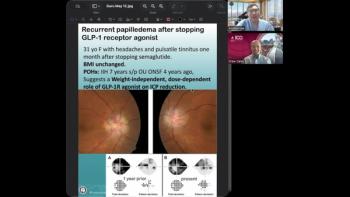
Andrew G. Lee, MD, presents the “no” perspective on whether GLP-1 agonists cause non-arteritic anterior ischemic optic neuropathy, arguing that current evidence shows association but not proven causation.

In this third case, Dr. Maria Berrocal describes a patient with highly cystic diabetic macular edema (DME) in the left eye who had shown minimal response to two prior steroid injections.

Pitha discusses how ophthalmic drug shortages — more frequent and longer-lasting than the national average — are threatening adherence to glaucoma therapy.


Joseph Anaya, MD, and Ashkan Abbey, MD, discuss the financial barriers facing patients with geographic atrophy, including Medicare coverage limitations, out-of-pocket costs, and the role of assistance programs such as Good Days in expanding treatment access.

Dhoot discusses the full results of the 5-year GALE extension study of pegcetacoplan in patients with GA secondary to age-related macular degeneration.

In this second case, Dr. Maria Berrocal presents a patient with severe, refractory diabetic macular edema (DME) who had received 13 prior anti-VEGF injections (bevacizumab and aflibercept) with persistent fluid and legal blindness (20/200 vision).

Joseph Anaya, MD, and Ashkan Abbey, MD, discuss how retina specialists identify appropriate candidates for complement inhibitor therapy in geographic atrophy, set patient expectations, and monitor treatment in real-world clinical practice.

Leng discusses preliminary results from an ongoing study investigating the interaction between pegcetacoplan and anti-VEGF treatments in patients with GA.

Joseph A. Anaya, MD, MBA, and Ashkan M. Abbey, MD, FASRS, FAAO, consider how emerging treatments impact patient vision, functional outcomes, and practical management of geographic atrophy.


In this opening segment, Dr. Maria Berrocal introduces a case-based discussion on real-world management of diabetic macular edema (DME), with a focus on improving retinal drying, extending durability, and reducing patient burden.

In the latest episode of The Retina TL;DR, host Christina Y. Weng, MD, MBA, FASRS, talks with Dr. Khanani about new retinal gene therapy trials, covering safety, delivery, and ways to reduce treatment burden.

Take a look at some, but certainly not all, that you may have missed from this year’s EnVision Summit.

Phase 1b data show KSI-101 rapidly clears inflammatory macular edema, delivers long-lasting fluid control without steroids, and advances into enrolling phase 3 trials.

Join Douglas D. Koch, MD, and Liliana Werner, MD, PhD, as they break down acrylic and silicone intraocular lenses, discuss material-specific risks, and explore the future of lens technology in this inaugural episode.

Zarmeena Vendal, MD, discussed the intersections between cataract surgery and glaucoma.

Inder Paul Singh, MD, discusses his practice's approach to office-based surgery.