

Samantha Harding, MD, discusses how ultra-widefield imaging reduces dilation needs and improves diagnosis in paediatric eye care.
Samantha Harding, MD, discusses how ultra-widefield imaging reduces dilation needs and improves diagnosis in paediatric eye care.

At WSPOS Subspecialty Day during the 44th Congress of the ESCRS in London, Mark Bullimore, PhD, MCOptom, shared early trial data suggesting the Stellest 2.0 lens may slow myopic progression twice as fast as the original.

Hove stresses surgeons who prescribe premium lenses or laser surgery to patients should be willing to have those same treatments themselves when needed.
Emami-Naeini previews Retina Society 2026's shift toward AI-derived, quantitative biomarkers in imaging and therapeutics.
Ana Miguel, MD, PhD, explains how artificial intelligence already outperforms experts in glaucoma screening, expands telemedicine access, and reshapes patient conversations.
Giuseppe Giannaccare, MD, PhD, FEBOphth, discusses new data on perioperative low-level light therapy for post-cataract dry eye at ESCRS 2026.
Anat Loewenstein, MD, previews EURETINA 2026 Vienna: the Innovation Spotlight, 17 sessions, symposia, and more.
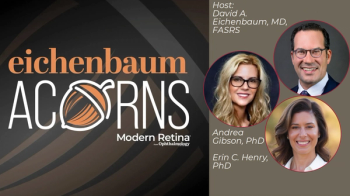
Andrea Gibson, PhD, and Erin C. Henry, PhD, trace 20 years in retina drug development—and the pathway gap still facing young scientists.
Ashraf Ahmad, MD, explains what's driving rising dry eye rates and why eyelid evaluation is often overlooked.
At ESCRS 2026, Imane Tarib, MD discusses fostering inclusive ophthalmology workplaces and mentorship for early-career surgeons.

ESCRS 2026 data: patient selection and education may be key to aceclidine (VIZZ; LENZ Therapeutics) persistence.

Alessandro Arrigo, MD, previews an ESCRS 2026 presentation on a patent-pending method that adapts blue light autofluorescence confocal imaging to grade cataracts objectively. The approach yielded reproducible numeric indices that correlated with both expert LOCS III scores and measurable loss of retinal image quality.

Adam Muzychuk, MD, discusses how AI like the Kane formula is improving outcomes, and why he still urges caution over relying on it for clinical decisions.
Hove explains how his own cataract surgery has changed the way he counsels patients about glare, halos, and near vision.

Jai Parekh, MD, MA, FAAO, says AI is poised to transform eye care—from retinal and glaucoma imaging to cataract surgery—without disrupting it.

Radhika Rampat, MBBS, FRCOphth, discusses how AI is already shaping intraocular lens selection and keratoconus screening, and where anterior segment imaging and patient-facing AI tools are headed next.
At the 44th Congress of the ESCRS in London, Mark Bullimore, PhD, MCOptom, said delaying myopia onset is more valuable than slowing its progression, and explained how to identify children most at risk.

Host Deborah Ristvedt, DO, welcomes Early to discuss the pivotal moment that led her to leave an established practice, build something of her own, and rediscover the human side of medicine.
At ESCRS 2026, Adam Muzychuk, MD, shares real-world data showing the enVista Envy IOL matches clinical trial outcomes, even in eyes with residual refractive error.
Two-year data presented at ESCRS 2026 show the ELIOS excimer laser procedure sustained IOP reduction and kept most glaucoma patients medication-free.
At ESCRS 2026, Zoltan Z. Nagy, MD, reported that femtosecond laser trabeculotomy (FLigHT) cut intraocular pressure by 27% at 48 months in open-angle glaucoma, with a stable, incision-free safety profile.
A prospective French study found intraoperative OCT most valuable for measuring key surgical distances in deep sclerectomy and MIGS procedures, and useful for training residents.
ESCRS 2026 real-world data: aceclidine (VIZZ; LENZ Therapeutics) drops show fast onset, high satisfaction for presbyopia.

Three-year ESCRS 2026 data show trans-epithelial PRK matches conventional PRK in refractive outcomes, safety, and pain, with faster surgical time.
A real-world study of an enhanced monofocal IOL found most patients achieved 20/20 distance vision and functional intermediate vision without glasses, according to Jai Parekh, MD, MA, FAAO, at ESCRS 2026.
New ESCRS 2026 data show corneal measurements shift meaningfully across the day, with early-morning readings potentially biased by overnight eyelid closure.
At ESCRS 2026 in London, Radhika Rampat, MBBS, FRCOphth, describes bringing low-level light therapy into her refractive practice, from dry eye care to chalazion treatment and pre-surgical ocular surface optimisation.

In the latest episode of The Retina TL;DR with Dr. Weng, host Christina Y. Weng, MD, MBA, FASRS, talks with Dr. Aaberg about the science, clinical data, and real-world reception of the first FDA-approved treatment for MacTel type 2.
Suzana Konjevoda, MD, presents data at ESCRS 2026 showing citicoline eye drops aid corneal nerve recovery post-cataract surgery.

ESCRS 2026 study shows multifocal IOLs tie at distance, but reading speed plunges in dim light; focus curves predict laser touch-ups.