






Gene Therapy
Latest News
Advertisement
Video Series






Shorts

1:08
How MCO-010 optogenetic therapy works in RP
7 days ago
by
Kenneth C. Fan, MD, MBA(+1 more)
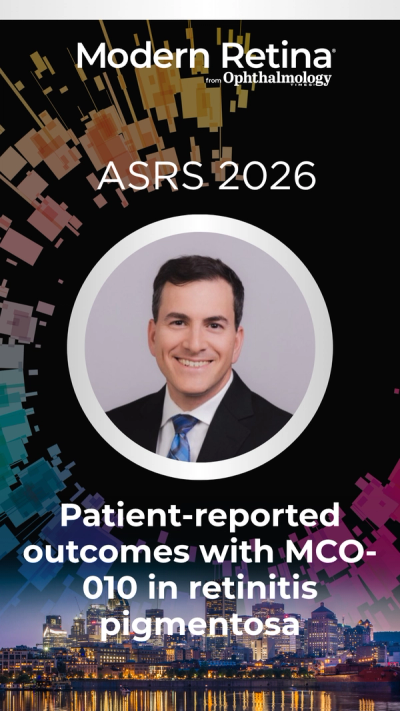
0:41
Patient-reported outcomes with MCO-010 in retinitis pigmentosa
2 months ago
by
Benjamin Bakall, MD, PhD(+2 more)

0:31
1-year RESTORE and 3-year RETAIN visual acuity outcomes
2 months ago
by
Benjamin Bakall, MD, PhD(+2 more)
CME Content













Advertisement

Three researchers share the prize for discovering channelrhodopsin, a light-sensitive protein now being tested to restore vision in retinal disease.

4DMT's 4D-150 gene therapy enters phase 3 4SIGHT trial in DME; 2-year SPECTRA data show +10.8-letter BCVA gain in 9 patients.

OT Roundup returns with MOGENRY's 4-year RP data, RCA's retina care report, SYD-101's FDA hearing, and new OCU410 GA data.

Japan's filing covers IRDs broadly, supported by RESTORE and open-label Stargardt data.

An industry symposium on intravitreal 4D-150 and a course on subretinal delivery lead gene therapy content at EURETINA 2026, alongside IRD courses and trial readouts.

One subretinal injection of medium-dose OCU410 gene therapy reduced geographic atrophy growth by up to 32%.

The FDA has accepted Nanoscope's BLA for sonpiretigene isteparvovec in retinitis pigmentosa, backed by RESTORE and REMAIN trial data.
OT Roundup debuts with new ADHD ocular findings, a surgeon's own trifocal IOL journey, MOGENRY's FDA filing, and myopia policy news.

Q3 2026 delivered advances in some closely watched pipeline products.

Benjamin Bakall, MD, PhD, weighs the RESTORE efficacy and safety data, the practical realities of in-office delivery, and how genotype-independent treatment reshapes candidacy and patient counseling.

The authors of a review of 16 gene therapy trials for inherited retinal diseases explain why the pediatric evidence base remains thin and argue that individual-level, age-stratified reporting is the change most needed before CRISPR-based editing reaches children.

Opus Genetics announced positive 3- and 6-month results OPGx-BEST1 in BEST1-related retinal diseases.

The FDA accepted Nanoscope's BLA for MOGENRY (sonpiretigene isteparvovec, MC-010), a gene therapy for retinitis pigmentosa with severe vision loss, supported by RESTORE trial data showing sustained BCVA improvement.

Jay Chhablani, MD, on how MacTel eyes turn neovascular, when to refer, and what Encelto means for treatment.

When to retest for inherited retinal dystrophies
Published: | Updated:
João Pedro Marques, MD, PhD, on how systematic reanalysis moved a cohort's solved rate from 59.4% to 70.1% and what it means for gene therapy eligibility

Noah G. Banoub discusses a study finding MacTel2 misdiagnosed in 25.5% of cases, common mimics, misleading imaging, and Encelto's approval.

Patient enrollment is complete in a phase 3 registrational, or pivotal, trial to evaluate OPGx-LCA5, a gene therapy that is under investigation for treating Leber congenital amaurosis type 5-associated inherited retinal disease.

Ahead of his November 10, 2026, start date, the incoming Duke ophthalmology chair shares his vision for research, training, and the integration of AI and data science.

An investigational treatment for vision loss associated with Bardet-Biedl syndrome is being tested in the first three patients treated.
The FDA has cleared an IND for RAG-1C, a first-in-class saRNA therapy targeting proliferative vitreoretinopathy.

Charles Wykoff, MD, PhD, of Retina Consultants of Texas, discusses 1 year of real-world revakinagene taroretcel experience, covering patient selection, surgical technique, early safety outcomes, and the platform’s potential beyond MacTel.
Rare retinal diseases initially were the primary targets of gene therapy, but that is no longer the case. The focus has expanded beyond those to also include more common, chronic diseases such as diabetic macular edema and wet age-related macular degeneration. During the first half of 2026, that trend was evident.

A successful Type B Rare Disease Evidence Principles meeting confirms the pivotal study design, opening a potential BLA pathway on 6-month efficacy data, with dosing expected to begin in the fourth quarter of 2026.

Three-year gene therapy data, an FDA reversal in wet AMD, light-powered dry eye treatment, a new macular supplement, and progress in childhood glaucoma—our review breaks down the 5 May 2026 stories that matter.
Alkeus Pharmaceuticals has dosed the first participant in the phase 3 NORTHSTAR trial of oral gildeuretinol for Stargardt disease, a condition with no approved treatments.
Advertisement
Advertisement
Trending on Eye Care Network - Ophthalmology Times
1
Alvotech files first known aflibercept 8 mg biosimilar with EMA
2
FDA approves phentolamine ophthalmic solution 0.75% (Ryzumvi) for presbyopia
3
FDA approves subcutaneous Enspryng for TED
4
OT Roundup: Optogenetics Nobel Prize, BRUNELLO, DRAGON, eye transplant
5