






Retina
Latest News
Advertisement
Video Series









Shorts

0:52
Linus Shen, MD, on making the most of fellowship
12 hours ago
by
Linus Shen, MD(+1 more)
0:56
Soluble IL-2 Receptor Shows Promise for Detecting Ocular Sarcoidosis
18 hours ago
by
Braden Venable, MS(+1 more)

0:29
Retina AI has potential—but few tools are ready for daily practice
a day ago
by
Linus Shen, MD(+1 more)
0:46
World Sight Day: Hopeful advancements in eye care
4 days ago
by
David Steel MBBS, FRCOphth, MD(Res)(+1 more)
0:45
EURETINA 2026: Predicting treatment and prognosis in central serous chorioretinopathy
7 days ago
by
Elon van Dijk, MD, PhD, FEBOphth(+1 more)
1:04
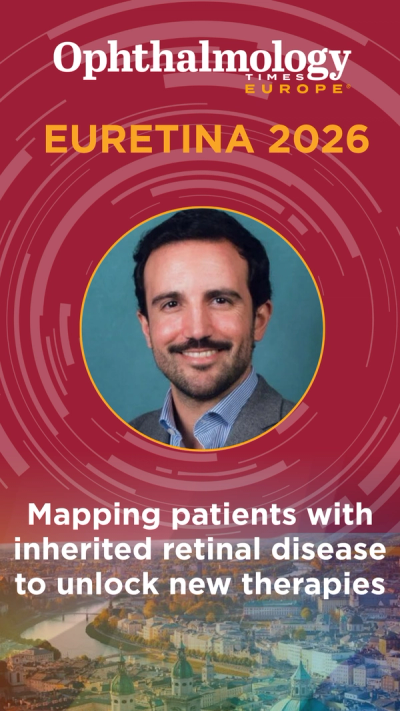
EURTINA 2026: Mapping patients with inherited retinal disease to unlock new therapies
8 days ago
by
João Pedro Marques, MD, MSc, PhD(+1 more)

0:53
Manju Subramanian, MD, on anti-VEGF and kidney function
13 days ago
by
Manju Subramanian, MD(+1 more)

0:32
Reducing patient treatment burden: The latest on EYP-1901
17 days ago
by
Charles Wykoff, MD, PhD(+2 more)

0:56
ESCRS 2026: Why retinal measurements can be wrong
24 days ago
by
Alessandro Arrigo, MD(+1 more)

0:59
EYP-1901 positioned as lower-burden option in DME treatment as phase 3 program completes enrollment
a month ago
by
Kassi Filkins(+1 more)
CME Content














Advertisement

Three researchers share the prize for discovering channelrhodopsin, a light-sensitive protein now being tested to restore vision in retinal disease.

Serena Salvatore, MD, discusses the retinal laser training gap, persistent laser myths, simulation and practical advice for safer laser at EURETINA 2026.
Ester Carreño, MD, PhD, explains how to tell retinitis pigmentosa from uveitis and why genetic confirmation now matters more.

OT Roundup returns with MOGENRY's 4-year RP data, RCA's retina care report, SYD-101's FDA hearing, and new OCU410 GA data.

Women’s systemic and ocular health associated with pregnancy is a focus at EURETINA 2026 in Vienna.

Three EURETINA 2026 e-posters examine OCT/OCTA biomarkers and real-world switching to faricimab or aflibercept 8 mg in nAMD.

Francesca Cordeiro, PhD, MD, FRCOphth, explains how Detection of Apoptosing Retinal Cells (DARC) imaging predicted the speed and direction of GA growth and could help stratify patients for treatment.

Inherited metabolic diseases affect the retina even before the systemic diagnosis is established.

Sharon Fekrat, MD, FACS, FASRS, discusses how retinal imaging fits into the diagnostic picture for CVI, TBI, and neurodegenerative disease.

An industry symposium on intravitreal 4D-150 and a course on subretinal delivery lead gene therapy content at EURETINA 2026, alongside IRD courses and trial readouts.

Topline data from the phase 2/3 study show that both dose levels of the subretinal gene therapy produced significant gains in low luminance visual acuity versus untreated control at 12 months.

Anat Loewenstein, MD, previews EURETINA 2026 Vienna: the Innovation Spotlight, 17 sessions, symposia, and more.
OT Roundup debuts with new ADHD ocular findings, a surgeon's own trifocal IOL journey, MOGENRY's FDA filing, and myopia policy news.

Alessandro Arrigo, MD, previews an ESCRS 2026 presentation on a patent-pending method that adapts blue light autofluorescence confocal imaging to grade cataracts objectively. The approach yielded reproducible numeric indices that correlated with both expert LOCS III scores and measurable loss of retinal image quality.

Q3 2026 delivered advances in some closely watched pipeline products.

Opus Genetics announced positive 3- and 6-month results OPGx-BEST1 in BEST1-related retinal diseases.

Women's Health: Giant cell arteritis and the sex gap: What every eye care clinician should know
Published: | Updated:
Women are more often affected than men, and the disease manifests differently between the sexes.

Ocugen's global phase 3 ArMaDa3 trial evaluates OCU410, a one-time gene therapy targeting multiple disease pathways in geographic atrophy secondary to dry age-related macular degeneration.

ZEISS CLINIC 360 is an all-in-one cloud and browser-based software platform designed to consolidate ophthalmic diagnostic and medical record data into a single, unified patient view.

The Jack McGovern Coats' Disease Foundation has announced the initiation of new research to develop the first validated animal model of Coats' Disease, a rare eye disorder that primarily affects children.

Patient enrollment is complete in a phase 3 registrational, or pivotal, trial to evaluate OPGx-LCA5, a gene therapy that is under investigation for treating Leber congenital amaurosis type 5-associated inherited retinal disease.
Wet AMD gains a new FDA-approved therapy as retina, glaucoma, and dry eye pipelines surge—plus AI, devices, and workforce trends reshaping care.

Physician AI use has more than doubled since 2023—but the next leap in ophthalmology won't come from smarter diagnostic algorithms alone.

The approval establishes LYTENAVA as the first and only FDA-approved ophthalmic formulation of bevacizumab for the treatment of wet AMD in the United States.

Louie Cai, MD, discusses why manual prescreening is so labor-intensive, how the study was designed, and what broader adoption of AI-assisted screening could mean for clinician time, patient satisfaction, and the pace of drug development.
Advertisement
Advertisement
Trending on Eye Care Network - Ophthalmology Times
1
AAO 2026: Optogenetic gene therapy heads to phase 2 trial in geographic atrophy
2
AAO 2026: BRUNELLO 1-year results for remigromig in DME
3
AAO 2026: MCO-010 sustains vision gains in RP through 4 years
4
Real-world VOYAGER data on faricimab in nAMD, DME, RVO at EURETINA 2026
5