





Retina
Latest News
Advertisement
Video Series







Shorts

1:08
How MCO-010 optogenetic therapy works in RP
7 days ago
by
Kenneth C. Fan, MD, MBA(+1 more)

0:52
Linus Shen, MD, on making the most of fellowship
7 days ago
by
Linus Shen, MD(+1 more)
0:56
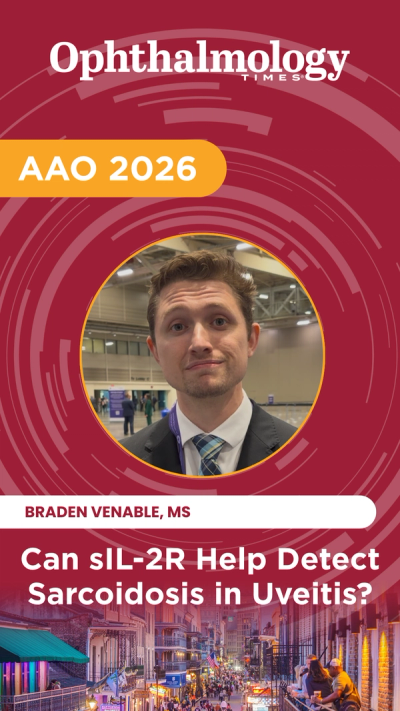
Soluble IL-2 Receptor Shows Promise for Detecting Ocular Sarcoidosis
7 days ago
by
Braden Venable, MS(+1 more)

0:29
Retina AI has potential—but few tools are ready for daily practice
8 days ago
by
Linus Shen, MD(+1 more)
0:46
World Sight Day: Hopeful advancements in eye care
10 days ago
by
David Steel MBBS, FRCOphth, MD(Res)(+1 more)

0:45
EURETINA 2026: Predicting treatment and prognosis in central serous chorioretinopathy
13 days ago
by
Elon van Dijk, MD, PhD, FEBOphth(+1 more)

1:04
EURTINA 2026: Mapping patients with inherited retinal disease to unlock new therapies
15 days ago
by
João Pedro Marques, MD, MSc, PhD(+1 more)

0:53
Manju Subramanian, MD, on anti-VEGF and kidney function
19 days ago
by
Manju Subramanian, MD(+1 more)

0:32
Reducing patient treatment burden: The latest on EYP-1901
23 days ago
by
Charles Wykoff, MD, PhD(+2 more)
0:56
ESCRS 2026: Why retinal measurements can be wrong
a month ago
by
Alessandro Arrigo, MD(+1 more)
CME Content













Advertisement

Discover how IRIS Registry real-world data turns EHR notes and images into evidence that speeds ophthalmology trials, recruitment, safety studies, and post-approval insights.

FDA accepts vamikibart BLA for UME as data show sustained gains at 1 year; decision July 2027.

Ehsan Rahimy, MD, says most PRIMA serious adverse events occurred early, while vision gains held through 36 months.

Anti-VEGF for ROP is not associated with systemic and neurodevelopmental outcomes.

Jacque Duncan, MD, reviews phase 3 DRAGON data on oral tinlarebant for Stargardt disease and its mechanism-related visual effects.

A glaucoma expert addressed the connection between systemic blood pressure, intraocular pressure, and glaucoma.

Michel Michaelides, MD, discusses phase 3 DRAGON results showing that oral tinlarebant slowed atrophic lesion growth by about 36% in adolescents with Stargardt disease.

A single intravitreal injection improved acuity in Stargardt disease; a randomized trial in geographic atrophy is planned.
Pivotal wet AMD, DME, and XLRP readouts; the MOGENRY BLA; and Retina Society, EURETINA, and ESCRS highlights from September.
Eyes on September 2026: ESCRS insights, gene therapy wins, and the push to treat myopia as a disease
September was one of the busiest months of the year in eye care—From ESCRS to Eyecon

Real-world VOYAGER data at EURETINA 2026 show vision and anatomic outcomes with faricimab across nAMD, DME, and RVO.
As with so many diseases, lung cancer manifests in men and women differently in type, symptoms, and prognosis.

Three researchers share the prize for discovering channelrhodopsin, a light-sensitive protein now being tested to restore vision in retinal disease.

Could one surgery replace years of GA injections? Phase 2 ArMaDa data suggest gene therapy OCU410 slows lesion growth.

4DMT's 4D-150 gene therapy enters phase 3 4SIGHT trial in DME; 2-year SPECTRA data show +10.8-letter BCVA gain in 9 patients.

Serena Salvatore, MD, discusses the retinal laser training gap, persistent laser myths, simulation and practical advice for safer laser at EURETINA 2026.

Ester Carreño, MD, PhD, explains how to tell retinitis pigmentosa from uveitis and why genetic confirmation now matters more.

OT Roundup returns with MOGENRY's 4-year RP data, RCA's retina care report, SYD-101's FDA hearing, and new OCU410 GA data.

Women’s systemic and ocular health associated with pregnancy is a focus at EURETINA 2026 in Vienna.
Three EURETINA 2026 e-posters examine OCT/OCTA biomarkers and real-world switching to faricimab or aflibercept 8 mg in nAMD.

Japan's filing covers IRDs broadly, supported by RESTORE and open-label Stargardt data.

Francesca Cordeiro, PhD, MD, FRCOphth, explains how Detection of Apoptosing Retinal Cells (DARC) imaging predicted the speed and direction of GA growth and could help stratify patients for treatment.

Inherited metabolic diseases affect the retina even before the systemic diagnosis is established.

Sharon Fekrat, MD, FACS, FASRS, discusses how retinal imaging fits into the diagnostic picture for CVI, TBI, and neurodegenerative disease.

An industry symposium on intravitreal 4D-150 and a course on subretinal delivery lead gene therapy content at EURETINA 2026, alongside IRD courses and trial readouts.
Advertisement
Advertisement
Trending on Eye Care Network - Ophthalmology Times
1
FDA approves phentolamine ophthalmic solution 0.75% (Ryzumvi) for presbyopia
2
Alvotech files first known aflibercept 8 mg biosimilar with EMA
3
Uveitis: a practical guide for ophthalmologists and optometrists
4
AAO 2026: How to become an ocular pain detective in dry eye
5