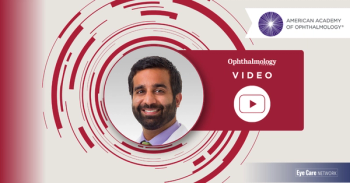
Murtaza K. Adam, MD, shares pearls on haptic docking, patient selection, and preventing complications with the Yamane technique.
Paul Nderitu, MBChB, MPhil, MBCS, FRCOphth, PhD, gives an update at EURETINA 2026 on Global RETFound, a foundation model being built with 108 partners from more than 40 countries
At the 26th EURETINA Congress in Vienna, Austria, Paul Nderitu, MBChB, MPhil, MBCS, FRCOphth, PhD, a research fellow at UCL and consultant ophthalmologist at Moorfields, gave an update on Global RETFound, which he described as an effort to build "the world's first truly global medical foundation model."
The project has spent the past year recruiting collaborators and now includes 108 partners from more than 40 countries, Nderitu said. Three-quarters of the partners have shared generative models trained on their local datasets, which the team is using to synthesise images; the remaining quarter—27 sites—have shared real data.
The team plans to synthesise approximately 100 million colour fundus images and combine them with real data. Nderitu said this would hopefully represent a 100-fold increase over the original RETFound model. More than 20 sites are trialling use cases to validate the model, from detecting diabetic retinopathy and macular degeneration to oculomics tasks and rarer tasks such as detecting retinopathy of prematurity. Nderitu emphasised that validation over the coming months is the priority, and the team aims to make the model open access for research.
The group recently published its peer-reviewed protocol paper, which describes the generative AI models used, how partners were recruited, governance across synthetic images, models and real data, and the support given to collaborators. Nderitu said the approach is not specific to retina and could be adopted by researchers in other fields, such as skin disease. "We want to see other global foundation models being made," he said.
Because AI learns from its data, Nderitu explained, models trained on populations from some countries but not others will underrepresent those populations, and AI embedded in healthcare delivery could become another way of increasing inequity. He hopes Global RETFound will highlight the need to build representation and inclusivity into AI to increase health equity.
Nderitu believes multimodal, multispecialty AI is needed because the field is currently siloed. He cited AlzEye, a dataset created by team member Siegfried Wagner that links Moorfields Eye Hospital data with Hospital Episode Statistics, and said a new version aims to bring in data from beyond the eye, such as neuroimaging.
The team is also surveying its datasets to identify where data are missing. Although the project has worked with sites in Africa, South America and Central Asia, Nderitu said gaps remain. The team hopes to run a second round in 2027 to fill those gaps and retrain the model with more models and greater diversity.