Now Playing

OT Roundup debuts with new ADHD ocular findings, a surgeon's own trifocal IOL journey, MOGENRY's FDA filing, and myopia policy news.
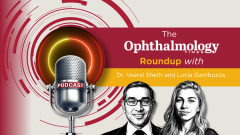
Ophthalmology Times launches The OT Roundup, a new biweekly podcast on ophthalmology news across the Eye Care Network. Episode 1 covers new research linking attention deficit/hyperactivity disorder (ADHD) to retinal changes, a surgeon's experience with a trifocal intraocular lens (IOL), the FDA's acceptance of a gene-agnostic therapy for retinitis pigmentosa (RP), and a new policy push on myopia.
A review presented at the
At the same meeting, Mfazo Hove, MD, discussed living with the trifocal IOL (AT LISA tri; Carl Zeiss Meditec) he implants in patients, 2.5 years after his own cataract surgery. Hove said glare and halos resolved within days, and he now sets patients' phones to the smallest text size after surgery to speed adaptation to near vision.
The FDA has accepted Nanoscope Therapeutics' biologics license application for sonpiretigene isteparvovec (MOGENRY), an optogenetic therapy for advanced RP that works regardless of the underlying gene mutation. Veeral Sheth, MD, joined the episode to discuss the phase 2b RESTORE trial (NCT04945772), in which treated eyes gained roughly 3 lines of visual acuity. "That's the difference between you know barely being able to see things moving in front of you…to now being able to see the plate in front of you at dinner, or you know, you're crossing the street and you can see a car kind of coming across the way," Sheth said of the gains in patients with advanced RP. Sheth also pointed to delivery as a factor in adoption: a one-time, in-office intravitreal injection with no genetic testing required for eligibility. Nanoscope is expected to present 4-year data from the program at the Retina Society's 59th Annual Scientific Meeting, September 23-26 in Los Angeles.
The American Medical Association has passed a resolution supporting formal classification of myopia as a disease, aiming to expand insurance coverage for pediatric myopia control treatments. Myopia affects roughly 41.6% of the US population, and the World Health Organization projects the condition will affect half the global population by 2050.
OT Roundup is part of the Eyepod podcast network.
New episodes of OT Roundup will be available every other Friday.