





Imaging
Latest News
Advertisement
Video Series






Shorts
0:56
Soluble IL-2 Receptor Shows Promise for Detecting Ocular Sarcoidosis
7 days ago
by
Braden Venable, MS(+1 more)
0:56
ESCRS 2026: Why retinal measurements can be wrong
a month ago
by
Alessandro Arrigo, MD(+1 more)

0:54
Could bedside OCT spot neurodevelopmental risk in infants before symptoms?
2 months ago
by
Cytnthia Toth, MD(+2 more)

1:12
How AI is transforming retina care, from RPE analysis to predictive modeling
2 months ago
by
Miguel A. Busquets, MD, FACS(+1 more)

0:57
Retina as a window to the brain: a biomarker approach to ROP
2 months ago
by
Cytnthia Toth, MD(+2 more)

0:37
Tracking infant brain health at the bedside
2 months ago
by
Cytnthia Toth, MD(+2 more)
CME Content












Advertisement

ZEISS CLINIC 360 is an all-in-one cloud and browser-based software platform designed to consolidate ophthalmic diagnostic and medical record data into a single, unified patient view.

AI accelerates retina trials and imaging insights, boosts screening access, and raises urgent questions on regulation, privacy, and equity.

Physician AI use has more than doubled since 2023—but the next leap in ophthalmology won't come from smarter diagnostic algorithms alone.

Ultra-widefield imaging reveals early retinal risk in pediatric patients.

A balanced mix of AI-generated and smartphone-captured images eliminated the domain-specific failures seen with single-source training

A retrospective study identifies thin choroid as the key factor behind ungradable ultrawidefield green-light fundus autofluorescence images in geographic atrophy.

A case report describes image-guided surgical excision combined with adjunctive cryotherapy and a single anterior chamber methotrexate injection, with no recurrence at 10 months.

Knowing pregnancy-related risks enhances patient safety.

Aixa Alarcon, PhD, and colleagues reported natural image analysis may better predict real-world visual performance of premium intraocular lenses than traditional single-frequency MTF testing, while also capturing the impact of dysphotopsias and residual astigmatism.

Multimodal imaging, OCT biomarkers, and the case for early diagnosis as treatment options emerge for macular telangiectasia.

At ARVO 2026, Michael Ip, MD, presented findings from a large-scale analysis of OCT biomarkers in patients with diabetic macular edema (DME), leveraging the robust DRCR Retina Network Protocol T dataset.

Images showed that Parkinson’s disease is associated with a thicker photoreceptor nuclear layer and a thinner layer of photoreceptor processes.

About 90% of patients are female with obesity and potential hormonal drivers

AI-powered polarized-light retinal imaging separates Alzheimer’s from ALS/FTLD deposits with 96% accuracy, promising low-cost early diagnosis.

Steffen Schmitz-Valckenberg, MD, discusses how optical coherence tomography-based models may enable rapid, noninvasive assessment of functional loss in GA at Angiogenesis 2026.
The 22nd International Scientific Symposium on Ophthalmic Imaging will take place September 18 to 19, 2026 in Singapore, featuring sessions on multimodal imaging, OCT, AI, and next-generation imaging technologies.

China approves ZEISS ARTEVO 750 and 850 ophthalmic microscopes, expanding 3D digital visualization and iOCT-ready workflows for cataract and retinal surgery.
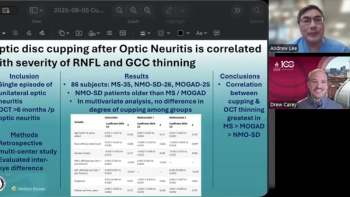
Andrew G. Lee, MD, and Drew Carey, MD, discuss how optic disc cupping after optic neuritis reflects nerve and ganglion cell thinning, not disease type, helping distinguish it from glaucoma.
AI reads infant retinal scans to flag lung disease early, while transient vision loss warns of looming stroke and heart events.

Optoretinography is an emerging technology used to test light-evoked photoreceptor activity.
From artificial intelligence to home monitoring, Joel Schuman, MD, of Wills Eye Hospital, explores the innovations that could change how clinicians detect and treat glaucoma in the new year.

Combining imaging and patient symptoms improves assessment of disease progression.

Dr. Melissa Yuan discusses the impact of weight and postmenstrual age on foveal maturation in preterm infants, highlighting critical insights for neonatal care.

AAO 2025 revealed that true-color widefield imaging, AI-powered home OCT, and refined FAERS analyses are collectively transforming retinal diagnostics into a more precise, continuous, and safety-aware system.
Advertisement
Advertisement
Trending on Eye Care Network - Ophthalmology Times
1
FDA approves phentolamine ophthalmic solution 0.75% (Ryzumvi) for presbyopia
2
Alvotech files first known aflibercept 8 mg biosimilar with EMA
3
Uveitis: a practical guide for ophthalmologists and optometrists
4
AAO 2026: How to become an ocular pain detective in dry eye
5