






AMD
Latest News
Advertisement
Video Series







Shorts

0:32
Reducing patient treatment burden: The latest on EYP-1901
2 months ago
by
Charles Wykoff, MD, PhD(+2 more)
CME Content












Advertisement

Three EURETINA 2026 e-posters examine OCT/OCTA biomarkers and real-world switching to faricimab or aflibercept 8 mg in nAMD.

Q3 2026 delivered advances in some closely watched pipeline products.

Ocugen's global phase 3 ArMaDa3 trial evaluates OCU410, a one-time gene therapy targeting multiple disease pathways in geographic atrophy secondary to dry age-related macular degeneration.

Topical chloroprocaine hydrochloride ophthalmic gel 3% (IHEEZO, Harrow) resulted in less pain f following intravitreal injections in patients undergoing same-day bilateral intravitreal injections.

Wet AMD gains a new FDA-approved therapy as retina, glaucoma, and dry eye pipelines surge—plus AI, devices, and workforce trends reshaping care.

Retina specialists Baruch D. Kuppermann, MD, PhD, and Firas M. Rahhal, MD, discuss the significance of bevacizumab-vikg's approval for wet AMD and its impact on physicians and patients.

Physician AI use has more than doubled since 2023—but the next leap in ophthalmology won't come from smarter diagnostic algorithms alone.

The approval establishes LYTENAVA as the first and only FDA-approved ophthalmic formulation of bevacizumab for the treatment of wet AMD in the United States.

Two-year PRISM results show 4D-150 gene therapy sustains wet AMD vision while cutting anti-VEGF injections up to 87%, with reassuring safety.
Rare retinal diseases initially were the primary targets of gene therapy, but that is no longer the case. The focus has expanded beyond those to also include more common, chronic diseases such as diabetic macular edema and wet age-related macular degeneration. During the first half of 2026, that trend was evident.

Offline smartphone AI fundus screening detects diabetic retinopathy, glaucoma, and macular degeneration in one capture, delivering high accuracy for low-resource eye care.

The trial over-enrolled and finished approximately 4 months ahead of initial projections, with 52-week topline data now expected in the second half of 2027.

The resubmission is considered a Class 1 submission and has a current PDUFA target action date of July 29, 2026.

Three-year gene therapy data, an FDA reversal in wet AMD, light-powered dry eye treatment, a new macular supplement, and progress in childhood glaucoma—our review breaks down the 5 May 2026 stories that matter.

Finding satisfaction in ocular research—considerations about AI and enhanced datasets.

Samsung Bioepis launched Opuviz, an aflibercept biosimilar, in Europe for wet AMD, DME, retinal vein occlusion, and myopic CNV.

The resubmission follows a successful appeal by the company with the Office of New Drugs (OND).

The FDA's OND found substantial evidence of effectiveness for bevacizumab-vikg in nAMD, clearing the way for a BLA resubmission in June 2026 and a decision expected within 60 days.

Bausch + Lomb's PreserVision AREDS3 combines the established AREDS2 micronutrient formula with a B-vitamin complex.
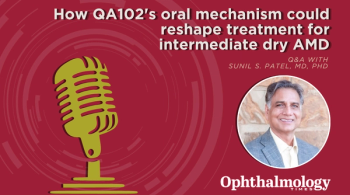
Sunil S. Patel, MD, PhD, of the University of Texas Southwestern Medical Center, breaks down QA102's first-in-class mechanism targeting harmful gut bacteria and retinal inflammation, what the phase 2 drusen volume and GA growth rate data reveal about the therapy's potential, and what a phase 3 program must address to bring an oral AMD treatment to patients without options.
Advertisement
Advertisement
Trending on Eye Care Network - Ophthalmology Times
1
How Lambert-Eaton myasthenic syndrome presents around the eyes
2
Tenpoint Therapeutics opens telehealth access to Yuvezzi for adults with presbyopia
3
The interplay between cardiac disease and the eye
4
City Therapeutics doses first participant in phase 1 trial of RNAi therapy CITY-RBP4 for Stargardt disease
5