



AMD
Latest News
Advertisement
Video Series





CME Content






Advertisement

In a first-in-human Phase 1 trial, a single TH103 injection improved vision and reduced fluid in treatment-naive wet AMD, with roughly a third of patients needing no retreatment through 6 months.

Presenters highlight clinical insights and lessons from recent trial data and surgical experience
Rare retinal diseases initially were the primary targets of gene therapy, but that is no longer the case. The focus has expanded beyond those to also include more common, chronic diseases such as diabetic macular edema and wet age-related macular degeneration. During the first half of 2026, that trend was evident.

Cascade Prodrug and Uneedle are partnering to test suprachoroidal delivery of CPD100 using Uneedle's Bella-Vue microneedle system for the treatment of wet AMD.

From a phase 3 durability readout for a first-in-class TKI to a new interchangeable ranibizumab biosimilar and a deep dive into geographic atrophy management, June brought a wide-ranging mix of regulatory, clinical, and practice-pattern news for retina specialists

Offline smartphone AI fundus screening detects diabetic retinopathy, glaucoma, and macular degeneration in one capture, delivering high accuracy for low-resource eye care.

Three cases illustrate how next-generation anti-VEGF agents are extending treatment intervals and improving durability across retinal vascular disease.

The trial over-enrolled and finished approximately 4 months ahead of initial projections, with 52-week topline data now expected in the second half of 2027.

SOL-1 results show intravitreal axitinib hydrogel delivered superior vision maintenance and anatomic outcomes through 52 weeks.

The resubmission is considered a Class 1 submission and has a current PDUFA target action date of July 29, 2026.

Learn how FDA’s interchangeable ranibizumab biosimilar may streamline injections, cut costs, and guide safe switching for retina patients.

Three-year gene therapy data, an FDA reversal in wet AMD, light-powered dry eye treatment, a new macular supplement, and progress in childhood glaucoma—our review breaks down the 5 May 2026 stories that matter.

Finding satisfaction in ocular research—considerations about AI and enhanced datasets.

FDA approves ranibizumab-hkdz as first interchangeable biosimilar ranibizumab available in both vials and prefilled syringes
Published: | Updated:
The FDA has approved ranibizumab-hkdz (Ranluspec; Lupin Limited) as an interchangeable biosimilar for wet AMD, DME, DR, RVO, and mCNV.

Samsung Bioepis launched Opuviz, an aflibercept biosimilar, in Europe for wet AMD, DME, retinal vein occlusion, and myopic CNV.

The resubmission follows a successful appeal by the company with the Office of New Drugs (OND).
SOL-1 results show intravitreal axitinib hydrogel delivered superior vision maintenance and anatomic outcomes through 52 weeks.

The FDA's OND found substantial evidence of effectiveness for bevacizumab-vikg in nAMD, clearing the way for a BLA resubmission in June 2026 and a decision expected within 60 days.

The FDA's OND found substantial evidence of effectiveness for bevacizumab-vikg in nAMD, clearing the way for a BLA resubmission in June 2026 and a decision expected within 60 days.

Oral QA102 shows imaging signals slowing drusen and GA progression in intermediate dry AMD at ARVO 2026, despite missing its primary end point.

Bausch + Lomb's PreserVision AREDS3 combines the established AREDS2 micronutrient formula with a B-vitamin complex.
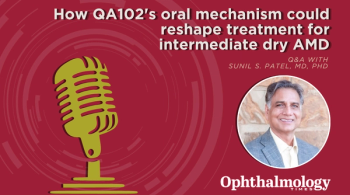
Sunil S. Patel, MD, PhD, of the University of Texas Southwestern Medical Center, breaks down QA102's first-in-class mechanism targeting harmful gut bacteria and retinal inflammation, what the phase 2 drusen volume and GA growth rate data reveal about the therapy's potential, and what a phase 3 program must address to bring an oral AMD treatment to patients without options.

Victor M. Villegas, MD, discusses supraorbital vibration as an adjunct to topical anesthesia in a high-volume retina practice.

Avacincaptad pegol may help preserve driving-related vision in geographic atrophy, but post hoc data did not reach statistical significance.

QA102 data suggest signal in intermediate dry AMD, but insignificant drusen volume change
Published: | Updated:
Oral QA102 shows imaging signals slowing drusen and GA progression in intermediate dry AMD at ARVO 2026, despite missing its primary end point.
Advertisement
Advertisement