In dry age-related macular degeneration (AMD), Weng asked whether clinicians can “step in before geographic atrophy happens” and “treat at intermediate stages of dry AMD,” and whether artificial intelligence can “predict who’s gonna convert to an exudative form of AMD before it happens.” About 15% of patients with dry AMD convert to wet AMD over their lifetime, she said. Weng, who works on home OCT, said the DRCR Retina Network fully enrolled Protocol AO as of June 2026. The artificial intelligence-based system captures images of patients daily to look for imaging biomarkers that appear right before patients convert, and finding them “would be really magical if we could find that, that secret sauce.”
A bias against corticosteroids
Michael A. Singer, MD, of the University of Texas Health Science Center, San Antonio, and Medical Center Ophthalmology Associates, said the gap is in what ophthalmologists are taught. “There’s definitely a bias against corticosteroids,” he said.
A clinician in community practice who does not like steroids is entitled to that view, Singer said, and he understands it. Teaching is different. “I think you have a moral obligation to expose them to all types of therapies,” he said of residents and fellows, “because they are more receptive during training than they’ll be anywhere else.”
Regulation, waste, and access to care
Isa S. K. Mohammed, MD, of the Wilmer Eye Institute, Johns Hopkins Medicine, framed his answer as a balance between efficiency and delivery of care on one side and regulation on the other. The field is starting to talk about it more, he said, but things are costly, and “it tends to cost even more because of restrictions and regulations that might be based off of very little science, but just based off of what seems right, but not, not necessarily proven.”
One example is the eye drop bottle that must be used once per patient. That leaves “a bottle with thousands and thousands of drops in it, and you use three drops in a patient, and then you have to dispose it because technically it’s used,” Mohammed said. Surgical waste is another, with “a lot of instruments and a lot of draping, a lot of waste that is limiting our resources.”
“We think that our resources are limitless,” he said, “but it is impacting the overall world and our ability to deliver care to everyone else.”
Mohammed said the savings could be redirected to deliver cataract surgery to people who need it, including those who “can’t see, you know, a hand in front of their face” and people with “significant glasses prescriptions that otherwise won’t be corrected.” “If we were able to redirect all those funds from our overly stringent, in some circumstances, regulations, I think it could make a big difference,” he said, “and I think the world’s starting to realize that.”
What the responses share
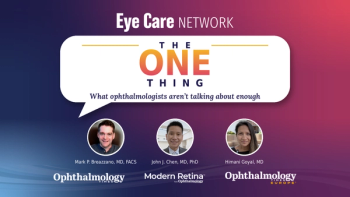
Read together, these three responses ask where attention and resources are going: to the earliest stage of disease, to the therapies taught during training, and to the way care is delivered. The One Thing is an editorially independent recurring series from the Eye Care Network that asks ophthalmologists to name the issue they believe deserves more attention. The views and perspectives are those of the ophthalmologists.