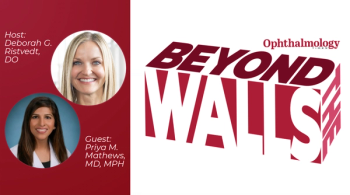
Host Deborah Ristvedt, DO, welcomes Dr. Mathews to discuss the relationships, passions, and intentional choices that have shaped her career as a cornea, cataract, and refractive surgeon, dry eye expert, and educator.

Andrea Gibson, PhD, and Erin C. Henry, PhD, trace 20 years in retina drug development—and the pathway gap still facing young scientists.
In this episode, Eichenbaum speaks with two longtime friends and retina drug-development veterans: Andrea Gibson, PhD, executive vice president of medical collaborations at Ocular Therapeutix, and Erin C. Henry, PhD, AVP of Ophthalmology, General and Specialty Medicine, Value and Implementation, Global Medical and Scientific Affairs at Merck Research Labs.
Gibson’s career preceeds the 2006 launch of ranibizumab (Lucentis; Genentech)—she started at Eyetech, working on the first approved anti-VEGF therapy, pegaptanib (Macugen), before an ASRS meeting presentation on an N-of-1 case using bevacizumab in the eye left the field “captivated,” she recalls, with the emerging Lucentis data drawing an “audible gasp” the same year. Henry joined the field just after Lucentis’ approval, moving from a neuroanatomy postdoc at Washington University in St. Louis into Genentech’s field medical team—a leap outside academia she calls fortunate, joining Gibson and others during what she describes as an exciting, cutting-edge time for the science.
Asked what’s kept both women in retina for two decades without a “retina holiday,” Gibson points to the culture of research she and Henry found early at Genentech—a corporate structure that backed serious investigator commitment and, she says, “meant what they said.” Henry credits her own loyalty to a constant appetite to learn, moving from field medical to in-house medical affairs to leading clinical development at a smaller company, always finding more of the drug-development process—manufacturing, early- versus late-stage trial design—to master. Both cite the tight-knit retina community itself as a driving force, calling it a group of clinician-scientists that makes the work fun even decades in.
The conversation turns to how few young scientists and physicians understand industry careers like theirs. Both guests recall having little clear route into the field themselves, with mentors sometimes discouraging a move into industry, and note that even inside companies, awareness of roles like medical affairs remains low. Existing efforts—internship programs, university partnerships—are a start, but the discussion lands on a shared conclusion: the industry needs a clearer path in, rather than leaving the next generation to stumble into it, as they did.
Closing out, Gibson says what excites her most is the continued advancement of the science itself, pointing to the number of programs nearing readout across the field. Henry says she is energized by building out her own team and mentoring the next generation of scientists, calling it a natural evolution after 20 years in the space. Both point to the broader retina community—its debates, its science, its people—as what keeps them engaged.