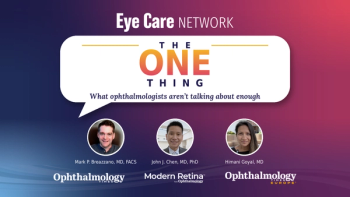
Himani Goyal, MD, John J. Chen, MD, PhD, and Mark P. Breazzano, MD, FACS, point to academic compensation, optic nerve damage, and who chooses retina.

A VR lens simulator used at InVision Eye Care lifted premium IOL conversion rates from 30%-35% to the mid-40s
InVision Eye Care is using a virtual reality-based patient education tool to show
Edward L. Hedaya, MD, an ophthalmologist at InVision Eye Care, said the shift reflects a gap he has seen for years between how well physicians think they explain lens options and how much patients actually retain. "From the perspective of a patient who doesn't really understand necessarily the ins and outs of what they're talking about, it's not particularly a good job," Hedaya said of verbal-only counseling.
Hedaya said the tool has also shifted when education happens in the care pathway, "it gives the opportunity to educate the patient before the doctor sees the patient," he said, adding that concepts like presbyopia and astigmatism are otherwise difficult for patients outside the field to grasp.
Vicky Corby, practice administrator at InVision Eye Care, said rolling out the technology required administrator and staff buy-in before it reached patients. "You want the administrator buy-in, because then she's going to train the staff," Corby said, describing a process that starts with a third-party vendor educating patients ahead of their cataract consultation and continues through a dedicated follow-up visit the practice calls the A-scan appointment, where the virtual lens simulation is introduced.
Corby said repeated touchpoints matter because patients absorb only a fraction of what they are told in a single visit. "Patients retain about 10% of what we're telling them," she said. "So especially when you're going over something scary, like eye surgery... it's safe to us, we do it all the time, but for patients, it's not."
The practice tracks the tool's effect through patient conversion to premium IOL options. Before adopting the device, Corby said, the practice's closure rate for patients upgrading from standard lenses was 30% to 35%. "So post now, our conversion rate is in the mid-40s," she said. "That's significant."
Corby said the same conversion-tracking approach extends to other technology investments, including monitoring underused equipment such as optical coherence tomography (OCT) machines to identify where additional staff training is needed.