
John Thompson, MD, discusses long-term results of using ICG to peel ILM in the treatment of macular holes
John Thompson, MD, discusses long-term results of using ICG to peel ILM in the treatment of macular holes
Thomas Aaberg, MD, gives an update on Neurotech Pharmaceuticals Encapsulated Cell Therapy platform for the potential treatment of Macular Telangiectasia Type 2, with a projected PDUFA goal date from the FDA at the annual ASRS meeting in Stockholm, Sweden.
Jennifer Lim, MD, FARVO, FASRS, gives an update on the phase 2 DAVIO 2 trial comparing EYP-1901 with aflibercept at the annual ASRS meeting in Stockholm, Sweden.
Richard B. Rosen, MD, from the New York Eye and Ear Infirmary of Mount Sinai discussed his presentation on sickle cell retinopathy and the measurement with dynamic OCT angiography and quad-fusion adaptive optics imaging at the annual ASRS meeting in Stockholm, Sweden.
Michael Singer, MD, speaks at the American Society of Retina Specialists meeting
Paolo Antonio Silva, MD, discussed his upcoming ASRS presentation on diabetic retinopathy lesions
Paolo Antonio Silva, MD, discusses his presentation on diabetic retinopathy lesion types and distribution on ultra-widefield imaging and the risk for disease worsening over time at the American Society of Retina Specialists meeting held in Stockholm, Sweden.
Ahead of the ASRS meeting in Stockholm, Sweden, Danny Mammo, MD, discusses use of suprachoroidal triamcinolone acetonide in non-infectious uveitis
Danny A. Mammo, MD, sat down with Sydney Crago, Assistant Managing Editor of Modern Retina, to discuss his presentation on intraocular pressure outcomes following suprachoroidal triamcinolone acetonide in patients with glaucoma at the American Society of Retina Specialists meeting held in Stockholm, Sweden.
Durga Borkar, MD, MMCi, discusses FAS inhibition with ONL-1204 for the treatment of geographic atrophy

The 2-year Phase III data presented at the American Society of Retina Specialists 2024 in Stockholm, Sweden, show Susvimo’s potential as an alternative to eye injections to treat diabetic macular edema and diabetic retinopathy.

Data in early-stage patients was presented at 42nd American Society of Retina Specialists Annual Scientific Meeting, being held in Stockholm, Sweden.

The purpose of the study was to determine if experience affects the surgeons’ dexterity response to pharmacologic and behavioral interventions.
Carl C Awh, MD, FASRS, sat down with Hattie Hayes, Editor of Ophthalmology Times Europe, to discuss the first readout of the Phase 3 PAGODA trial at the American Society of Retina Specialists meeting held in Stockholm, Sweden.
Theodore Leng, MD, MS, speaks about his ASRS presentation, focusing on the FARETINA-DME Study
Rishi P. Singh, MD, sat down with Sydney Crago, Editor of Modern Retina, to discuss his presentation on the results from part 1 of the Phase 2/3 SIGLEC trial assessing AVD-104 for GA at the American Society of Retina Specialists meeting held in Stockholm, Sweden.
Durga Borkar, MD, sat down with Sydney Crago, Assistant Managing Editor of Modern Retina, to discuss her presentation on Fas inhibition with ONL1204 for the Treatment of Geographic Atrophy and the first-time results From a Phase 1b study at the American Society of Retina Specialists meeting held in Stockholm, Sweden.
Theodore Lang, MD, MS, sat down to discuss his presentation on the FARETINA-DME Study at the American Society of Retina Specialists meeting held in Stockholm, Sweden.
Ahead of the ASRS meeting, Rishi P. Singh, MD, previews results from part 1 of the Phase 2/3 SIGLEC trial assessing AVD-104 for geographic atrophy
Carl C. Awh, MD, FASRS, gives an overview of the Phase 3 Pagoda trial year 2 results
Martin Zinkernagel, MD, PhD, sat down with Hattie Hayes, Editor of Ophthalmology Times Europe, to discuss his time on the sustainability expert panel Study at the American Society of Retina Specialists meeting held in Stockholm, Sweden.
Carl Danzig, MD, sat down with Sydney Crago, Assistant Managing Editor of Modern Retina, to discuss his presentation on the 72-Week results from the Phase 3 BALATON and COMINO trials at the American Society of Retina Specialists meeting held in Stockholm, Sweden.
Carl J. Danzig, MD, discusses efficacy, safety, and durability of faricimab in macular oedema due to retinal vein occlusion
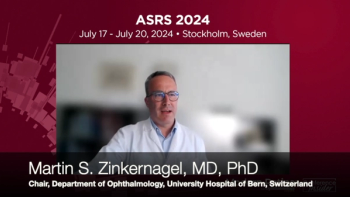
This year, the ASRS meeting will feature an expert panel on sustainability — learn more from panelist Martin Zinkernagel, MD, PhD
Srinivas Sai Kondapalli, MD, discusses outer retinal tubulations in lesion growth for subfoveal and non-subfoveal geographic atrophy
Srinivas Sai Kondapalli, MD, sat down with Sydney Crago, Assistant Managing Editor of Modern Retina, to discuss his presentation on the predictive role of outer retinal tubulations in lesion growth for subfoveal and non subfoveal geographic atrophy at the American Society of Retina Specialists meeting held in Stockholm, Sweden.
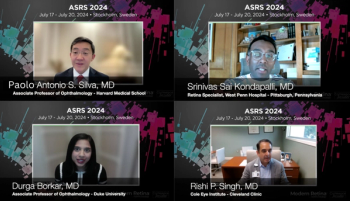
Four retina specialists share what they're most looking forward to at the 2024 ASRS meeting

6E10 combined with local prophylaxishas been selected for Phase 3 pivotal trials, with a favorable safety profile and potential best-in-class product profile at 26 weeks.
Sydney M. Crago, Assistant Managing Editor of Ophthalmology Times and Modern Retina, spoke with attendees, who shared which topics they are most looking forward to discussing at the American Society of Retina Specialists (ASRS) meeting held in Stockholm, Sweden.
Attendees shared which topics they are most looking forward to discussing at the American Society of Retina Specialists (ASRS) meeting held in Stockholm, Sweden.