
This year at ARVO, Daniel Saban PhD, was awarded the Cogan Award Lecture. He spoke with the Eye Care Network about this lecture and what the award meant to him.
This year at ARVO, Daniel Saban PhD, was awarded the Cogan Award Lecture. He spoke with the Eye Care Network about this lecture and what the award meant to him.
David Eichenbaum, MD, spoke with Modern Retina about the phase 3 trial of sozinibercept at the 2024 Retina World Congress meeting.
Modern Retina spoke with Paulo-Eduardo Stanga, MD, from The Retina Clinic London, London, United Kingdom at the 2024 Retina World Congress meeting.
Christine Kay, MD, spoke with Modern Retina to share insights from her presentation on longitudinal BCVA and safety analysis of mutation-agnostic MCO-010 optogenetic therapy For retinitis pigmentosa
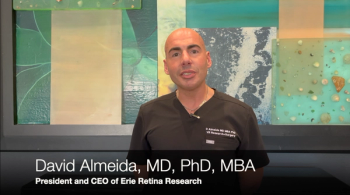
David Almeida, MD, PhD, MBA, presented on gene therapy associated uveitis at the 2024 Retina World Congress meeting in Fort Lauderdale, Florida.
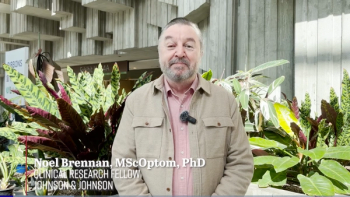
At this year's ARVO meeting in Seattle, Washington, the Eye Care Network spoke with Noel Brennan, MScOptom, PhD. The clinical research fellow at Johnson and Johnson shared highlights from his presentation on myopia control and predictive modeling.
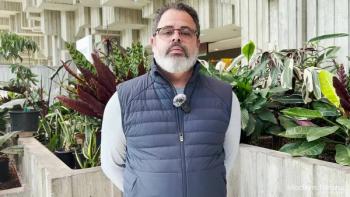
At this year's ARVO meeting, the Eye Care Network spoke with Daniel Saben PhD, who is being awarded the Cogan Lecture at this year's event.
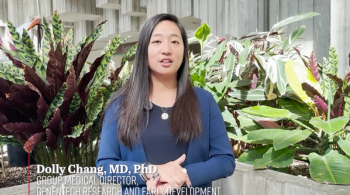
At this year's ARVO meeting in Seattle, Washington, Dolly Chang, MD, PhD, presented data on the early fluid reduction in patients with diabetic macular edema, and how that correlates with 1-year outcome with a deep learning-based retina segmentation tool using the Phase 2 BOULEVARD trial.
Sunir Garg, MD, FACS, shares strategies to minimize pain with intravitreal injections.
Modern Retina spoke with Veeral Sheth, MD, MBA, FASRS, FACS, at the 2024 Retina World Congress meeting about the PRISM study, 4DMT's gene therapy trial for wet AMD.
Michael A. Singer, MD, shares details about the an IRIS database look at Triamcinolone Acetonide.
At this year's ARVO meeting, Allen Ho, MD, presented a paper on the 12-month results of a mutation agnostic optogenetic program for patients with severe vision loss from retinitis pigmentosa.
Elias Kahan speaks about his ARVO poster, "Contact specular microscopy reliably images the same location of the corneal epithelium."
At this year's ARVO meeting, Deborah A. Ferrington, PhD, presented "Genotype-specific differences in mitochondrial function specific to the CFH Y402H risk allele associated with AMD."
At this year's ARVO meeting, Paul Kayne, PhD, gave insight on his paper titled "Mapping the melanocortin receptors in the human eye."
At this year's ARVO meeting, Deborah A Ferrington, MD, PhD, presented "Genotype-specific differences in mitochondrial function specific to the CFH Y402H risk allele associated with AMD."

In a retrospective interventional cohort study, the investigators analyzed the outcomes of 80 patients with submacular hemorrhages who were treated with subretinal aflibercept or intravitreal aflibercept.
At the 2024 ARVO meeting, Andrew D. Pucker, OD, PhD, presented a paper on measuring meibomian gland morphology
Allen Ho, MD, presented on the 12-month results of an mutation agnostic optogenetic programme at the ARVO 2024 meeting
SriniVas R Sadda, MD, presented "Post Hoc Analysis of a Phase 3 Trial on SB15 (Proposed Aflibercept Biosimilar): Assessment on Pre-to-Post Switching Efficacy and Safety in Neovascular Age-related Macular Degeneration."
At this year's ARVO meeting, Allen Ho, MD, presented a paper on presenting a paper on the 12 month results of a mutation agnostic optogenetic program for patients with severe vision loss from retinitis pigmentosa.
From surgeon to mentor: Smith fuels her commitment to improving glaucoma care by training future ophthalmologists.

Several presentations at Retina World Congress 2024 highlight the importance of diversity equity and inclusion in the retina field.
At this year's ARVO meeting, the Eye Care Network got a glimpse at the future of paediatric myopia control research

Several companies working in the retina space have shared that they plan to release data at this year’s meeting in Fort Lauderdale, Florida.
Incoming ARVO president SriniVas R. Sadda, MD, discussed major challenges in vision science research and how annual meetings inspire innovation in ophthalmology
At this year's ARVO meeting, SriniVas R Sadda, MD, presented "Post Hoc Analysis of a Phase 3 Trial on SB15 (Proposed Aflibercept Biosimilar): Assessment on Pre-to-Post Switching Efficacy and Safety in Neovascular Age-related Macular Degeneration."
An analysis showed an association between patients who previously had undergone intravitreal injections and cataract surgery and a higher risk of the development of a non-clearing vitreous hemorrhage, retinal detachment, retinal tear, and glaucoma surgery.