
Jayakrishna Ambati, MD, discusses phase 2 K8 results in GA, its inflammasome mechanism, and dosing designed for convenience.
Jayakrishna Ambati, MD, discusses phase 2 K8 results in GA, its inflammasome mechanism, and dosing designed for convenience.
Hunter Cherwek, MD, of Orbis discusses summit commitments, eye care workforce training, and AI in low-resource settings.
Christopher J. Rapuano, MD, discusses emergency eye care access, retina advances and responsible AI use in ophthalmology.
IRIS Registry data showed no change in anti-VEGF frequency, vision, or retinal thickness after patients with DME began a GLP-1RA.

Murtaza K. Adam, MD, shares pearls on haptic docking, patient selection, and preventing complications with the Yamane technique.
Andrew G. Lee, MD, and Drew Carey, MD, break down the link between optic neuritis and uveitis in central nervous system demyelinating disease.
Anat Galor, MD, MSPH, discusses subtyping dry eye, emerging diagnostic tools, and when to consider oral neuromodulation.

Jordi Monés, MD, PhD, explains why RP and Stargardt data support testing son-vec to restore vision in advanced GA.
At AAO 2026, Anjum F. Koreishi, MD, shared how to prevent complications after cataract surgery in patients with uveitis.
David F. Chang, MD, shares how to set realistic refractive IOL expectations and streamline patient counseling.
Timothy Janetos, MD, explained when to refer uveitis to a specialist and why access to uveitis care remains limited.

LUGANO missed its visual noninferiority endpoint for the vorolanib insert vs aflibercept in nAMD despite comparable anatomic control. Regillo attributes the gap partly to 9 outliers with vision loss unrelated to nAMD.
Vaidehi Dedania, MD, discussed surgical advances, candidates, and how far whole eye transplant is from clinical use.
At AAO 2026, Adam, MD, shares Yamane technique pearls, from docking the trailing haptic to preventing tilt and haptic exposure.
Anat Galor, MD, MSPH, explains how to tell whether dry eye pain stems from the nerves or the tear film and how to target it.
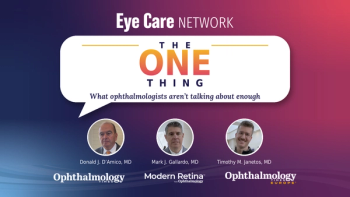
Timothy M. Janetos, MD, Donald J. D’Amico, MD, and Mark J. Gallardo, MD, point to uveitis access, clinical trial rigor, and procedural pharmaceuticals.
At AAO 2026, Michael T. Yen, MD, explained how at-home subcutaneous elegrobart could ease treatment burden in thyroid eye disease.
Liza M. Cohen, MD, explains when to use CT vs MRI in thyroid eye disease and why to review images yourself.
Anjum F. Koreishi, MD, explains why inflammation control and planning are key to cataract surgery for patients with uveitis.

FDA accepts vamikibart BLA for UME as data show sustained gains at 1 year; decision July 2027.
Liangbo Shen, MD, discussed unmet needs in geographic atrophy and how implants could ease treatment burden.
Ehsan Rahimy, MD, says most PRIMA serious adverse events occurred early, while vision gains held through 36 months.
David F. Chang, MD, explained how offering complementary refractive IOLs reduces patient anxiety and indecision.
Vaidehi Dedania, MD, shared what the first whole eye transplant revealed about reperfusion, retinal cells, and sight.
Timothy Janetos, MD, outlined can’t-miss uveitis diagnoses, warning signs, and why every new patient needs dilation.
Anti-VEGF for ROP is not associated with systemic and neurodevelopmental outcomes.

The evidence for nutrition in eye care is strong for some conditions and thin or absent for others.

Jacque Duncan, MD, reviews phase 3 DRAGON data on oral tinlarebant for Stargardt disease and its mechanism-related visual effects.
Kenneth C. Fan, MD, MBA, shared 4-year REMAIN data showing durable vision gains with MCO-010 in retinitis pigmentosa.

John A. Hovanesian, MD, discusses the Armenian Eyecare Project’s annual trip, from preparation and surgery to teaching and student involvement.