


AMD
Latest News
Advertisement
Video Series
CME Content













Advertisement
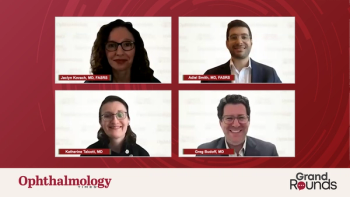
Jaclyn Kovach, MD, FASRS, presents the case of a patient with neovascular AMD with persistent subretinal fluid, and members of the panel share their experiences treating similar patients.
Adiel Smith, MD, FASRS, presents the case of a patient with neovascular age-related macular degeneration (nAMD) with treatment-resistant pigment epithelium detachment, and the panel offers clinical insights on treatment decisions.

The program will use OCT images to identify and monitor AMD in its early stages.

David Eichenbaum, MD, discusses his experiences with aflibercept, faricimab.

The molecule is being evaluated in 2 phase 3 clinical trials for wet AMD and is administered via intravitreal injection in combination with standard-of-care anti–VEGF-A therapy.
Oculogenex founder talks about collaboration with NASA and ISS on experiment in macular degeneration
Hema Ramkumar, an ophthalmologist and founder of Oculogenex, sat down with David Hutton of Ophthalmology Times to discuss their connection with NASA and their experiment on macular degeneration-treated mice in space.

The SAB additions include Usha Chakravarthy, MBBS, PhD; Allen Ho, MD, FACS, FASRS, and Frank Holz, MD, FEBO, FAVO.

Experts discuss the use of steroids, particularly in the context of diabetic macular edema (DME). The inflammatory nature of DME reveals the effectiveness of steroids, especially in cases where persistent fluid remains despite anti-VEGF treatment.
Experts discusses concerns related to the use of new agents, focusing on intraocular inflammation (IOI) and potential batch variations in biologics faricimab and aflibercept. He emphasizes close monitoring for IOI and advises clinicians to scrutinize patients for any signs of inflammation during follow-up visits.
Peter Kaiser, MD shares his early experiences with faricimab and high dose aflibercept for nAMD and DME. He notes positive outcomes, especially with hard-to-treat patients, and emphasizes the ongoing evaluation of patient response to treatment.

Age-related macular degeneration continues to be a key development area for many pharmaceutical companies as the work to develop new treatment options and present data in the first few months of the year.

Research around the globe is working not only to develop treatments for AMD, but also to determine risk factors for the disease to help prevent future cases.
Peter Kaiser, MD discusses the utilization of newer agents, faricimab and high dose aflibercept, for refractory patients who haven't responded well to previous treatments and for patients doing well but aiming to extend dosing intervals.
Experts discuss the use of steroids, particularly in the context of diabetic macular edema (DME). The inflammatory nature of DME reveals the effectiveness of steroids, especially in cases where persistent fluid remains despite anti-VEGF treatment.

Explore cutting-edge ophthalmology innovations in this new series on the Ophthalmology Times EyePod podcast. Throughout this series, we'll hear insights from various stakeholders in clinical practice, academia, and industry. In this episode, host Ehsan Sadri, MD, engages in a conversation with Jeffry Weinhuff, managing partner at Visionary Ventures, exploring trends and offering advice for individuals driven by an entrepreneurial mindset.

The European Commission is expected to make a decision about the application before the end of June.

The positive opinion concerns authorization of bevacizumab gamma (ONS-5010/LYTENAVA), a formulation of bevacizumab for treatment of wet age-related macular degeneration (wet AMD).

The prevalence of AMD features in Republic of Korea Air Force pilots was higher than in other general populations studied.
David Eichenbaum, MD, FASRS concludes this series with the final case of a treatment-experienced patient switching from aflibercept 2 mg to high-dose aflibercept 8 mg with noticeable improvement after the first dose.
David Eichenbaum, MD, FASRS provides his clinical experience with faricimab and aflibercept 8 mg, highlighting the small and large changes that benefit a patient’s quality of life, such as improved visual anatomy or reducing the frequency of visits.
David Eichenbaum, MD, FASRS discusses his clinical experience in managing retinal fluid, emphasizing the need to dramatically reduce intraretinal fluid, highlighting different strategies of care that offer the best results for patients.
Experts discuss the approach to loading doses in the context nAMD and DME. Kaiser, MD explains that loading doses may not be necessary based on studies like the CAT study, while he highlights the importance of individualized treatment plans tailored to the specific needs of each patient and the nuances of different retinal diseases.
David Eichenbaum, MD, FASRS discusses a case of exudative macular degeneration and opted for aflibercept 8 mg as treatment, which led to significant improvements in visual acuity and anatomical features.
Advertisement
Advertisement
Trending on Eye Care Network - Ophthalmology Times
1
One day, three approvals: FDA expands options for ocular redness, thyroid eye disease, and presbyopia
2
Brepocitinib meets all Phase 3 end points in noninfectious uveitis
3
Diabetic macular edema: an inflammatory disease in focus
4
Matching artificial tears to dry eye phenotype: a Q&A with Omur Ucakhan, MD
5