
Jeff Cleland, PhD, CEO of Ashvattha, discusses safety data for an at-home subcutaneous injection option being developed for wet AMD and DME. The anti-VEGF candidate will enter a Phase 2 study later this year.
Jeff Cleland, PhD, CEO of Ashvattha, discusses safety data for an at-home subcutaneous injection option being developed for wet AMD and DME. The anti-VEGF candidate will enter a Phase 2 study later this year.
Presented at ARVO 2022, research from Mass Eye and Ear hopes to open a new avenue for therapies that are for helping treat patients that develop primary open angle glaucoma.
Professor Anat Loewenstein, MD, discusses data regarding the efficacy of faricimab at targeting both the VEGF and Ang2 pathways in patients with neovascular AMD and diabetic macular edema.
The Phase 3 integrated PEACHTREE and AZALEA study data revealed strong safety and efficacy for triamcinolone acetonide via suprachoirodal injection.
The study found that if certain forms of nystagmus that are seen in patients, then there is a higher chance of poor binocular visual function, as well as higher interocular suppression.
Ora's Caitlin Black, senior director and therapeutic area head of medical devices, talks about the next generation of ophthalmic device therapies and diagnostics, clinical trial updates and new innovations that are most exciting for presbyopia treatment.
EyePoint Pharmaceuticals hopes to usher in a new paradigm of retinal eye disease treatments with their candidate EYP-1901.
The OpRegen trial is a cell therapy trial, looking to explore potential safety and efficacy for patients with advanced dry age-related macular degeneration (AMD).
As novel therapies in the pipeline are aiming to decrease the rate of GA expansion—the endpoint Karl Csaky, MD and Fredrick Ferris III, MD, identified in 2007—Dr. Csaky reinforces on the importance of preserving the central retinal tissue.
The study found that if certain forms of nystagmus that are seen in patients, then there is a higher chance of poor binocular visual function, as well as higher interocular suppression.
The study evaluates three separate cases, each which experiences irreversible changes in their corneal structure caused by challenges in getting timely treatment due to various reasons, including insurance, lost to follow up, and the coronavirus pandemic.
At ARVO 2022 in Denver, Colorado, Timothy Blenkinsop, MD, presented “3D Eye Organoids with Distinct Cornea.” His presentation outlined how these organoids have developed sophisticated cornea structures.
The Phase 3 integrated PEACHTREE and AZALEA study data revealed strong safety and efficacy for triamcinolone acetonide via suprachoirodal injection.
The study's primary endpoints were to look at increasing Schirmer's scores, as well as eye discomfort score.
Catching up after ASCRS 2022, Ora's Caitlin Black, senior director and therapeutic area head of medical devices, talks about the next generation of ophthalmic device therapies and diagnostics, clinical trial updates and new innovations that are most exciting for presbyopia treatment.
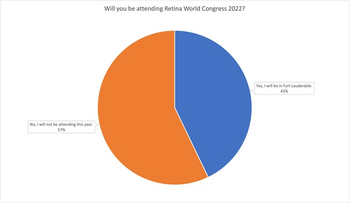
Results from our recent poll regarding Retina World Congress 2022 attendance indicate that while many retina specialists will attend the Congress, the majority will not be in Fort Lauderdale, Florida.
The Phase 3 integrated PEACHTREE and AZALEA study data revealed strong safety and efficacy for triamcinolone acetonide via suprachoirodal injection.
Penny Asbell, MD, FACS, MBA, discusses “Antibiotic Resistance among Ocular Staphylococcal Pathogens: Longitudinal Trends in the ARMOR Study."
Takeaway: there doesn't seem to be a specific dry eye phenotype that does better or worse.
The OpRegen trial is a cell therapy trial, looking to explore potential safety and efficacy for patients with advanced dry age-related macular degeneration (AMD).

Dr. Diana Do presents data on a novel patient-reported outcome instrument for patients with proliferative diabetic retinopathy with the hope of capturing the burden of the disease and treatment.

Diana Do, MD, professor of ophthalmology at Stanford's Byers Eye Institute, presents research on a newly developed, novel patient-reported outcome instrument (PRO) for patients who have proliferative diabetic retinopathy and who are undergoing treatment with either intravitreal anti-VEGF therapy, or panretinal photocoagulation.
A second FDA indication for the treatment of allergic conjunctivitis proves promising for patient relief.
Two year data shows a promising future for the OCD guided, noninvasive technology for glaucoma treatment.
Alex Dastgheib, MD, ABO, discusses the findings of the paper, "325 Cases of Phacoemulsification in Blind Cataracts," presented at the 2022 ASCRS conference in Washington, DC. The paper won the Challenging Cases session during the meeting.

Newer generation formulas generally outperformed older generation formulas, with SRK/T performing the best of older formulas, especially when using TK values.

The Association for Research in Vision and Ophthalmology’s 2022 annual meeting in Denver, Colorado, revealed a variety of advancements in technology, pivotal trials and clinical trial design.
Dr Jennifer I. Lim reviews the 2-year results of the YOSEMITE and RHINE trials, outlining the efficacy, durability, and safety of faricimab in diabetic macular oedema.

Lens thickness and anterior chamber duct values obtained by Lenstar can be improved by SpikeFinder to reduce errors in measurements.
Jennifer I. Lim, MD, FARVO, FASRS, reviews the 2-year results of the YOSEMITE and RHINE trials, outlining the efficacy, durability, and safety of faricimab in diabetic macular edema.