
Rishi Singh, MD, presented data from the Phase 3 DERBY and OAKS clinical trials for geographic atrophy at the 2023 Angiogenesis, Exudation, and Degeneration conference.
Rishi Singh, MD, presented data from the Phase 3 DERBY and OAKS clinical trials for geographic atrophy at the 2023 Angiogenesis, Exudation, and Degeneration conference.
Carl D. Regillo, MD, highlights the Talon Phase 3b results for brolucizumab vs aflibercept in a matched treat-and-extend superiority study for neovascular AMD at the virtual 2023 Angiogenesis conference.
Carl D. Regillo, MD, highlights the Talon Phase 3b results for brolucizumab vs aflibercept in a matched treat-and-extend superiority study for neovascular AMD at the virtual 2023 Angiogenesis conference.
In a presentation at the Angiogenesis, Exudation, and Degeneration 2023 conference, Justis Ehlers, MD, presented "Ellipsoid Zone Integrity in Dry AMD: An Imaging Biomarker for Progression Risk and Clinical Trial Endpoint.”
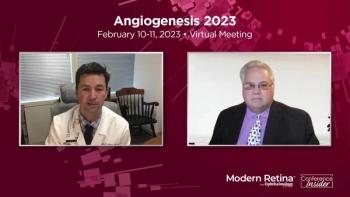
In a presentation at the Angiogenesis, Exudation, and Degeneration 2023 conference, Justis Ehlers, MD, presented "Ellipsoid Zone Integrity in Dry AMD: An Imaging Biomarker for Progression Risk and Clinical Trial Endpoint.”

In a presentation at the Angiogenesis, Exudation, and Degeneration 2023 meeting hosted by Bascom Palmer Eye Institute, Baruch Kupperman, MD, PhD, detailed research in which investigators evaluated risuteganib for safety and effectiveness in patients with dry AMD.

In a presentation at the Angiogenesis, Exudation, and Degeneration 2023 meeting hosted by Bascom Palmer Eye Institute, Baruch Kupperman, MD, PhD, detailed research in which investigators evaluated risuteganib for safety and effectiveness in patients with dry AMD.

In a presentation at the 2023 Angiogenesis, Exudation, and Degeneration program, Usha Chakravarthy, PhD, FRCOphth, CBE, presented data from the trial of lampalizumab, which is peeling back some of the mystery shrouding geographic atrophy.

A study conducted by Gemmy Cheung, MBBS, FRCOphth and colleagues shows geographic atrophy (GA) lesion phenotypes, associated features, and growth rates differ between Asians and non-Asians.

A study conducted by Gemmy Cheung, MBBS, FRCOphth and colleagues shows geographic atrophy (GA) lesion phenotypes, associated features, and growth rates differ between Asians and non-Asians.

A study conducted by Gemmy Cheung, MBBS, FRCOphth and colleagues shows geographic atrophy (GA) lesion phenotypes, associated features, and growth rates differ between Asians and non-Asians.

CEO and cofounder of the International Keratoconus Academy S. Barry Eiden, OD, FAAO, FSLS, sits down to discuss the inaugural symposium, which will be held April 22-23, 2023, in Scottsdale, Arizona.

Adrienne Graves, PhD, and Andrew Iwach, MD, co-founders of Glaucoma 360, share insights into the formation of the Glaucoma Research Foundation and what makes Glaucoma 360 such a unique conference.
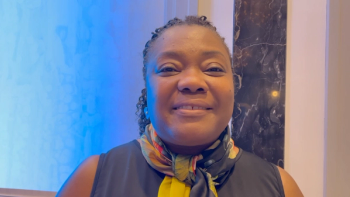
Oluwatosin U. Smith, MD, provides some key takeaways from her Glaucoma 360 2023 presentation, "Glaucoma Management Lessons Learned from a Pandemic."

Ruth Williams, MD, explained the importance of hypotension in glaucoma and its potential as a modifiable risk factor at the 27th annual Glaucoma Symposium during Glaucoma 360 at the Westin St. Francis San Francisco on Union Square.

Robert L. Stamper, MD, discusses some of the devices in development for measuring patients' intraocular pressure outside of doctors' office hours in his presentation at Glaucoma Research Foundation's annual Glaucoma Symposium.

L. Jay Katz, MD, provides some key takeaways from his Glaucoma 360 2023 presentation, "Steroid Induced Glaucoma Management."

Shan C. Lin, MD, provides an overview of the various intraocular lens technologies that are available, as well as considerations for contrast sensitivity and vision loss in patients at Glaucoma Research Foundation's annual Glaucoma Symposium.

Ying Han, MD, PhD, provides some key takeaways from her Glaucoma 360 2023 presentation, "Tube shunt update."

Thurein Htoo, MS, MBA, CEO and co-founder of Qlaris Bio, took the podium at the New Horizons Forum at the Glaucoma 360 conference in San Francisco to discuss the performance of the company’s episcleral venous pressure eyedrop, QLS-111.

Kristen H. Ingenito, MBA, vice president and director of ophthalmics at Market Scope, discusses the volume of ophthalmologists offering interventional glaucoma treatment as well as emerging therapies in her presentation at the Glaucoma 360 New Horizons Forum.

Over the years, IKA has become an invaluable resource for eye care professionals.

The Bascom Palmer program showcases neovascular, exudative, and degenerative eye diseases, and is designed for retina specialists, general ophthalmologists, and researchers.

The Bascom Palmer program showcases neovascular, exudative, and degenerative eye diseases, and is designed for retina specialists, general ophthalmologists and researchers.

A poll for retina specialists: Let us know if you will be logging on for this annual Bascom Palmer Eye Institute symposium, which will be held virtually on February 10 and 11, 2023.
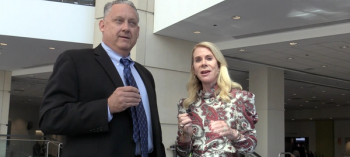
Glaucoma 360's co-founders and co-chairs Adrienne L. Graves, PhD, and Andrew G. Iwach, MD, speak with Ophthalmology Times® on what attendees can expect from the upcoming meeting, being held Feb. 2-4 in downtown San Francisco.

All events in the 2023 annual gathering, scheduled for February 2 to 4 in downtown San Francisco, California, will take place at a new venue, The Westin St Francis San Francisco on Union Square.

In a conversation with David Hutton of Ophthalmology Times®, Ferhina S. Ali, MD, MPH, discussed the real world use of faricimab in the IRIS Registry during a presentation this week at Hawaiian Eye in Kauai Hawaii, focusing on the use of faricimab for the treatment of neovascular AMD and diabetic macular edema.

Jay Pepose, MD, PhD. presented Incorporating "Topical Therapy in the Treatment of Presbyopia" at EyeCon 2022 in Marco Island, Florida.

Jefferson Doyle, MBBCh, MD, PhD, MHS, of the Wilmer Eye Institute at Johns Hopkins University School of Medicine, addresses myopic concerns, such as public health measures including time outdoors, as well as pharmacological approaches including the current atropine data that has been completed and ongoing studies.