Takeaway: there doesn't seem to be a specific dry eye phenotype that does better or worse.

Takeaway: there doesn't seem to be a specific dry eye phenotype that does better or worse.

The OpRegen trial is a cell therapy trial, looking to explore potential safety and efficacy for patients with advanced dry age-related macular degeneration (AMD).

Though the speed of traditional guillotine cutters has increased significantly in recent years, there are certain limitations. With the advent of hypersonic vitrectomy, Sunir J. Garg, MD, FACS, explains how retinal surgeons can remove the vitreous gel with more efficiency.

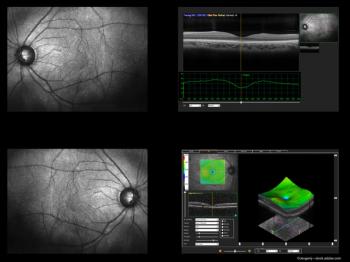
The study assesses retinal blood biomarkers using a new prototype OCT, aiming to measure retinal biomarkers such as blood flow volume, average velocity and vessel diameter with a new prototype.

While the DAZZLE trial failed to meet its primary endpoint, KSI-301 demonstrated good initial visual gains and anatomic effects as well as positive durability.

In the study, the faricimab molecule, which is a combined anti-Ang2 and anti-VEGF, performed better than the aflibercept drug in many different ways. Rishi P. Singh, MD, FASRS, summarizes some of these key findings.

The study found that if certain forms of nystagmus that are seen in patients, then there is a higher chance of poor binocular visual function, as well as higher interocular suppression.

Presented at ARVO 2022, research from Mass Eye and Ear hopes to open a new avenue for therapies that are for helping treat patients that develop primary open angle glaucoma.


Dr Carlos Quezada Ruiz, senior medical director at Genentech, discusses “Predicting optimal treatment regimen for patients with neovascular age-related macular degeneration using machine learning.”

The study assess retinal blood biomarkers using a new prototype OCT, aiming to measure retinal biomarkers such as blood flow volume, average velocity, and vessel diameter with a new prototype.

Yasha S. Modi, MD, discusses his best tips and tricks for finding and diagnosing infectious uveitis.

The study evaluates three separate cases, each of which experienced irreversible changes in their corneal structure caused by challenges in getting timely treatment due to various reasons, including insurance, lost to follow up, and the COVID-19 pandemic.

Carlos Quezada Ruiz, MD, senior medical director at Genentech, discusses “Predicting optimal treatment regimen for patients with neovascular age-related macular degeneration using machine learning.”

Presented at ARVO 2022, research from Mass Eye and Ear hopes to open a new avenue for therapies that are for helping treat patients that develop primary open angle glaucoma.

As novel therapies in the pipeline are aiming to decrease the rate of GA expansion—the endpoint Karl Csaky, MD and Fredrick Ferris III, MD, identified in 2007—Dr. Csaky reinforces on the importance of preserving the central retinal tissue.

Carlos Quezada Ruiz, MD, senior medical director at Genentech, discusses “Predicting optimal treatment regimen for patients with neovascular age-related macular degeneration using machine learning.”

Jeff Cleland, PhD, CEO of Ashvattha, discusses safety data for an at-home subcutaneous injection option being developed for wet AMD and DME. The anti-VEGF candidate will enter a Phase 2 study later this year.

Presented at ARVO 2022, research from Mass Eye and Ear hopes to open a new avenue for therapies that are for helping treat patients that develop primary open angle glaucoma.

Professor Anat Loewenstein, MD, discusses data regarding the efficacy of faricimab at targeting both the VEGF and Ang2 pathways in patients with neovascular AMD and diabetic macular edema.

The Phase 3 integrated PEACHTREE and AZALEA study data revealed strong safety and efficacy for triamcinolone acetonide via suprachoirodal injection.

The study found that if certain forms of nystagmus that are seen in patients, then there is a higher chance of poor binocular visual function, as well as higher interocular suppression.

Ora's Caitlin Black, senior director and therapeutic area head of medical devices, talks about the next generation of ophthalmic device therapies and diagnostics, clinical trial updates and new innovations that are most exciting for presbyopia treatment.

EyePoint Pharmaceuticals hopes to usher in a new paradigm of retinal eye disease treatments with their candidate EYP-1901.

The OpRegen trial is a cell therapy trial, looking to explore potential safety and efficacy for patients with advanced dry age-related macular degeneration (AMD).

As novel therapies in the pipeline are aiming to decrease the rate of GA expansion—the endpoint Karl Csaky, MD and Fredrick Ferris III, MD, identified in 2007—Dr. Csaky reinforces on the importance of preserving the central retinal tissue.

The study found that if certain forms of nystagmus that are seen in patients, then there is a higher chance of poor binocular visual function, as well as higher interocular suppression.

The study evaluates three separate cases, each which experiences irreversible changes in their corneal structure caused by challenges in getting timely treatment due to various reasons, including insurance, lost to follow up, and the coronavirus pandemic.

At ARVO 2022 in Denver, Colorado, Timothy Blenkinsop, MD, presented “3D Eye Organoids with Distinct Cornea.” His presentation outlined how these organoids have developed sophisticated cornea structures.

The Phase 3 integrated PEACHTREE and AZALEA study data revealed strong safety and efficacy for triamcinolone acetonide via suprachoirodal injection.