





Retina
Latest News
Advertisement
Video Series
CME Content











Advertisement

Telomir-1 shows promising results in restoring vision and retinal structure in age-related macular degeneration, marking a significant advancement in treatment.

The drug has been reported previously to cause neuropathy and hypersensitivity reactions in breast cancer patients.

The therapy planning support tool has been trained on thousands of patient cases from more than 200 retina centres throughout Europe
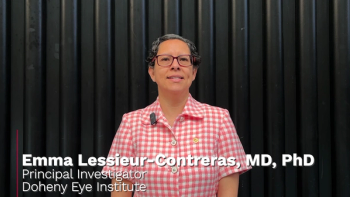
ARVO 2025: Retina extracellular vesicles in diabetic retinopathy
Published: | Updated:
At ARVO 2025, in Salt Lake City, Utah, Emma Lessieur-Contreras, MD, PhD, talked about her poster on retina extracellular vesicles, and the role that they play on diabetic retinopathy.
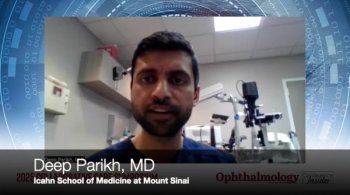
Deep Parikh, MD, sat down with Emily Kaiser Maharjan from Optometry Times to talk about his presentation at Collaborative Care Symposium on advanced treatments in neovascular retinal disease.
Lori Wright, JD, sat down to talk about a discussion at Collaborative Care Symposium about the risk under federal statutes and how to minimize that risk as an optometrist or an ophthalmic practice.
Dilraj S. Grewal, MD, FASRS, provides an in-depth overview of the current state of research and treatment innovations.

Lysine, proline and arginine levels progressively increased from non-proliferative DR to proliferative DR stages

This partnership aims to address care gaps by identifying untreated and undertreated patients at scale.
Sunir Garg, MD, discusses a challenge in ophthalmological procedures: patient discomfort during intravitreal injections caused by povidone iodine.
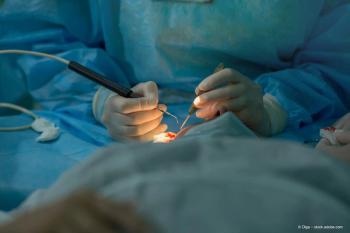
The new surgical technique incorporates a new surgical clamp that maintains eye pressure during the insertion of 2 tissue patches in immediate succession while minimizing damage to the surrounding tissue.
ABCA4-associated retinopathies include Stargardt disease, retinitis pigmentosa 19, and cone-rod dystrophy 3.
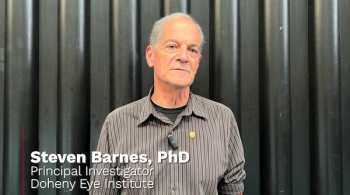
At ARVO 2025, in Salt Lake City, Utah, Steven Barnes, PhD, talked about his research on the OPA1 mutation in retinal ganglion cells' effect on the cell's electrical function.

Swedish researchers reveal that vitamins B6, B9, B12, and choline offer neuroprotection against glaucoma, highlighting potential new treatment avenues.
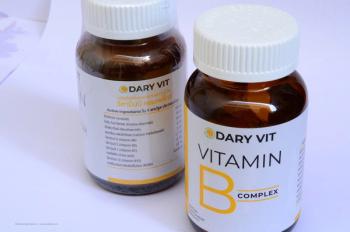
Vitamins B6, B9 and B12 were found to be neuroprotective against retinal ganglion cell death

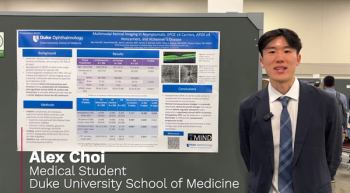
At ARVO 2025, in Salt Lake City, Utah, Alex Choi discussed his poster on APOE carrier genetic status and its relation to Alzheimer disease as well as changes of the retina that might reflect early signs leading to an earlier diagnosis of the disease
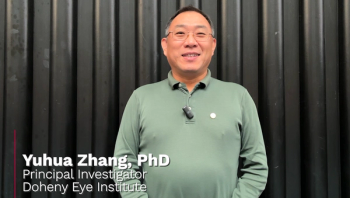
At ARVO 2025, in Salt Lake City, Utah, Yuhua Zhang, PhD, talked about his presentation on in vivo imaging of retinal pigment epithelium metabolic function in age-related macular degeneration
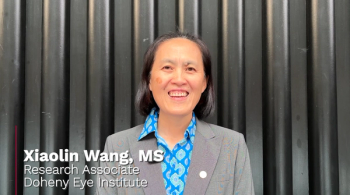
At ARVO 2025, in Salt Lake City, Utah, Xiaolin Wang, MS, talked about her presentation on in vivo imaging of retinal pigment epithelium metabolic function in AMD.
Susvimo is the first and only FDA-approved, continuous delivery treatment shown to maintain vision in people with DR with just one refill every 9 months

Join global experts at the 2025 International SPECTRALIS Symposium in Heidelberg, exploring innovations in ophthalmology and space-related ocular health.
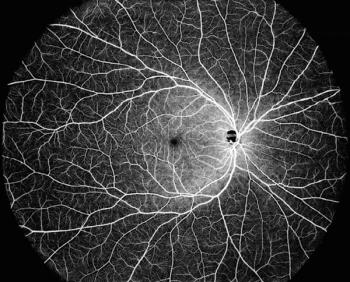
The OCT platform offers deep imaging depth, rapid sweeping speed, extensive scan range, accurate results and multimodal imaging capabilities
The designation is based off previously reported phase 3 data from the ongoing DRAGON trial.
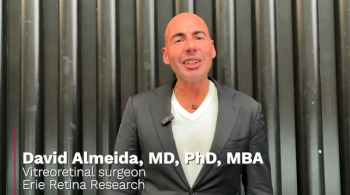
At ARVO 2025, in Salt Lake City, Utah, David Almeida, MD, MBA, PhD, talked about 12-month results from the PAVIA phase 2 trial of EYP-1901 in nonproliferative diabetic retinopathy.
Advertisement
Advertisement