






Imaging
Latest News

November 13th 2024
By David Hutton
A recent cohort study revealed low adoption of FDA-approved AI-based diabetic retinopathy detection, with less than 5% of diabetic patients receiving ophthalmic imaging. Researchers emphasize the need for improved awareness, cost-effectiveness, and integration to increase diabetic retinopathy screening rates.
Advertisement
Video Series
CME Content




Advertisement

CVD could impact physicians' ability to identify choroidal melanoma from choroidal nevus.
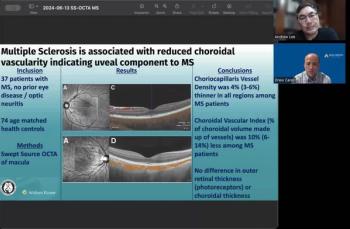
Andrew Lee, MD, and Andrew Carey, MD, sit down on another episode of the NeuroOp Guru to discuss Multiple Sclerosis and its association with reduced choroidal vascularity.

The nOCT allows for detailed visualization of the brain's vascular anatomy.
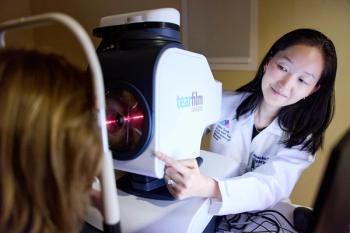
TFI employs spectral interference technology to image and map the corneal surface.
Paolo Antonio Silva, MD, discusses his presentation on diabetic retinopathy lesion types and distribution on ultra-widefield imaging and the risk for disease worsening over time at the American Society of Retina Specialists meeting held in Stockholm, Sweden.

The companies are teaming up to reduce care gaps and improve eye and vision health by bringing diabetic retinopathy and other eye disease screening services to patients in their own homes and workplaces.

Technology offers increased usability, safety, and accuracy in MIGS procedures.

Comanagement is a key component for treatment of disease.
The mapping method revealed prominent microscopic abnormalities consistent with diabetic retinopathy.

Alternate methods of screening may lead to earlier diagnosis of disease.

Joseph Izatt was a skilled researcher and inventor who played a foundational role in the development of optical coherence tomography.

Contrary to the traditional understanding that this disorder remains stable, long-term structural changes were observed through spectral-domain optical coherence tomography (SD-OCT) imaging.
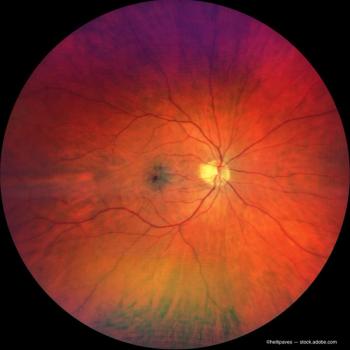
Mobile cameras allow University of Colorado ophthalmology residents working in hospital settings to conduct more comprehensive and efficient patient evaluations.

According to the company, 2,500 clinical and peer-reviewed studies that span 235 disease states have demonstrated the clinical utility of Optos technology.
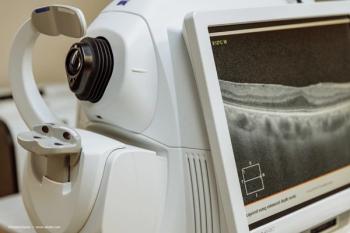
Multimodal technology bridges the gap between advanced age-related macular degeneration (AMD) biomarkers and clinical features.

Researchers at Mass Eye and Ear have demonstrated that retinal imaging can help predict a person’s risk of developing ocular, neuropsychiatric, cardiac, metabolic, and pulmonary diseases.
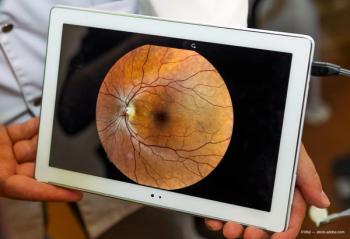
While the potential for fundus images is recognized, the methodology and clinical application must be improved.
Varun Chaudhary, MD, FRCSC, addressed the big questions in treating patients with retinal vascular diseases at the Retina 2024 meeting in Maui.
The goal is to understand how individuals with CVI interact with their visual world

A Q-switched, 532 nm-wavelength, frequency-doubled Nd:YAG laser, the Eagle is intended for use in performing selective laser trabeculoplasty.

ROP can be a disease that affects both the retinal and choroidal vasculatures.
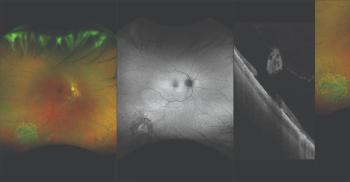
Technology is an option for evaluating, documenting certain types of retinal pathology.

The goal is to evaluate neonates with retinopathy of prematurity (ROP) who met only 1 screening criterion with the goal of easing the burden of ROP screening.
Physician discusses 5 keys to achieve optimal results for patients
Investigators note a supply shortage led to use of half a dose for imaging purposes.
Advertisement
Advertisement
Trending on Eye Care Network - Ophthalmology Times
1
Eyedaptic launches Eva, an agentic AI visual assistant for patients with retinal disease
2
Eyes on October 2026: AAO and EURETINA highlights, a trio of FDA approvals, and optogenetics takes the spotlight
3
Complement inhibition in GA: Timing, safety, and follow-up
4
October 2026 retina recap: Duravyu stumbles, DAYBREAK delivers, and optogenetics takes the Nobel
5