

Clinical Diagnosis
Latest News


Prevent Blindness declares 5th annual Thyroid Eye Disease Awareness Week
By David Hutton

Study examines the use of AI–based detection of diabetic retinopathy in the US
By David Hutton
Advertisement
Video Series

CME Content














Advertisement
News
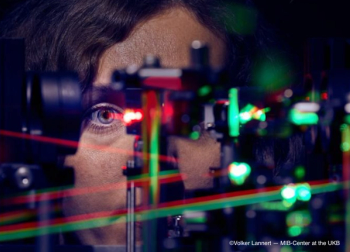
A group of German researchers has discovered how tiny eye movements and the density of photoreceptors assist in visual acuity.
News
A study led by researchers at the University of Birmingham finds AI-powered models can match ophthalmologists in diagnosing infectious keratitis, offering promise for global eye care improvements.
News
A recent paper reveals increasing rates of diabetic retinopathy in young patients with diabetes, sparking concerns over inadequate screening and management, especially among Black and Hispanic youths.

A team of researchers at Arizona State University has developed tools to aid in the diagnosis of myopic maculopathy.
Ehsan Sadri, MD, FACS, of Visionary Eye Institute in Newport Beach, California, sat down with Professor Emeritus Colin R. Green, PhD, DSc, University of Auckland, in Auckland, New Zealand, to learn more about a novel therapy in development for the treatment of keratoconus and other corneal ectasias.

Push to identify biomarkers for earlier diagnosis, new therapeutic targets.
In this PER On Air Ophthalmology Times podcast, an expert panel discusses the latest advances in X-linked retinitis pigmentosa and how to optimize diagnosis as well as developments in gene therapy.
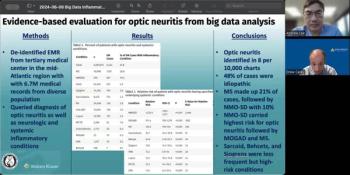
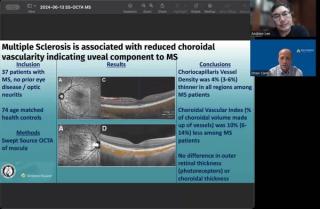
Andrew Lee, MD, and Andrew Carey, MD, sit down on another episode of the NeuroOp Guru to discuss evidence-based evaluation for optic neuritis from big data analysis
In this PER On Air Ophthalmology Times podcast, an expert panel discusses diagnosing TED and providing appropriate pharmacologic and surgical treatments.

Current Fuchs endothelial corneal dystrophy treatments include implanted cultured human endothelial cells.
Cochair Kelly K. Nichols, OD, PhD, MPH, FAAO, highlights her passion for dry eye research and the vital collaboration between ophthalmology and optometry at EyeCon.
Early diagnosis of NMOSD is key to preventing disability, improving survival.

Researchers train deep learning model on OCT scans to ID patients eligible for GA trials.
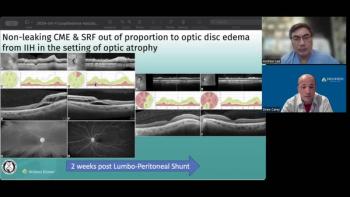
Andrew Lee, MD, and Andrew Carey, MD, sit down on another episode of the NeuroOp Guru to discuss nonleaking cystoid macular edema and subretinal fluid out of proportion to optic disc edema in idiopathic intracranial hypertension in the setting of optic atrophy.
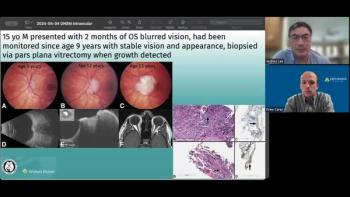
Andrew Lee, MD, and Andrew Carey, MD, sit down on another episode of the NeuroOp Guru to discuss a unique case of a 15-year-old who showed signs of meningioma with epithelial whirls and some psammoma bodies in the eye.

According to Genentech, faricimab-svoa is the first and only syringe prefilled with an FDA-approved bispecific antibody to treat retinal conditions that can cause blindness.
In this PER On Air Ophthalmology Times podcast, a team of experts provides insights into the diagnosis and management of patients with NK (including assessing their underlying cause of NK), with a look at the range of treatments available for patients with advanced stages of NK.
This PER On Air - Ophthalmology Times podcast examines the new treatment paradigm for patients with geographic atropy, following the introduction of complement-targeting therapies.
In this Ophthalmology Times EyePod podcast, Mandeep S. Singh, MD, PhD, speaks with Mark S. Humayun, MD, PhD, about the progress made by a team of USC researchers on a novel stem cell patch for treating advanced dry age-related macular degeneration.
Optimizing corneal neurotization outcomes with cryopreserved amniotic membrane.
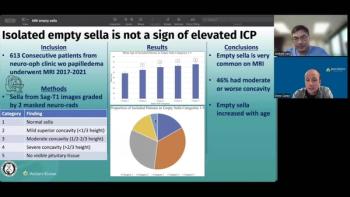
Andrew Lee, MD, and Andrew Carey, MD, sit down on another episode of the NeuroOp Guru to discuss how isolated empty sella is not a sign of elevated ICP

VISTA is a global randomly assigned, controlled, masked, multi-center pivotal study evaluating the efficacy, safety, and tolerability of 2 dose levels of AGTC-501 for the treatment of X-linked retinitis pigmentosa

Positive data from the GALE long-term extension study showed patients developed fewer new scotomatous points with 36 months of both continuous monthly and every-other-month treatment.

Researchers examined data of more than 200,000 people, some at an early stage of the disease and some without age-related eyesight issues
According to the company, it will finalize its Phase 3 development plans following an End-of-Phase 2 meeting with the FDA.
Advertisement
Advertisement
Trending on Eye Care Network - Ophthalmology Times
1
2026 Nobel Prize in Physiology or Medicine awarded for optogenetics discovery
2
EURETINA 2026: Optogenetic therapy MCO-010 aims to restore vision in advanced macular disease
3
Oku Digital Health launches from Topcon to link eye care, primary care
4
Real-world VOYAGER data on faricimab in nAMD, DME, RVO at EURETINA 2026
5