

A new treatment is presented that eliminates the root cause of the disease and restores ocular surface health.

A new treatment is presented that eliminates the root cause of the disease and restores ocular surface health.
Hipsley shares insights into ocular biomechanics and dynamic range of focus, that can help the field to work toward vision restoration and increase eye health.

Discover how RGB technology enhances eye disease diagnosis, improving accuracy and efficiency in clinical practice with advanced imaging techniques.
Advanced imaging technologies like intraoperative OCT and heads-up displays enhance surgical precision and patient outcomes in retina surgery.
A study reveals that cryopreserved amniotic membrane enhances recovery and reduces infection risk in post-corneal cross-linking patients.

Donaldson introduces the panel and outlines the series’ focus on improving dry eye management through tear function optimization.
Donaldson introduces the panel and outlines the series’ focus on improving dry eye management through tear function optimization.
Surgeons explore innovative cataract surgery techniques that significantly lower intraocular pressure while ensuring patient safety and comfort.
A severe case of misdiagnosis is revisited to show how careful evaluation led to recovery and renewed patient trust.
Discover the latest advancements in laser vision correction, including next-gen LASIK techniques that achieve unprecedented visual outcomes.

It seems there is no text provided for summarization. Please provide the text you'd like summarized, and I'll be happy to help!
To celebrate Ophthalmology Times' 50th anniversary, we asked leading experts what the practice would look like today had optical coherence tomography (OCT), one of the biggest innovations in the field, never been invented.
Marguerite B. McDonald, MD, FACS, reflects on a first-year residency case that taught her the importance of trusting her instincts and advocating for patient safety.
A clinician explains a step-by-step approach to diagnosing and managing a common eyelid disease in everyday practice.
To celebrate Ophthalmology Times' 50th anniversary, we asked leading experts what the practice would look like today had optical coherence tomography (OCT), one of the biggest innovations in the field, never been invented.

Deborah Ristvedt, DO, recalls a retinal detachment repair that took an unexpected turn, teaching lasting lessons in patient awareness and surgical presence.
To celebrate Ophthalmology Times' 50th anniversary, we asked leading experts what the practice would look like today had optical coherence tomography (OCT), one of the biggest innovations in the field, never been invented.
Peter J. McDonnell, MD, reflects on his early experience managing bullous keratopathy with penetrating keratoplasty and how advances like DMEK have transformed outcomes across corneal, refractive, and cataract surgery.
To celebrate Ophthalmology Times' 50th anniversary, we asked leading experts what the practice would look like today had optical coherence tomography (OCT), one of the biggest innovations in the field, never been invented.
Oluwatosin U. Smith, MD, reflects on early experiences caring for pediatric patients with complex glaucoma and how evolving tools and advancing science have reshaped treatment options over the decades.
Andrew G. Lee, MD, and Drew Carey, MD, discuss the case of a patient with persistent papilledema after brain tumor resection due to superficial siderosis.
To celebrate Ophthalmology Times' 50th anniversary, we asked leading experts what the practice would look like today had optical coherence tomography (OCT), one of the biggest innovations in the field, never been invented.
David Eichenbaum, MD, FASRS, recalls an early-career case managing bilateral diabetic macular edema with frequent intravitreal triamcinolone injections—leading to severe steroid-induced glaucoma and valve implants.
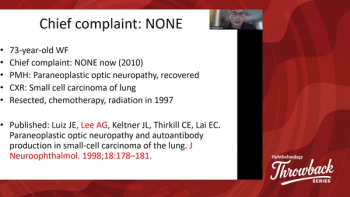
Andrew G. Lee, MD, revisits a 1997 case in which recognizing paraneoplastic optic neuropathy led to the diagnosis—and life-saving treatment—of small cell lung carcinoma.
Neda Shamie, MD, recounts a humbling experience performing cataract surgery in Honduras using older-generation phaco machines, revealing how technology elevates both skill and patient care.

Their discussion sheds light on the importance of physician advocacy in ophthalmology—from shaping policy and protecting patients to building community.