



















An ischaemia modulator has demonstrated it is safe and well tolerated in a Phase 1/2a trial in diabetic macular ischaemia patients.
An ischaemia modulator has demonstrated it is safe and well tolerated in a Phase 1/2a trial in diabetic macular ischaemia patients.
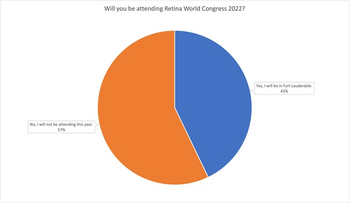
Results from our recent poll regarding Retina World Congress 2022 attendance indicate that while many retina specialists will attend the Congress, the majority will not be in Fort Lauderdale, Florida.
The OpRegen trial is a cell therapy trial, looking to explore potential safety and efficacy for patients with advanced dry age-related macular degeneration (AMD).

Diana Do, MD, professor of ophthalmology at Stanford's Byers Eye Institute, presents research on a newly developed, novel patient-reported outcome instrument (PRO) for patients who have proliferative diabetic retinopathy and who are undergoing treatment with either intravitreal anti-VEGF therapy, or panretinal photocoagulation.
Dr Jennifer I. Lim reviews the 2-year results of the YOSEMITE and RHINE trials, outlining the efficacy, durability, and safety of faricimab in diabetic macular oedema.

Variable TULP1 missense mutations in inherited retinal diseases.

Dr Eva Chamorro points out that myopia control spectacle lenses affect the diurnal rhythms in the AL in young adult human and produced a small short-term increase in the AL that varies in intensity and time interval for each of the 3 studied lenses.

Investigators from the Karolinska Institutet and St. Erik Eye Hospital, Stockholm, Sweden, reported that they have developed a prognostic test, referred to as serUM, that they believe is a strong predictor of metastasis of uveal melanoma.
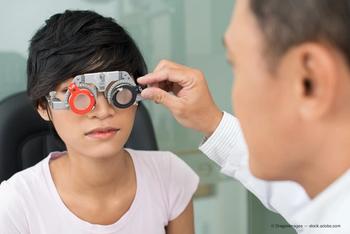
In a poster presented at the Association for Research in Vision and Ophthalmology’s 2022 annual meeting in Denver, Eva Chamorro, PhD, MSc, points out that myopia control spectacle lenses affect the diurnal rhythms in the AL in young adult human and produced a small short-term increase in the AL that varies in intensity and time interval for each of the 3 studied lenses.

Investigators from the Karolinska Institutet and St. Erik Eye Hospital, Stockholm, Sweden, reported that they have developed a prognostic test, referred to as serUM, that they believe is a strong predictor of metastasis of uveal melanoma.

THR-687 is currently being evaluated in a phase 2 clinical trial in patients with DME. The first data from the dose-optimization study is expected to be released in the first half of 2022.

THR-687 is currently being evaluated in a phase 2 clinical trial in patients with DME. The first data from the dose-optimization study is expected to be released in the first half of 2022.
Mike Watson, Vice President of OraNet, unpacks some of the most pressing challenges to clinical research in today’s climate.

The study found no association between treatment and the risk of chronic kidney disease or end-stage renal disease.

In a poster presented at the Association for Research in Vision and Ophthalmology’s 2022 annual meeting, Dr Osama Ibrahim Hirayama and colleagues offered results that demonstrating that anisometropia and astigmatic error were greater among the patients with high myopia compared with the other groups. Compared with the subjects with no myopia, those with high myopia reported significantly more dryness, less photophobia, and less pain.

In a poster presented at the Association for Research in Vision and Ophthalmology’s 2022 annual meeting in Denver, Osama Ibrahim Hirayama, MD, and colleagues offered results that demonstrating that anisometropia and astigmatic error were greater among the patients with high myopia compared with the other groups. Compared with the subjects with no myopia, those with high myopia reported significantly more dryness, less photophobia, and less pain.
Dr. David Bingaman of Ora Clinical discusses today’s need to accelerate clinical studies and increase investments in retina and challenging disease states.
Dr David Bingaman of Ora Clinical discusses today’s need to accelerate clinical studies and increase investments in retina and challenging disease states.

Treatments include tinted spectacles and/or contact lenses, low-vision aids, atropine drops, and patching for amblyopia, as well as eye muscle surgery for the nystagmus or any anomalous head posture and associated strabismus.
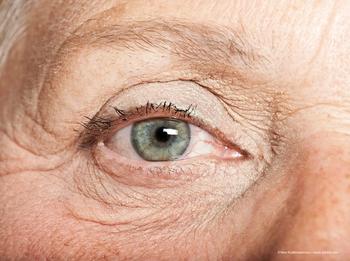
The axitinib intravitreal implant (OTX-TKI) is being evaluated to treat wet age-related macular degeneration in a phase 1b clinical trial.
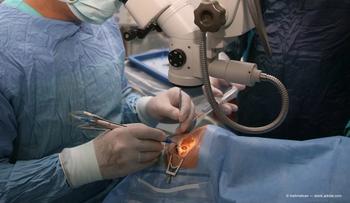
The intravitreal implant (OTX-TKI) is being evaluated to treat wet age-related macular degeneration in a phase 1b clinical trial.

In a poster presented at the Association for Research in Vision and Ophthalmology’s 2022 annual meeting in Denver, Mamoru Ogawa, MD, noted that investigators have found that the choroidal and central corneal thicknesses increased over a very short period of time following intensive outdoor activity.
At ARVO 2022, Dr Jason S. Slakter presents data on the efficacy and safety of OPT-302 when combined with ranibizumab for polypoidal choroidal vasculopathy.

A poll for retina specialists regarding their attendance at the 2022 Retina World Congress in Fort Lauderdale, Florida. This poll is now closed.
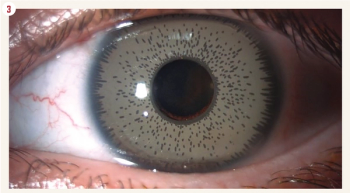
Authors of a retrospective study into complications associated with iris implants advise that the procedure should be considered as malpractice.