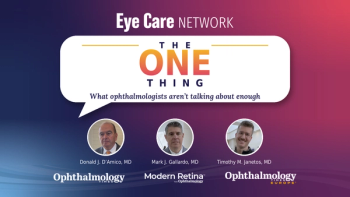
Timothy M. Janetos, MD, Donald J. D’Amico, MD, and Mark J. Gallardo, MD, point to uveitis access, clinical trial rigor, and procedural pharmaceuticals.

Himani Goyal, MD, John J. Chen, MD, PhD, and Mark P. Breazzano, MD, FACS, point to academic compensation, optic nerve damage, and who chooses retina.
Ask ophthalmologists what the field should discuss more, and the answers can go in very different directions. The Eye Care Network posed that question to numerous ophthalmologists: “What aren’t ophthalmologists talking about enough?” Three answers anchor the second episode of The One Thing: one on
Himani Goyal, MD, of NYU Langone Health, pointed to academic medicine itself. Coming from academics, she said, she may be the only one who talks a lot about “the importance of academics and how important it is to dedicate our time and recruit talent to teach our residents.” Goyal said she is passionate about the issue and that her department at NYU has done well on that front.
The field also does not discuss the “discrepancy in pay” between academic and private ophthalmologists, she said. “It is a labor of love, but at the same time, we are bringing and raising the next generation and keep feeding our industry.” How much teachers are valued, and whether that translates into how they are compensated, is “an eternal question,” Goyal said.
John J. Chen, MD, PhD, of Mayo Clinic, named a goal the field has yet to reach. “What we need is a way to regenerate the optic nerve,” he said. Right now, Chen said, the conversation is about better outcomes for optic neuritis, and clinical trials in neuro-ophthalmology are testing ways to treat disease-specific conditions such as optic neuritis.
“But once the damage is done, is there a way to be able to regenerate that optic nerve?” he asked. “It’s talked about a lot. We just don’t have that solution yet, but I think that’ll be the next big step in providing better outcomes for our patients.”
Mark P. Breazzano, MD, FACS, of the Flaum Eye Institute at the University of Rochester, turned to the pipeline of future retina specialists. Relative to general ophthalmology, he said, “I think there’s a little bit less interest among current trainees to pursue retina.”
He attributed much of that to the perceived duties and responsibilities of retina surgeons and the ability to practice compared with prior years, citing “stress points in terms of surgery and increased number of injections that are being performed,” along with the perception of handling urgent and emergent cases. “It’s not unique just to retina,” Breazzano said, “but I think it’s something to look out for.”
Taken together, these three responses point to gaps beyond the next therapy: in how academic medicine is valued, in what treatment can do for the optic nerve, and in who chooses to pursue retina. The One Thing is an editorially independent recurring series that asks ophthalmologists to name the issue they believe deserves more attention.