





Geographic Atrophy
Latest News

Advertisement
Video Series






CME Content














Advertisement

A retrospective study identifies thin choroid as the key factor behind ungradable ultrawidefield green-light fundus autofluorescence images in geographic atrophy.

Findings from an 856-patient analysis suggest that evaluating GA topography beyond foveal involvement may better capture patient-reported functional impairment.

Avacincaptad pegol may help preserve driving-related vision in geographic atrophy, but post hoc data did not reach statistical significance.
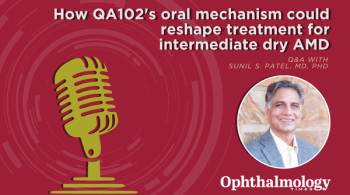
Sunil S. Patel, MD, PhD, of the University of Texas Southwestern Medical Center, breaks down QA102's first-in-class mechanism targeting harmful gut bacteria and retinal inflammation, what the phase 2 drusen volume and GA growth rate data reveal about the therapy's potential, and what a phase 3 program must address to bring an oral AMD treatment to patients without options.

Biogen buys Apellis, taking over Syfovre for geographic atrophy—what it means for GA care, trial data, safety signals, and future formulations.

Avacincaptad pegol may help preserve driving-related vision in geographic atrophy, but post hoc data did not reach statistical significance.

QA102 data suggest signal in intermediate dry AMD, but insignificant drusen volume change
Published: | Updated:
Oral QA102 shows imaging signals slowing drusen and GA progression in intermediate dry AMD at ARVO 2026, despite missing its primary end point.

Biogen’s $5.6B Apellis deal boosts GA and renal complement therapies, spotlighting SYFOVRE benefits, safety signals, and future access.

The Opti-GAIN study from Complement Therapeutics is assessing the safety, tolerability, and preliminary efficacy in GA secondary to age-related macular degeneration (AMD) of CTx001.

The Opti-GAIN study from Complement Therapeutics is assessing the safety, tolerability, and preliminary efficacy in GA secondary to age-related macular degeneration (AMD) of CTx001.

Q1 2026 eye-care roundup: first dual-agent presbyopia drop, new EDOF IOL, wet AMD phase 3 win, and gene-therapy advances.

Phase 2 ArMaDa data show statistically significant 31% reduction in GA lesion growth with OCU410 at 12 months, with a favorable safety profile supporting phase 3 development.

The trial, sponsored by ONL Therapeutics, aims to enroll approximately 324 patients across sites in Europe, the United States, and Canada.


University of Utah data show US ophthalmic drug and eye drop shortages last longer and occur more often, affecting local and systemic medications equally.

Three real-world GA cases reveal why early imaging-guided treatment matters, how fast vision can decline, and how to manage CNV risk with anti-VEGF.

Steffen Schmitz-Valckenberg, MD, discusses how optical coherence tomography-based models may enable rapid, noninvasive assessment of functional loss in GA.

From artificial intelligence and IOL innovation to biosimilars, geographic atrophy, and postoperative eye protection, Joshua Mali, MD, FASRS, shares what he believes will define ophthalmology in the year ahead.

Steffen Schmitz-Valckenberg, MD, discusses how optical coherence tomography-based models may enable rapid, noninvasive assessment of functional loss in GA at Angiogenesis 2026.

Experts debate real-world retina cases—mystery vitreous hemorrhage, floater vitrectomy, buckle comeback, PDR laser vs anti-VEGF, GA timing.

The results of a multicenter controlled clinical trial showed that the device resulted in “a significant improvement in visual acuity (VA) from baseline to month 12.

The deal will see MeiraGTx assume development rights to ZipBio’s experimental therapies targeting the complement pathway in geographic atrophy (GA).

MTII tracking in geographic atrophy reveals central macula preservation and predicts vision loss better than lesion area, shaping future trial endpoints.

From artificial intelligence and IOL innovation to biosimilars, geographic atrophy, and postoperative eye protection, Joshua Mali, MD, FASRS, shares what he believes will define ophthalmology in the year ahead.

Imaging and biomarkers are driving earlier, more individualized GA treatment
Advertisement
Advertisement
Trending on Eye Care Network - Ophthalmology Times
1
AAO 2026: BRUNELLO 1-year results for remigromig in DME
2
AAO 2026: Optogenetic gene therapy heads to phase 2 trial in geographic atrophy
3
AAO 2026: MCO-010 sustains vision gains in RP through 4 years
4
Real-world VOYAGER data on faricimab in nAMD, DME, RVO at EURETINA 2026
5