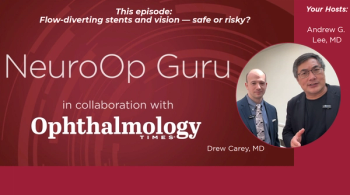
Andrew G. Lee, MD, and Drew Carey, MD, break down the visual safety of flow-diverting stents for carotid-ophthalmic aneurysms.

Uday Devgan, MD, FACS, Jordana G. Fein, MD, MS, and Carl D. Regillo, MD, FASRS, point to IOL education, emerging retina therapies, and treatment burden.
From the
Uday Devgan, MD, FACS, of Devgan Eye Surgery, says ophthalmologists share a foundation in optics. “At the end of the day, we’re all scientists. We all study lots of science in school, especially optics, and so we understand that real well.”
He points to the growing list of choices: “We’ve got monofocal lens which you’re used to. Then now there are monofocal plus, and there are a few different flavors of that. Now there are EDOF, extended depth of focus lenses, a few different varieties of that one.” Understanding how the options differ, he says, can be “sometimes a little difficult.”
Jordana G. Fein, MD, MS, of Retina Group of Washington, says, “I’m excited about things like gene therapy, and the potential for tyrosine kinase inhibitors.” She adds, “some of these clinical trials are really relatively far along. And I think we’ll probably hear about some readouts” from phase 3 trials.
The landscape is also getting “a lot more complicated, as we have more options to pick from going forward,” she says, so “these discussions about what we use when is only going to grow.”
Carl D. Regillo, MD, FASRS, is a partner at Mid Atlantic Retina, former chief of the Retina Service at Wills Eye Hospital and professor of ophthalmology at Sidney Kimmel Medical College at Thomas Jefferson University. He is also cohost of
Regillo says, “I think we need to talk more about the patient experience.” Effective anti-VEGF therapies have left the field “still somewhat in the honeymoon phase,” he says, but for patients, “it’s really challenging. It’s difficult for the patients to get to the office, to get injections on a frequent to regular basis.”
“Decreasing treatment burden is the term we all use. But, sustained delivery is really the best way to approach that.” The patient experience, the burden and “maintaining the best possible vision,” he says, “needs to be always part of the conversation.”
Each answer asks for clearer conversation about what changes for the clinician or patient as options multiply: more lenses to explain, more retina therapies to weigh, and more demands on patients receiving care. The One Thing is an editorially independent KOL-voiced series from the Eye Care Network that asks ophthalmologists to name the issue they believe deserves more attention. The views and perspectives are those of the ophthalmologists.