
Real-world data show tear film and Schirmer improvements with two preservative-free dry eye drops at ESCRS 2026.

Real-world data show tear film and Schirmer improvements with two preservative-free dry eye drops at ESCRS 2026.

The 44th Congress of the ESCRS kicked off at ExCeL London with iNovation Day and the Opening Ceremony, setting the stage for a five-day programme.

Suzana Konjevoda, MD, previews ESCRS 2026, highlighting new IOLs, presbyopia correction, AI in everyday practice, and advances in post-cataract surgery recovery and comfort.
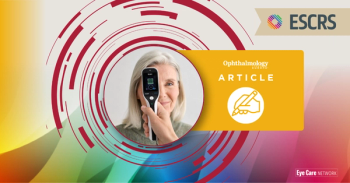
Handheld IC1000 pairs rebound tonometry with camera-guided alignment

The FDA accepted Nanoscope's BLA for MOGENRY (sonpiretigene isteparvovec, MC-010), a gene therapy for retinitis pigmentosa with severe vision loss, supported by RESTORE trial data showing sustained BCVA improvement.
Piotr A. Woźniak, MD, PhD, previews the ESCRS' growing focus on AI-assisted digital surgery and an expanding dry eye programme.
Ahead of the 44th ESCRS Congress in London, a look at the presbyopia-correcting IOL, glaucoma and dry eye disease research on this year's scientific programme.

Dante Pieramici, MD, discusses the phase 3 COMO and CAPRI trials of EYP-1901 in diabetic macular edema and what 6-month dosing could mean for treatment burden.

Zero Blind Babies uses wide-field retinal imaging and telemedicine to expand ROP screening across Ghana, Ethiopia, Tanzania, and Syria—screening 400 infants weekly at $56 per QALY—while stressing that local staff and complete-pathway systems remain essential.

Dante Pieramici, MD, on how a sustained-release TKI dosed every six months could cut clinic volume, ease treatment burden, and protect patients who otherwise disappear from care.

Jay Chhablani, MD, on how MacTel eyes turn neovascular, when to refer, and what Encelto means for treatment.

Jordi Mones, MD, PhD, discusses what is believed to be the first direct-to-phase 2 trial testing an optogenetic gene therapy to restore vision lost to GA.

Retina specialist David A. Eichenbaum, MD, FASRS, discusses KSI-101 (tabirafusp alfa), a dual IL-6/VEGF-blocking biologic in the Phase 3 PEAK trial, as a potential steroid-sparing, first-line therapy for uveitic macular edema.

A priority review in Stargardt disease, two pivotal-trial milestones, an emerging bispecific for wet AMD, and new diagnostic guidance defined a busy August for retina.

Researchers from China and Singapore found that the macular microvasculature is altered as early as the pre-diabetic stage of the disease. The findings suggest that the status of the choriocapillaris can be used to monitor early metabolic disease.

Jonathan Gloth, MD, discusses how a dual Tie2/VEGF mechanism could reduce injection burden and the consequences of missed doses in wet AMD.

John W. Kitchens, MD, discusses patient selection for geographic atrophy treatment, counseling approaches, and emerging therapies including a C1q inhibitor and cell-based options.

Reem Amine, MD, discusses why clinic distance predicts loss to follow-up in geographic atrophy and shares one retention check practices can implement now.

At WIO 2026, Durga Borkar, MD, discussed DAVIO2 trial results for EYP-1901 in wet AMD.

Kodiak fully enrolled the first pivotal cohort of its phase 3 PEAK trial testing KSI-101 for inflammatory macular edema, with topline data expected December 2026.
Jonathan Gloth, MD, explains how MK-8748's dual Tie2 agonist/VEGF inhibitor mechanism differs from VEGF blockade alone, and what distinguishes an unstable vessel from a stabilized one in wet AMD.
Dante Pieramici, MD, discusses EYP-1901, a sustained-delivery tyrosine kinase inhibitor targeting VEGF, PDGF, and IL-6 JAK/STAT signaling, in the phase 3 COMO and CAPRI diabetic macular edema trials.
Dante Pieramici, MD, breaks down the phase 3 COMO and CAPRI trials of EYP-1901 (Duravyu), an insert designed to ease treatment burden in diabetic macular edema.

Noah G. Banoub discusses a study finding MacTel2 misdiagnosed in 25.5% of cases, common mimics, misleading imaging, and Encelto's approval.

A former US Navy flight surgeon turned three-time CMO, David J. Tanzer, MD, ABO, reflects on a career built at the pharma-clinic bridge.

Phase 3 DURAVYU insert misses key vision endpoint in wet AMD but cuts injections; pivotal LUCIA readout may decide its future.

Byron Lam, MD, and Benjamin Bakall, MD, PhD, discuss what an FDA approval of tinlarebant could mean for the Stargardt disease type 1 standard of care.

Host Christina Y. Weng, MD, MBA, FASRS, talks with Dr. Flaxel and Dr. Rudnick about how a home monitoring device could reshape treatment decisions and reduce office visits for patients with wet AMD.

EyePoint has finished enrolling both pivotal Phase 3 trials evaluating its sustained-release intravitreal insert against aflibercept in diabetic macular edema, setting up a topline readout in late 2027.

Margaret A. Chang, MD, MS, on MK-8748's dual Tie2/VEGF mechanism, what MALBEC's data must show to shift wet AMD care, and where DME and RVO fit next.