
The cross sector initiative that intends to drive a shift from reactive to proactive health care by leveraging ocular data through the means of oculomics.
The cross sector initiative that intends to drive a shift from reactive to proactive health care by leveraging ocular data through the means of oculomics.
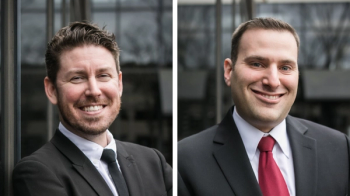
In this Q&A, John D. Gelles, OD, and Steven Greenstein, MD, chat about what inspired them to launch the symposium, what makes this year’s agenda especially exciting, and why the future of refractive care depends on stronger collaboration between ODs and MDs.
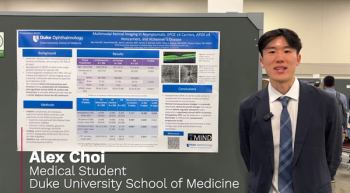
At ARVO 2025, in Salt Lake City, Utah, Alex Choi discussed his poster on APOE carrier genetic status and its relation to Alzheimer disease as well as changes of the retina that might reflect early signs leading to an earlier diagnosis of the disease
Steven Greenstein, MD, one of the cochairs of the Collaborative Care Symposium gave some insight into the upcoming conference and what attendees can expect.
At ARVO 2025, in Salt Lake City, Utah, Yuhua Zhang, PhD, talked about his presentation on in vivo imaging of retinal pigment epithelium metabolic function in age-related macular degeneration
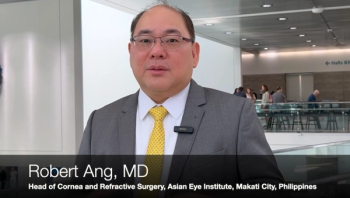
At the 2025 ASCRS meeting, Dr Ang said small aperture IOLs can benefit all patients, especially those with complex corneas or who have undergone previous corneal refractive surgery
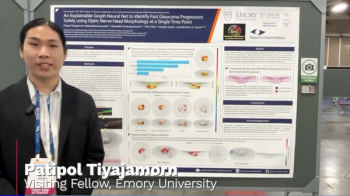
At ARVO 2025, in Salt Lake City, Utah, Patipol Tiyajamorn, talked about his poster on using graph neural networks to identify fast glaucoma progressors solely using optic nerve head morphology at a single time point
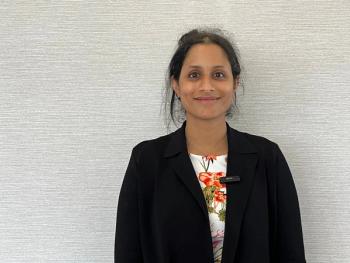
Retina specialist Priya Vakharia, MD, reveals promising ANX007 trial results, showing potential to prevent vision loss in geographic atrophy.
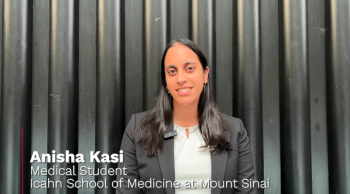
At ARVO 2025, in Salt Lake City, Utah, Anisha Kasi talked about her presentation on how her team used the TriNetX database, a large database of over 150 million patients worldwide, to validate the connection between hidradenitis suppurativa and inflammatory eye conditions.
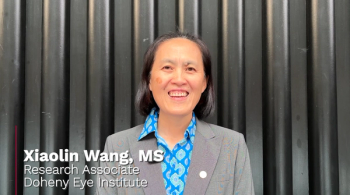
At ARVO 2025, in Salt Lake City, Utah, Xiaolin Wang, MS, talked about her presentation on in vivo imaging of retinal pigment epithelium metabolic function in AMD.

Join global experts at the 2025 International SPECTRALIS Symposium in Heidelberg, exploring innovations in ophthalmology and space-related ocular health.
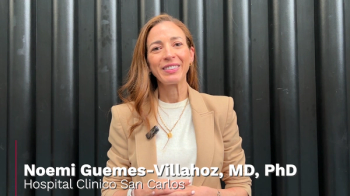
At ARVO 2025, in Salt Lake City, Utah, Noemi Guemes-Villahoz, MD, PhD, talked about 12-month results of vision-related quality of life in myopic children using combination treatment with atropine and DIMS (Defocus Incorporated Multiple Segments) spectacle lenses.
Matthew Starr, MD, highlights the RHONE-X trial's findings on faricimab, showcasing improved vision and reduced treatment burden for diabetic macular edema patients.
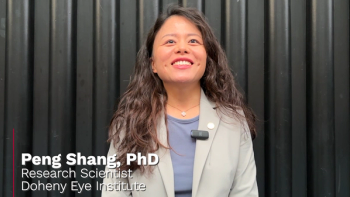
At ARVO 2025, in Salt Lake City, Utah, Peng Shang, PhD, talked about her presentation on how the Y402H polymorphism of Complement Factor H (CFH), a major genetic risk factor for AMD, and chronic oxidative stress affect the lipid profile of retinal pigment epithelial (RPE) cells.
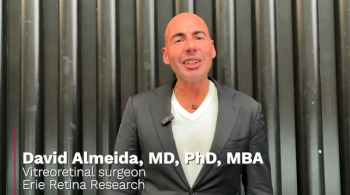
At ARVO 2025, in Salt Lake City, Utah, David Almeida, MD, MBA, PhD, talked about 12-month results from the PAVIA phase 2 trial of EYP-1901 in nonproliferative diabetic retinopathy.
Kapil Mishra, MD, discusses his presentation title "Radiation Retinopathy: Future Strategies" given at the 2025 Retina World Congress meeting.

Detecting mitochondrial dysfunction may give clinicians a chance to reduce the rate of cognitive decline in patients with dementia
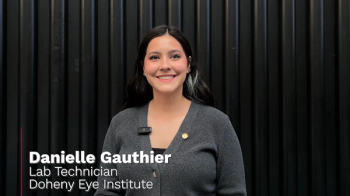
At ARVO 2025, in Salt Lake City, Utah, Danielle Gauthier talked about her poster on autosomal dominant Alzheimer disease in relation to optic nerve head drusen.
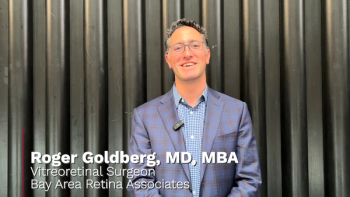
At ARVO 2025, in Salt Lake City, Utah, Roger Goldberg, MD, MBA, talked about his presentation on the effect of AREDS vitamins in geographic atrophy.
Ophthalmologist Tarek Hassan introduces new surgical approach for proliferative vitreoretinopathy, using precise small retinotomies instead of extensive retinal removal to improve patient outcomes.
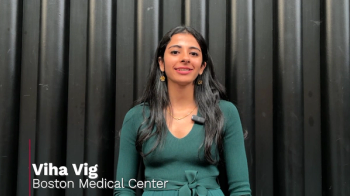
At ARVO 2025, in Salt Lake City, Utah, Viha Vig, talked about her poster presentation investigating the relationship between ocular and systemic mitochondrial diseases and dementia
Ultra-wide field imaging shows nonperfusion and leakage independently predict diabetic retinopathy progression, suggesting earlier treatment with anti-VEGF or photocoagulation may prevent complications.

Kriya Therapeutics presented preclinical data on its gene therapy candidate for the treatment of geographic atrophy.

Ashvattha Therapeutics reveals promising phase 2 results for migaldendranib, showcasing significant improvements in retinal disease treatment and reduced injection burden.

Ashvattha Therapeutics announced positive interim phase 2 results for migaldendranib for the treatment of AMD and DME.
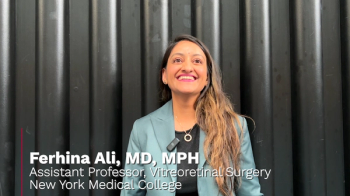
At ARVO 2025, in Salt Lake City, Utah, Ferhina Ali, MD, MPH, talked about her presentation on the early real-world use of aflibercept 8 mg in treatment-naive patients with neovascular age-related macular degeneration
Four-year study shows faricimab in treat-and-extend regimen maintains vision for diabetic macular edema patients with significantly fewer injections over time.