










Kamuvudine-8, also known as K8, is administered to the back of the eye via a sustained released intravitreal implant.

Kamuvudine-8, also known as K8, is administered to the back of the eye via a sustained released intravitreal implant.

News
According to the company, a subretinal injection of ATSN-201 was well tolerated in all patients in the first cohort with extensive resolution of schisis observed in 2 patients. Safety data from the first cohort of the LIGHTHOUSE study will be presented at the Retinal Cell and Gene Therapy Innovation Summit 2024 being held May 3, 2024, in Seattle.

Researchers found the model demonstrated “near-perfect” detection capabilities.

According to the company, OCU410 utilizes an AAV delivery platform for the retinal delivery of the RORA gene.


The Phase 1/2 study includes a dose-escalation phase of the study featuring 3 cohorts each one receiving either a low, medium, or high dose of OCU410.

Modern Retina’s interview with Aracelis Torres, PhD, MPH sheds light on how real-world insights empower researchers to see trends and develop new strategies, sometimes even new products, to meet the treatment needs of patients.

Explore cutting-edge ophthalmology innovations in this new series on the Ophthalmology Times EyePod podcast. Throughout this series, we'll hear insights from various stakeholders in clinical practice, academia, and industry. In this episode, host Ehsan Sadri, MD, engages in a conversation with Jeffry Weinhuff, managing partner at Visionary Ventures, exploring trends and offering advice for individuals driven by an entrepreneurial mindset.

Since its U.S. launch in September 2023, more than 40,000 avacincaptad pegol intravitreal solution vials have been distributed to physician practices.

The Phase 2 trial tested whether inhibiting microglia with minocycline might help slow GA expansion and its corresponding vision loss.
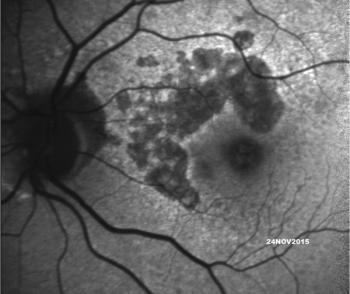
It is important that the ophthalmic community redouble our efforts in following patients with age-related macular degeneration (AMD) using optical coherence tomography (OCT) to find the early signs of geographic atrophy (GA).

The good news for patients is that GA is transitioning from an untreatable disease to a potentially treatable one with development of new therapies to reduce the growth rate, and use of anti-complement therapies have caused the growth rate of GA lesions to decrease.

OCU410 is a modifier gene therapy candidate being developed for geographic atrophy, an advanced stage of dry age related macular degeneration.

Early detection of the disease is key to optimal patient outcomes

Early detection of the disease is key to optimal patient outcomes

According to the company, its proprietary non-viral gene therapy platform with minimally invasive delivery technology is providing long lasting gene expression and favorable distribution in the retina.

New treatments for geographic atrophy coming down the pike has the potential to change eye care providers' approach to identifying and managing the disease.


Sydney M Crago, the editor of Modern Retina, talks with Arshad M Khanani, MD, MA, FASRS, about the expanded efficacy data from the GATHER 2 trial for geographic atrophy (GA).

Sydney M Crago, the editor of Modern Retina, talks with Arshad M Khanani, MD, MA, FASRS, about the expanded efficacy data from the GATHER 2 trial for geographic atrophy (GA).

Trial will analyze efficacy, safety of AVD-104 versus avacincaptad pegol to treat GA

Allen Ho, MD, FACS, FASRS, will make a presentation at the meeting, to be held virtually on February 3.

The company’s ANX007 global pivotal program in geographic atrophy is expected to start in mid-2024. It is the first pivotal trial to use vision preservation as a primary outcome measure in GA.

In a letter to shareholders, Ricciardi provided updates on Cognition’s 2024 pipeline and expected advances for several diseases.

Anchored matching-adjusted indirect comparison may aid decision-making