

Commentary|Podcasts|September 25, 2026
The Retina TL;DR with Dr. Weng: Advice for retina fellowship success with Darius Bordbar, MD, and Asad Loya, MD
Fact checked by: Sheryl Stevenson
In the latest episode of The Retina TL;DR with Dr. Weng—part 1 of a special two-part series—host Christina Y. Weng, MD, MBA, FASRS, sits down with two of her former residents, now second-year surgical retina fellows, for candid advice on matching, transitioning, and thriving in fellowship.
Advertisement
Don't miss Part 2!
In this episode of
Darius Bordbar, MD, is a second-year surgical retina fellow at Mass Eye and Ear in Boston, Massachusetts; Asad Loya, MD, is a second-year surgical retina fellow at Beaumont Associated Retinal Consultants in Royal Oak, Michigan (both were first-year fellows at the time of recording). This is Part 1 of a two-part series; Part 2 will feature former co-residents Monia Reding, MD, and Amer Alsoudi, MD.
Episodes in this series

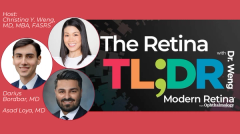
Like what you just watched? The goal of The Retina TL;DR with Dr. Weng video series, hosted by Christina Y. Weng, MD, MBA, FASRS, is to provide fast-paced, high-level information for today's modern retina specialist. We'd love to hear your feedback. Email us at eyecarenetwork@mjhlifesciences.com .
The TL;DR on matching
Bordbar offered his “TL;DR” (“too long; didn’t read”): matching into a top surgical retina fellowship is less about hitting a specific number of publications or board scores, and more about how you show up every single day during residency—treating every person you interact with, from attending to technician to junior resident, with respect and a commitment to excellence.
Weng noted that last year was a banner year at Baylor, with a record four residents applying into surgical retina and an outstanding match across the board. She asked Bordbar and Loya to share what they felt made the difference. Bordbar emphasized treating co-residents as collaborators rather than competition, noting that many of the items on his fellowship application stemmed directly from conversations, debates, and shared research projects with his peers. He also stressed that programs may ask for peer references—a reminder that how you treat those around you every day matters more than most applicants realize.
Loya focused on the practical side of the application process: starting early, giving letter writers adequate turnaround time, requesting letters from attendings who can speak to both surgical and clinical skills, and being prepared to submit a program director letter or supplemental letter when required. On the interview trail, he advised showing up to every interview as if it is the program you most want to attend—giving 100%, dressing sharp, arriving on time—while also approaching the process as a two-way evaluation to ensure the program is the right fit.
Transitioning into fellowship
Weng asked Bordbar what advice he would give residents preparing for the transition into a retina fellowship. His perhaps surprising answer: invest fully in anterior segment surgery during residency. The microsurgical skills developed in cataract surgery, strabismus, and tube shunts translate directly to retinal surgery—from scleral buckling to vitrectomy—and residents who treat every rotation as an opportunity to build their surgical toolbox will find the fellowship transition significantly smoother.
Excelling as a fellow
Loya closed with two pieces of advice for thriving in fellowship. First, be intentional about every day—both in clinic and in the OR—rather than falling into cruise control. Two years is a short time to absorb as much surgical and medical retina as possible, and approaching each day with a specific learning goal makes a meaningful difference. Second, take good notes: document OR feedback to track growth and avoid repeating the same mistakes, and follow patients longitudinally in clinic to understand their full course of care rather than seeing only snapshots.
Weng closed by reminding viewers that fellowship is the last stage of training where a mentor is always at your side—and that investing in that environment fully sets the foundation for everything that follows.
The content of this program is editorially independent.
Christina Y. Weng, MD, MBA, FASRS, is professor and the Alice R. McPherson Retina Research Foundation Chair in Ophthalmology, and fellowship program director, vitreoretinal diseases and surgery, with Baylor College of Medicine in Houston, Texas. Weng has no relevant disclosures.
Darius Bordbar, MD, is a second-year surgical retina fellow at Mass Eye and Ear, Boston, Massachusetts. He has no relevant disclosures.
Asad Loya, MD, is a second-year surgical retina fellow at Beaumont Associated Retinal Consultants, Royal Oak, Michigan. He has no relevant disclosures.
Advertisement
Related to this article
Timothy M. Janetos, MD, Donald J. D’Amico, MD, and Mark J. Gallardo, MD, point to uveitis access, clinical trial rigor, and procedural pharmaceuticals.
Drew Carey, MD, and Andrew G. Lee, MD, discuss triage, visual fields, double vision, and cataract topics from Neuro-Ophthalmology Subspecialty Day.

John A. Hovanesian, MD, discusses the Armenian Eyecare Project’s annual trip, from preparation and surgery to teaching and student involvement.
John J. Chen, MD, PhD, of Mayo Clinic discusses how NMOSD and MOGAD antibodies are changing optic neuritis care and the two trials now enrolling.
Mark J. Gallardo, MD, discusses how the laser performed alongside cataract surgery in open-angle glaucoma, including medication burden and safety.
Vaidehi Dedania, MD, discussed surgical advances, candidates, and how far whole eye transplant is from clinical use.
Anat Galor, MD, MSPH, explains how to tell whether dry eye pain stems from the nerves or the tear film and how to target it.
At AAO 2026, Michael T. Yen, MD, explained how at-home subcutaneous elegrobart could ease treatment burden in thyroid eye disease.
Advertisement
Advertisement
Trending on Eye Care Network - Ophthalmology Times
1
Alvotech files first known aflibercept 8 mg biosimilar with EMA
2
AAO 2026: How to become an ocular pain detective in dry eye
3
AAO 2026: Tinlarebant in Stargardt disease: Jacque Duncan, MD, on DRAGON results
4
AAO 2026: Vamikibart shows sustained gains in uveitic macular edema as FDA accepts BLA
5