

Commentary|Podcasts|October 23, 2026
The Retina TL;DR with Dr. Weng: Thriving in fellowship with Amer Alsoudi, MD, and Monia Reding, MD
Fact checked by: Sheryl Stevenson
In the latest episode of The Retina TL;DR with Dr. Weng—Part 2 of a special two-part series—host Christina Y. Weng, MD, MBA, FASRS, sits down with two more of her former residents for candid advice on transitioning into fellowship, balancing research and family, and what excites them most about the future of retina.
Advertisement
Missed Part 1?
In this episode of
Monia Reding, MD, is a second-year surgical retina fellow at Casey Eye Institute, Oregon Health & Science University, in Portland, Oregon; Amer Alsoudi, MD, is a second-year surgical retina fellow at Associated Retinal Consultants / Beaumont in Royal Oak, Michigan (both were first-year fellows at the time of recording).
Episodes in this series

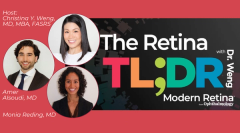
Like what you just watched? The goal of The Retina TL;DR with Dr. Weng video series, hosted by Christina Y. Weng, MD, MBA, FASRS, is to provide fast-paced, high-level information for today’s modern retina specialist. We’d love to hear your feedback. Email us at eyecarenetwork@mjhlifesciences.com .
The TL;DR on thriving as a trainee
Reding offered her “TL;DR” (“too long; didn’t read”): be inquisitive. Your mentors carry a wealth of knowledge drawn from lived experience and years of training—it is up to you to tap into that during your time as a trainee, and beyond. “Be a kind person, work hard,” she added. “People notice those kinds of things, and that’s going to make you a better doctor, a better person overall.”
The match trail—and matching with a co-resident
Weng noted that four residents from Baylor College of Medicine applied into surgical retina last year—an unprecedented number—and asked Alsoudi what it was like to go through the process alongside his co-residents, and how it felt to end up matching at the same program as Asad Loya, MD.
Alsoudi said the shared experience made an intense season feel more manageable. “It made the process so much more fun and way less lonely,” he said. They supported each other while staying focused on their own individual goals—a reminder, he noted, of how valuable strong colleagues are in a small field like retina. “Who knows? You might actually end up matching with your co-resident.”
The transition to the retina OR
Weng noted that Reding is highly regarded as a surgeon and asked her to speak to the transition into the retina OR—new pedals, a new viewing system, new instruments, and far less prior experience compared with cataract or glaucoma surgery.
Reding was candid: “Retina surgery’s a totally different beast.” Her advice to incoming fellows is to focus less on accumulating vitreoretinal cases during residency—there will never be enough—and more on becoming extremely comfortable instrumenting in the eye and developing ambidexterity. “Your non-dominant hand plays just as big of a role during retina surgery as your dominant hand.” Surgical confidence built in cataract and anterior segment work, she noted, translates meaningfully to the back of the eye.
From residency to fellowship: A shift in ownership
Alsoudi described the most challenging part of fellowship as the step up in ownership—making the call when cases are more complex and the consequences feel higher. He drew a clear distinction between the two phases of training: residency is about breadth, learning to manage and triage across every specialty; fellowship is about depth, refining judgment and thinking longitudinally.
“You’re not following a plan anymore,” he said. “You’re actually expected to build the plan and deliver it consistently.”
Balancing research, fellowship, and family
Weng noted that Alsoudi has remained remarkably productive in research even as a busy fellow and asked how he manages it all. Alsoudi credited clarity of purpose—in clinic, it is the patients; in research, it is the chance to contribute beyond his own exam room.
He also credited his young son with putting everything in perspective: “Parenthood has actually made me more intentional and efficient.” He plans his week, protects a few non-negotiables, and tries to be fully present wherever he is. “You can’t do everything on your own,” he said. “It truly takes a village.”
What excites them most about retina
Reding pointed to gene therapy as the new frontier—still largely untapped, with the potential to meaningfully change the outlook for diseases carrying high treatment burden or long-term poor prognosis. Weng added that ultra-long durability therapeutics paired with technologies like home OCT could further move the needle for the field. Alsoudi closed with a broader perspective: retina is entering an era of earlier detection, more personalized care, and more durable therapies. “It feels like retina is entering an era where we can not only preserve vision more reliably, but in some cases, potentially restore it—and even prevent vision loss before it even starts.”
The content of this program is editorially independent.
Christina Y. Weng, MD, MBA, FASRS, is professor and the Alice R. McPherson Retina Research Foundation Chair in Ophthalmology, and fellowship program director, vitreoretinal diseases and surgery, with Baylor College of Medicine in Houston, Texas. Weng has no relevant disclosures.
Monia Reding, MD, is a second-year surgical retina fellow at Casey Eye Institute, Oregon Health & Science University, Portland, Oregon. Reding has no relevant disclosures.
Amer Alsoudi, MD, is a second-year surgical retina fellow at Associated Retinal Consultants/Beaumont, Royal Oak, Michigan. Alsoudi has no relevant disclosures.
Advertisement
Related to this article
Andrew G. Lee, MD, and Drew Carey, MD, break down the link between optic neuritis and uveitis in central nervous system demyelinating disease.
Himani Goyal, MD, John J. Chen, MD, PhD, and Mark P. Breazzano, MD, FACS, point to academic compensation, optic nerve damage, and who chooses retina.
OT Roundup covers the optogenetics Nobel Prize, remigromig in DME with Veeral Sheth, MD, Stargardt disease and a total human eye transplant.
Timothy M. Janetos, MD, Donald J. D’Amico, MD, and Mark J. Gallardo, MD, point to uveitis access, clinical trial rigor, and procedural pharmaceuticals.
Prevent Blindness marks IED Week, October 19 to 25, as new therapies and pivotal trials reshape care for uveitis and thyroid eye disease.

Murtaza K. Adam, MD, shares pearls on haptic docking, patient selection, and preventing complications with the Yamane technique.
Himani Goyal, MD, reviews a patient case and discusses what a multispecialty group is seeing in practice.

CLARITY program data show significantly longer time to treatment failure and higher rates of steroid-free quiescence vs placebo.
Advertisement
Advertisement
Trending on Eye Care Network - Ophthalmology Times
1
Matching artificial tears to dry eye phenotype: a Q&A with Omur Ucakhan, MD
2
One day, three approvals: FDA expands options for ocular redness, thyroid eye disease, and presbyopia
3
Brepocitinib meets all Phase 3 end points in noninfectious uveitis
4
Murtaza K. Adam, MD, on pearls for the Yamane scleral-fixated IOL technique
5