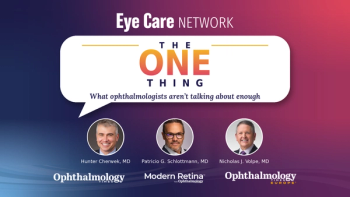
Patricio G. Schlottmann, MD, Nicholas J. Volpe, MD, and Hunter Cherwek, MD, point to retinopathy follow-up, missed diagnoses, and low-resource care.

For Jeffrey S. Heier, MD, shaping retina trials, joining industry, and staying in clinic all rest on family and a strong team.
In this episode, Eichenbaum sits down with his longtime mentor, Jeffrey S. Heier, MD, director of the vitreoretinal service and director of retina research at Ophthalmic Consultants of Boston (OCB) and chief scientific officer of Ocular Therapeutix, to discuss how a generation of retina specialists changed the way clinical trials are run, what drew Heier into pharmaceutical leadership, and how he balances clinic, research, consulting, and family.
Heier recalls that when he entered retina, industry-sponsored trials were nearly nonexistent, and most studies ran through academic institutions under a strong belief that research required an academic center. He and colleagues, including David Brown, MD; David Boyer, MD; Pravin U. Dugel, MD; and Peter K. Kaiser, MD, helped prove otherwise through what they called private academic centers. Because these practices could move through startup, regulatory review, budget negotiations, and central institutional review board approval more efficiently, Heier says, “We could be up and running in a new study in four to six weeks, where an academic center would take four to six months.”
That shift positioned private academic centers at the center of the registration trials for Lucentis and the injectables that followed. Eichenbaum credits Heier with passing the model along rather than guarding it, teaching fellows how to build and run research programs of their own.
Heier traces his interest in clinical research to the Persian Gulf War, where he served as an Army flight surgeon in a combat support hospital with little ophthalmic care available. He collected ocular injury data, and after the war a mentor helped him prepare the retrospective study for publication in Archives of Ophthalmology.
Presenting it around the world as a first-year resident, he recalls thinking, “This is pretty cool. You get to do research.” That work led to early research in cystoid macular edema and, eventually, to the anti-VEGF trials.
Heier has consulted for well over 100 companies and at times sat on 20 to 30 or more scientific advisory boards. He had served on the board of directors of Ocular Therapeutix for several years when Dugel, who was being recruited to the board, asked whether Heier and Kaiser would join the company as employees. The prospect of working full time with a core group of longtime colleagues, among them Nadia Waheed, MD, alongside a program they all believed in, was “just too exciting to overlook.”
Heier has now spent approximately 2.5 years with the company, where he serves as chief scientific officer, and he continues to consult outside areas of direct competition, an arrangement Dugel supported from the start. He also remains director of the vitreoretinal service and director of retina research at OCB.
Asked how he prioritizes among competing demands, Heier says compartmentalizing is essential, as is a supportive family and a long-tenured team. He credits his wife, Polly, and their daughters, and says he made a point of never missing an important family event, even when that meant missing meetings.
He also credits colleagues who have worked with him for decades, including a clinic leader of more than 25 years and a lead coordinator of nearly 20. Eichenbaum, who describes learning the same lesson from Heier, adds a message for younger listeners: “Your family doesn’t hold your career back. Your family moves your career forward.”
Looking ahead, Heier says he is energized by advances across retina, from wet age-related macular degeneration and diabetic disease to inherited retinal disease, and by the growth of a new generation of researchers and clinical trialists. He isn’t ready to slow down, though he expects to make room for family, including a grandson and relatives moving closer to home.