R. Ross Lakhanpal, MD, FACS, Anu Patel, MD, and Yasha S. Modi, MD, MHS, point to cell replacement in geographic atrophy, care burden, and glycemic control.

Patricio G. Schlottmann, MD, Nicholas J. Volpe, MD, and Hunter Cherwek, MD, point to retinopathy follow-up, missed diagnoses, and low-resource care.
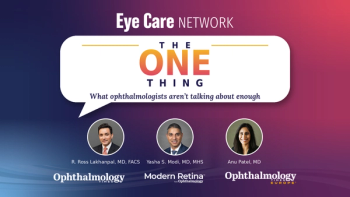
Some of the most pressing gaps in eye care are less about what ophthalmologists can treat than about who receives that care, and when. For this episode of The One Thing, the Eye Care Network asked three ophthalmologists: “What aren’t ophthalmologists talking about enough?” One points to the long-term management of
Patricio G. Schlottmann, MD, of Organización Médica de Investigación, Buenos Aires, Argentina, says, “What we’re not talking enough about in the retina world is probably the long-term management of patients with diabetic retinopathy.” Patients “keep progressing over time,” he says, and not many manage to stop that progression, “despite the new drugs for losing weight or … any of the new treatments that they may have for diabetes.”
Laser has been the standard “for the last 40, 50, 60 years maybe,” he says, and injections show an effect, but “who’s gonna receive injections on a monthly or bimonthly basis just to prevent something that may in two to three years down the line?” The goal, he says, is managing nonproliferative diabetic retinopathy “for the long term … so we avoid any of these patients getting into the … edge of the cliff.”
Nicholas J. Volpe, MD, of Northwestern University Feinberg School of Medicine, Chicago, Illinois, says, “We don’t talk enough about the patients that are undertreated, that have completely treatable causes and detectable causes of blindness that aren’t detected, because they don’t have access to ophthalmologists and eye care.” He also points to meeting the needs of an aging population “with a declining number of ophthalmologists available to treat a lot of very treatable diseases.”
On “the more exciting side,” he points to precision medicine and oculomics, saying eye diagnosis “is going to be critical in understanding everything from preeclampsia to Alzheimer’s disease.” Both conditions, he says, “can potentially be detected in their earliest forms from retinal images,” and ophthalmology and its research enterprises “need to really step up into the space of oculomics and precision medicine.”
Hunter Cherwek, MD, of Orbis International, asks, “How can I reach the most people, the people who need it most?” He says, “So much of the genius of technology is making it more globalized, more simplified so that anyone has access to it.” His request to those inventing and innovating is to “think about low-resource settings and how can that technology reach that community.”
He says that work is already happening. “Things that I never thought would be achieved in my lifetime are happening on a daily basis,” he says, noting that small-gauge vitrectomy is “now getting everywhere around the world.” When people design products, he says, “to think of those problems and be part of our solution globally would be incredible.”
Each answer turns on reaching patients sooner or more widely: people with diabetic retinopathy who need care before their vision is threatened, people whose treatable disease goes undetected, and communities that new technology has yet to reach. The One Thing is an editorially independent KOL-voiced series from the Eye Care Network that asks ophthalmologists to name the issue they believe deserves more attention. The views and perspectives are those of the ophthalmologists.