Chhablani reports revakinagene taroretcel-lwey slowed cavitation volume growth and preserved photoreceptor structure in MacTel type 2.
Chhablani reports revakinagene taroretcel-lwey slowed cavitation volume growth and preserved photoreceptor structure in MacTel type 2.

Dilsher S. Dhoot, MD, FASRS, breaks down the Phase 3 SOL-1 results on intravitreal axitinib hydrogel (OTX-TKI) and aflibercept on vision maintenance.
Talisa Forest (de Carlo), MD, discusses how dynamic complement biomarkers track with artificial intelligence-measured geographic atrophy progression.
K. Thiran Jayasundera, MD, MS, FACS, on how patient interviews shaped a tool capturing functional and psychological burdens overlooked by visual acuity.

One subretinal injection of medium-dose OCU410 gene therapy reduced geographic atrophy growth by up to 32%.

The meeting will include an Open Public Hearing.

Christine Kay, MD, discusses 4-year REMAIN data showing durable visual acuity gains with MCO-010, a mutation-agnostic intravitreal optogenetic therapy for advanced retinitis pigmentosa.

Remigromig met its BRUNELLO primary end point in DME, with higher PDR and vitreous hemorrhage rates than ranibizumab.
Reconstructing periocular defects in children requires planning for growth, not just repair.

EURETINA President Nicole Eter, MD, picks the sessions busy clinicians should follow at the 26th EURETINA Congress in Vienna, from durability data to AI. She also explains why early referral is still the most effective retina treatment.

Study found anti-VEGF therapy was linked to kidney function decline in patients with diabetic retinopathy or retinal vein occlusion.

At ESCRS 2026, Jascha Wendelstein, MD, noted standard ETDRS visual acuity testing misses functional differences between multifocal IOLs that reading-speed testing reveals.
Helena Noguera Nuñez, MD, discusses a prospective study of the TECNIS Odyssey IOL from ESCRS 2026.

For decades, topical medications have been the default first-line treatment for glaucoma. However, the well-recognized challenges of daily eye drops, including poor adherence, ocular surface disease, fluctuating intraocular pressure (IOP), and long-term treatment, have fueled a significant transformation in glaucoma therapy. As a result, glaucoma management has undergone a fundamental shift towards laser-based solutions.
Epithelial basement membrane dystrophy can affect premium IOL outcomes.

A checklist could help keep patients with geographic atrophy on track.

Samantha Harding, MD, discusses how ultra-widefield imaging reduces dilation needs and improves diagnosis in paediatric eye care.

At WSPOS Subspecialty Day during the 44th Congress of the ESCRS in London, Mark Bullimore, PhD, MCOptom, shared early trial data suggesting the Stellest 2.0 lens may slow myopic progression twice as fast as the original.

Hove stresses surgeons who prescribe premium lenses or laser surgery to patients should be willing to have those same treatments themselves when needed.

EyeCon is an opportunity for ophthalmologists and optometrists to sit down together.

Topline data from the phase 2/3 study show that both dose levels of the subretinal gene therapy produced significant gains in low luminance visual acuity versus untreated control at 12 months.

Emami-Naeini previews Retina Society 2026's shift toward AI-derived, quantitative biomarkers in imaging and therapeutics.
Ana Miguel, MD, PhD, explains how artificial intelligence already outperforms experts in glaucoma screening, expands telemedicine access, and reshapes patient conversations.

Learn who benefits most from Encelto for MacTel type 2, its long-lasting CNTF implant results, and key safety counseling points.
Giuseppe Giannaccare, MD, PhD, FEBOphth, discusses new data on perioperative low-level light therapy for post-cataract dry eye at ESCRS 2026.

Sessions at the 1-4 October Vienna congress address GA patient selection, AI-based functional prediction, imaging biomarkers, and surgical intervention.
NESTS survey reveals patients often normalize dry eye symptoms, delaying care despite major impacts on daily life.

Anat Loewenstein, MD, previews EURETINA 2026 Vienna: the Innovation Spotlight, 17 sessions, symposia, and more.
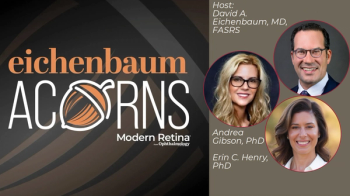
Andrea Gibson, PhD, and Erin C. Henry, PhD, trace 20 years in retina drug development—and the pathway gap still facing young scientists.
Ashraf Ahmad, MD, explains what's driving rising dry eye rates and why eyelid evaluation is often overlooked.