Liza M. Cohen, MD, explains when to use CT vs MRI in thyroid eye disease and why to review images yourself.
EURETINA President Nicole Eter, MD, picks the sessions busy clinicians should follow at the 26th EURETINA Congress in Vienna, from durability data to AI. She also explains why early referral is still the most effective retina treatment.
The 26th EURETINA Congress runs October 1–4, 2026, in Vienna, Austria, with attendees from more than 140 nationalities. This year's program tries new formats. World Retina @ EURETINA gives partner societies their own stage for all 4 days, and a Global Leadership Forum brings presidents of ophthalmic societies from around the world together for an open debate with the audience. There is also a redesigned Free Paper Forum and a new Poster Theatre for original research. The FEBOS-R exam and the Innovation Spotlight take place on September 30. On the clinical side, treatment durability is the big theme: longer-acting agents, sustained delivery, and early gene therapy results. So is the move of artificial intelligence (AI) from research into the clinic.
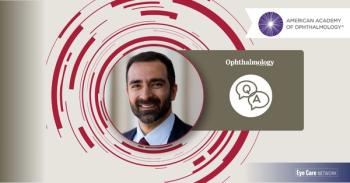
In this Q&A, Nicole Eter, MD, president of EURETINA and director of the Department of Ophthalmology at University Hospital Münster, Germany, previews what clinicians should watch in Vienna. She covers what durability means for real-world treatment burden and access, EURETINA's plans for a registry of routine retinal care, and her message to general ophthalmologists: time is vision.
Nicole Eter, MD: Personally, I am most looking forward to Session 11 on Saturday afternoon, “The Future of Retina: A Global Leadership Forum.” It is a format we have never had before: presidents of ophthalmic societies from around the world debate openly, with the audience being able to participate, where our field should go.
For the busy clinician, I would pick two things. The first is the new data on durability—longer-acting agents, sustained delivery, and the first gene therapy results—because this is what will change your clinic schedule in the coming years. The second is artificial intelligence, with a dedicated EURETINA session on Saturday. AI is moving from research into the consulting room, and every retina specialist should know what it can and cannot do.
Eter: World Retina @ EURETINA reflects what EURETINA has become: far more than a European society. Previously, our partner societies met at a World Retina Day every two years. Now they have their own stage and networking space on all four days, as co-hosts rather than guests.
For a colleague travelling from outside Europe, I hope for two things. First, to find their own questions on the programme, discussed by people from their own region alongside European colleagues. Second, to leave Vienna with new partners. Many of our collaborations begin with a conversation in the corridor—and they can grow from there, whether through the FEBOS-R exam, which is open to candidates worldwide, our fellowship and mentorship programmes, or joint research.
Eter: The shift is from listening to taking part. The revamped Free Paper Forum and the new Poster Theatre give original research—very often from young colleagues—a real stage and room for discussion, instead of a board in a hall or a few minutes at the end of a session.
Around the congress, the pieces now form a pathway. The FEBOS-R exam on September 30, already in its fourth year, certifies retina specialists to a common European standard. The Innovation Spotlight on the same day looks at what is coming next. It drew more than 800 registrations last year, and this year it again includes a direct exchange with regulators. And the education does not stop when the congress closes: webinars, podcasts, Case Club, and the on-demand content continue through the year.
Eter: Durability is the right goal, because treatment burden is our biggest real-world problem. In registries, patients receive far fewer injections than in trials—and they lose vision because of it. Every injection we can safely save helps patients, carers, and overstretched clinics.
But the real world is more complicated than the trials. Longer intervals only help if patients stay in follow-up. Sustained-delivery devices and gene therapy bring questions of long-term safety, inflammation, and surgical delivery that we can only answer with long-term data. And access is uneven: in many European countries the question is not which new agent to use, but which one is reimbursed. Biosimilars are improving access here.
That is why EURETINA is planning to build a registry of routine retinal care in the future to translate the evidence into practical guidelines. We are also talking directly with regulators and HTA bodies—the agencies that assess a therapy’s added benefit for reimbursement—so that innovation reaches all patients, not only some.
Eter: …that time is vision. Most of the retinal diseases we treat today are treatable, but only if they reach us in time. A patient with new distortion or a sudden drop in central vision may have neovascular AMD and needs to be seen within days, not weeks. And a diabetic patient who has never had a retinal examination should not leave the practice without one. Early referral is the most effective retina treatment there is.