
Nimesh Patel, MD, urges the FDA to reconsider SYD-101 as pediatric myopia drives earlier retinal damage in US children.

Nimesh Patel, MD, urges the FDA to reconsider SYD-101 as pediatric myopia drives earlier retinal damage in US children.
Sequencing IOL choice by eye can ease patient decision paralysis.
Aldeyra Therapeutics will submit a FDRR to the FDA for reproxalap, an investigational drug or dry eye disease.

For CVI Awareness Day, 3 experts explain why CVI can hide behind a normal eye exam and why early referral matters.
Coats, OD, FAAO, explains how neurotrophic keratitis, demodex, cosmetic habits and mucus fishing complicate dry eye disease.
Cathleen McCabe, MD, presents real-world data from a 57-site US study of the enVista Aspire IOL at ESCRS 2026, reporting over 90% patient satisfaction and 20/32 uncorrected intermediate vision in more than 70% of patients.
Nimesh A. Patel, MD, explains why myopia-related retinal detachments are appearing earlier and how routine exams can catch them.
Alessandro Arrigo, MD, describes an early-stage method that uses blue light autofluorescence imaging to grade cataracts objectively. He explains why a reproducible score could help with surgeon selection, IOL power calculation, and retinal image quantification.
Uday Devgan, MD, FACS, co-chair of EyeCon 2026, highlights what makes cataract surgery challenging, when to add MIGS, and why no patient is routine.
Nimesh A. Patel, MD, discusses compounded low-dose atropine and SYD-101 ahead of an October 30 FDA advisory committee meeting.
Concurrent exudative disease, early intervention, and a rare masquerader complicate the classic picture of geographic atrophy.
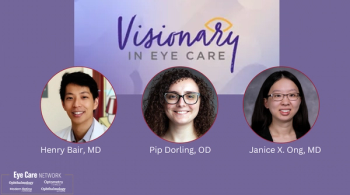
Three residents were honored for their leadership, education and research, and patient care contributions in ophthalmology, optometry, and retina.

Patient enrollment is complete in the the ASTRA phase 3 study AURN001 to treat corneal edema associated with corneal endothelial dysfunction.

The meeting will include an Open Public Hearing.
Reconstructing periocular defects in children requires planning for growth, not just repair.
EURETINA President Nicole Eter, MD, picks the sessions busy clinicians should follow at the 26th EURETINA Congress in Vienna, from durability data to AI. She also explains why early referral is still the most effective retina treatment.

At ESCRS 2026, Jascha Wendelstein, MD, noted standard ETDRS visual acuity testing misses functional differences between multifocal IOLs that reading-speed testing reveals.
Helena Noguera Nuñez, MD, discusses a prospective study of the TECNIS Odyssey IOL from ESCRS 2026.
Epithelial basement membrane dystrophy can affect premium IOL outcomes.
A checklist could help keep patients with geographic atrophy on track.
Samantha Harding, MD, discusses how ultra-widefield imaging reduces dilation needs and improves diagnosis in paediatric eye care.

At WSPOS Subspecialty Day during the 44th Congress of the ESCRS in London, Mark Bullimore, PhD, MCOptom, shared early trial data suggesting the Stellest 2.0 lens may slow myopic progression twice as fast as the original.

Hove stresses surgeons who prescribe premium lenses or laser surgery to patients should be willing to have those same treatments themselves when needed.
EyeCon is an opportunity for ophthalmologists and optometrists to sit down together.

Topline data from the phase 2/3 study show that both dose levels of the subretinal gene therapy produced significant gains in low luminance visual acuity versus untreated control at 12 months.
Ana Miguel, MD, PhD, explains how artificial intelligence already outperforms experts in glaucoma screening, expands telemedicine access, and reshapes patient conversations.
Learn who benefits most from Encelto for MacTel type 2, its long-lasting CNTF implant results, and key safety counseling points.
Giuseppe Giannaccare, MD, PhD, FEBOphth, discusses new data on perioperative low-level light therapy for post-cataract dry eye at ESCRS 2026.
Anat Loewenstein, MD, previews EURETINA 2026 Vienna: the Innovation Spotlight, 17 sessions, symposia, and more.
Ashraf Ahmad, MD, explains what's driving rising dry eye rates and why eyelid evaluation is often overlooked.