

Remigromig noninferior to ranibizumab in phase 2b/3 BRUNELLO DME trial
Published: | Updated:
Remigromig met its BRUNELLO primary end point in DME, with higher PDR and vitreous hemorrhage rates than ranibizumab.

Remigromig met its BRUNELLO primary end point in DME, with higher PDR and vitreous hemorrhage rates than ranibizumab.
EURETINA President Nicole Eter, MD, picks the sessions busy clinicians should follow at the 26th EURETINA Congress in Vienna, from durability data to AI. She also explains why early referral is still the most effective retina treatment.

Study found anti-VEGF therapy was linked to kidney function decline in patients with diabetic retinopathy or retinal vein occlusion.

At ESCRS 2026, Jascha Wendelstein, MD, noted standard ETDRS visual acuity testing misses functional differences between multifocal IOLs that reading-speed testing reveals.
Helena Noguera Nuñez, MD, discusses a prospective study of the TECNIS Odyssey IOL from ESCRS 2026.
Samantha Harding, MD, discusses how ultra-widefield imaging reduces dilation needs and improves diagnosis in paediatric eye care.

At WSPOS Subspecialty Day during the 44th Congress of the ESCRS in London, Mark Bullimore, PhD, MCOptom, shared early trial data suggesting the Stellest 2.0 lens may slow myopic progression twice as fast as the original.

Hove stresses surgeons who prescribe premium lenses or laser surgery to patients should be willing to have those same treatments themselves when needed.

Emami-Naeini previews Retina Society 2026's shift toward AI-derived, quantitative biomarkers in imaging and therapeutics.
Ana Miguel, MD, PhD, explains how artificial intelligence already outperforms experts in glaucoma screening, expands telemedicine access, and reshapes patient conversations.

Learn who benefits most from Encelto for MacTel type 2, its long-lasting CNTF implant results, and key safety counseling points.
Giuseppe Giannaccare, MD, PhD, FEBOphth, discusses new data on perioperative low-level light therapy for post-cataract dry eye at ESCRS 2026.
Anat Loewenstein, MD, previews EURETINA 2026 Vienna: the Innovation Spotlight, 17 sessions, symposia, and more.
Andrea Gibson, PhD, and Erin C. Henry, PhD, trace 20 years in retina drug development—and the pathway gap still facing young scientists.

The 26th EURETINA Congress convenes in Vienna, Austria, from October 1–4, headlined by a new World Retina networking initiative and a revamped Free Paper Forum stage.
At ESCRS 2026, Imane Tarib, MD discusses fostering inclusive ophthalmology workplaces and mentorship for early-career surgeons.
RCA's first State of Retina Care report surveys 115+ affiliated specialists on access, practice pressures, and clinical research.
The FDA has accepted Nanoscope's BLA for sonpiretigene isteparvovec in retinitis pigmentosa, backed by RESTORE and REMAIN trial data.

ESCRS 2026 data: patient selection and education may be key to aceclidine (VIZZ; LENZ Therapeutics) persistence.

Alessandro Arrigo, MD, previews an ESCRS 2026 presentation on a patent-pending method that adapts blue light autofluorescence confocal imaging to grade cataracts objectively. The approach yielded reproducible numeric indices that correlated with both expert LOCS III scores and measurable loss of retinal image quality.
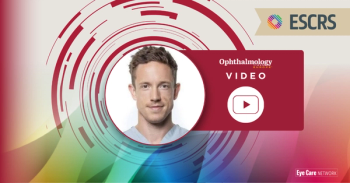
Adam Muzychuk, MD, discusses how AI like the Kane formula is improving outcomes, and why he still urges caution over relying on it for clinical decisions.

After four years and 500+ office-based procedures, Johnathan Feistmann, MD, shares how the model shortened time to surgery for fovea-threatening cases while reshaping patient experience and practice workflow.
Hove explains how his own cataract surgery has changed the way he counsels patients about glare, halos, and near vision.

Jai Parekh, MD, MA, FAAO, says AI is poised to transform eye care—from retinal and glaucoma imaging to cataract surgery—without disrupting it.

Radhika Rampat, MBBS, FRCOphth, discusses how AI is already shaping intraocular lens selection and keratoconus screening, and where anterior segment imaging and patient-facing AI tools are headed next.
At the 44th Congress of the ESCRS in London, Mark Bullimore, PhD, MCOptom, said delaying myopia onset is more valuable than slowing its progression, and explained how to identify children most at risk.
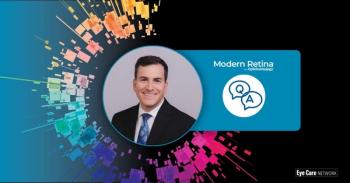
Benjamin Bakall, MD, PhD, weighs the RESTORE efficacy and safety data, the practical realities of in-office delivery, and how genotype-independent treatment reshapes candidacy and patient counseling.
At ESCRS 2026, Adam Muzychuk, MD, shares real-world data showing the enVista Envy IOL matches clinical trial outcomes, even in eyes with residual refractive error.
The authors of a review of 16 gene therapy trials for inherited retinal diseases explain why the pediatric evidence base remains thin and argue that individual-level, age-stratified reporting is the change most needed before CRISPR-based editing reaches children.

Majda Hadziahmetovic, MD, on MacTel neovascular warning signs, urgent referral, and how Encelto reshapes screening.