

ZEISS CLINIC 360 is an all-in-one cloud and browser-based software platform designed to consolidate ophthalmic diagnostic and medical record data into a single, unified patient view.
ZEISS CLINIC 360 is an all-in-one cloud and browser-based software platform designed to consolidate ophthalmic diagnostic and medical record data into a single, unified patient view.

Amy Zhang, MD, on the ergonomic habits and equipment changes that protect ophthalmic surgeons' careers long-term.

The FDA issued a recall notice for an eye drop designed to relieve ocular redness, itching, burning, and watery eyes. The Class II recall alerts consumers and physicians to possible temporary or reversible health effects, but serious harm is unlikely.

Neel S. Vaidya, MD, MPH, MBA, on why keratoconus can progress aggressively in children and teens—and how early topographic screening and prompt crosslinking protect long-term vision.
Researchers in the UK have developed a new treatment approach for aniridia-related keratopathy (ARK), a rare genetic ocular disease, namely, a collagen scaffold that delivers limbal epithelial stem cells and stromal stem cells to the area affected by ARK. The treatment resulted in improved ocular surface scores and visual acuities.

Host Deborah G. Ristvedt, DO, welcomes Dr. Berdahl to discuss the formative experiences, entrepreneurial drive, and personal philosophy that have shaped his career as a surgeon, innovator, and mentor.

AI accelerates retina trials and imaging insights, boosts screening access, and raises urgent questions on regulation, privacy, and equity.

AI model beats human graders at spotting glaucoma risk in UK population retinal photos, boosting accuracy and strengthening the case for scalable AI vision screening.

The Jack McGovern Coats' Disease Foundation has announced the initiation of new research to develop the first validated animal model of Coats' Disease, a rare eye disorder that primarily affects children.

Phase 3 DURAVYU insert misses key vision endpoint in wet AMD but cuts injections; pivotal LUCIA readout may decide its future.
A roundup of Ophthalmology Times' H1 2026 refractive coverage shows the field moving toward individualized care through adjustable lens outcomes, AI-assisted planning, and refined pediatric myopia monitoring.

Byron Lam, MD, and Benjamin Bakall, MD, PhD, discuss what an FDA approval of tinlarebant could mean for the Stargardt disease type 1 standard of care.

Host Christina Y. Weng, MD, MBA, FASRS, talks with Dr. Flaxel and Dr. Rudnick about how a home monitoring device could reshape treatment decisions and reduce office visits for patients with wet AMD.

EyePoint has finished enrolling both pivotal Phase 3 trials evaluating its sustained-release intravitreal insert against aflibercept in diabetic macular edema, setting up a topline readout in late 2027.

Approach centers on pressure-free messaging and optometric education

Patient enrollment is complete in a phase 3 registrational, or pivotal, trial to evaluate OPGx-LCA5, a gene therapy that is under investigation for treating Leber congenital amaurosis type 5-associated inherited retinal disease.
Two investigational pipeline therapies take aim at the root causes of dry eye disease

Margaret A. Chang, MD, MS, on MK-8748's dual Tie2/VEGF mechanism, what MALBEC's data must show to shift wet AMD care, and where DME and RVO fit next.
Noha Ekdawi, MD, FAAP, explains why pediatric myopia demands individualized, progression-based management—detailing how they sequence spectacle defocus lenses, low-dose atropine, and specialty contacts; drive long-term adherence; and frame lifetime risk for parents without causing alarm.
Wnt modulators, sustained-release TKIs, and topical steroids are in phase 3 trials for DME—offering alternatives to anti-VEGF injections.

Waste, cost, and carbon are converging to reshape how cataract centers choose instruments.

A maternal high-fat diet can negatively affect the retinal structure in mice.

Ahead of his November 10, 2026, start date, the incoming Duke ophthalmology chair shares his vision for research, training, and the integration of AI and data science.

FDA grants priority review to Belite Bio's tinlarebant NDA for Stargardt disease type 1, setting a February 2027 PDUFA date for a potential first STGD1 therapy.
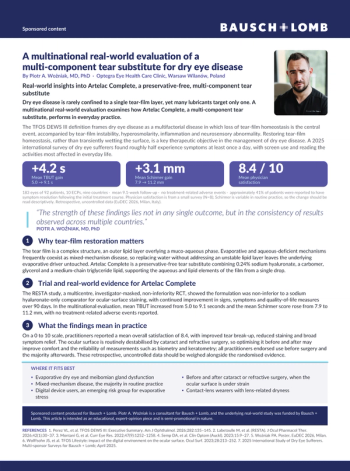
Real-world insights into Artelac Complete, a preservative-free, multi-component tear substitute

Sight Sciences' newest MIGS device gains FDA clearance for single-pass canaloplasty and trabeculotomy in open-angle glaucoma.

25.5% of patients labeled with MacTel2 didn't meet diagnostic criteria, most often due to cystic OCT changes and telangiectatic vessels mistaken for the disease.

The trial is evaluating the company’s orally administered synthetic cannabinoid, ART27.13
Gene therapies, Tie2 agonism, and new delivery platforms are advancing through phase 3 trials in wet and dry AMD, testing mechanisms distinct from anti-VEGF and complement inhibition.
In this Q&A from EDES 2026 in Milan, Piotr A. Woźniak, MD, PhD, discusses his real-world evidence study on a dry eye lubricating drop, including its effects on tear film stability.