



Retina
Latest News

Advertisement
Video Series



CME Content











Advertisement

The second and third required PPQ batches are scheduled, and should they meet specifications, the new TRIESENCE production process will be complete, allowing Harrow to relaunch during 2024.
We stand on the cusp of a new era in vitreoretinal surgery, one that has been marked by only a select few seminal innovations

The COVID-19 pandemic changed medicine forever, and now scientists are forging a new path for healthcare in the future, including in ophthalmology.
David Almeida, MD, PhD, MBA, shared insights on the surgical tools he uses in his practice at the 2024 Retina World Congress meeting in Fort Lauderdale, Florida.


The diagnostic screening technology is able to diagnose diabetic retinopathy by using 1 image taken of each eye with over 99% imageability.

The collaboration will bring automated, AI-powered OCT segmentation to MICRON Software Suite.

The company’s AI technology uses retinal imaging to assess potential health risks in patients.

Scientists at the National Institutes of Health use artificial intelligence called ‘P-GAN’ to improve next-generation imaging of cells in the back of the eye.

The company created this new role as they see continued growth and room for more expansion.

The effort led to the creation of an artificial vitreous body for treating retinal detachment. This solution is based on a natural carbohydrate derived from algae.

The company noted that individuals can purchase the ARx AI headset and register for access to the Seeing AI app through the provided links or download the latest version of the NaviLens app.
Retina specialists Giuseppe Querques, MD, PhD, and Paolo Lanzetta, MD, debate at the Congress on Controversies in Ophthalmology
At this year's Congress on Controversies in Ophthalmology, keynote speaker Ursula Schmidt-Erfurth, MD, addressed the clinical use of artificial intelligence

The collaboration combines Clario's transformative technology with Cleveland Clinic's market-leading imaging expertise and AI-enabled analysis to help bring new therapies to patients, faster.

Advances in virtual reality and AI are helping those with AMD and low vision.

ChatGPT-4 (OpenAI) had an overall “fair” performance when answering multiple-choice ophthalmic questions unrelated to multifocal imaging.

The approval marks the first new steroid on the ophthalmic market in more than 15 years.
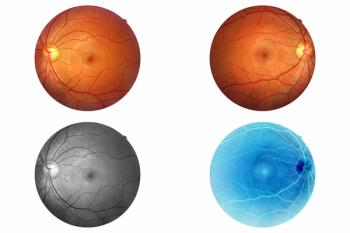

AI matched and outshone human specialists.

The platform to streamline clinical decision workflows, management of teleophthalmology, referral decisions and patient management while improving clinic efficiencies.

Toku’s AI technology, CLAiR, has obtained CE and UKCA Marks. CLAiR provides fast, accurate, non-invasive cardiovascular disease (CVD) risk assessments using standard retinal images.

Massachusetts Eye and Ear researchers came up with a mobile app called All_Aboard, designed to be used along with mainstream GPS systems and focuses on improving micro-navigation.

LambdaVision is leveraging the microgravity environment of the space station to develop higher-quality implants than is currently possible on Earth.

According to researchers at Johns Hopkins Children’s Center, AI-driven cameras take images of the back of the eye and require no eye drops can be used to close care gaps.
Advertisement
Advertisement
Trending on Eye Care Network - Ophthalmology Times
1
FDA approves phentolamine ophthalmic solution 0.75% (Ryzumvi) for presbyopia
2
Alvotech files first known aflibercept 8 mg biosimilar with EMA
3
Uveitis: a practical guide for ophthalmologists and optometrists
4
AAO 2026: How to become an ocular pain detective in dry eye
5