


AMD
Latest News
Advertisement
Video Series

CME Content













Advertisement


The SAB additions include Usha Chakravarthy, MBBS, PhD; Allen Ho, MD, FACS, FASRS, and Frank Holz, MD, FEBO, FAVO.

Experts conclude the series with the hope that longer-acting agents will lead to better real-world outcomes for patients, mirroring clinical trial results and potentially preventing vision loss, especially in countries with limited access to healthcare.
Experts discusses concerns related to the use of new agents, focusing on intraocular inflammation (IOI) and potential batch variations in biologics faricimab and aflibercept. He emphasizes close monitoring for IOI and advises clinicians to scrutinize patients for any signs of inflammation during follow-up visits.
Peter Kaiser, MD shares his early experiences with faricimab and high dose aflibercept for nAMD and DME. He notes positive outcomes, especially with hard-to-treat patients, and emphasizes the ongoing evaluation of patient response to treatment.

Age-related macular degeneration continues to be a key development area for many pharmaceutical companies as the work to develop new treatment options and present data in the first few months of the year.

Research around the globe is working not only to develop treatments for AMD, but also to determine risk factors for the disease to help prevent future cases.
Peter Kaiser, MD discusses the utilization of newer agents, faricimab and high dose aflibercept, for refractory patients who haven't responded well to previous treatments and for patients doing well but aiming to extend dosing intervals.
Experts discuss the use of steroids, particularly in the context of diabetic macular edema (DME). The inflammatory nature of DME reveals the effectiveness of steroids, especially in cases where persistent fluid remains despite anti-VEGF treatment.

The European Commission is expected to make a decision about the application before the end of June.

The prevalence of AMD features in Republic of Korea Air Force pilots was higher than in other general populations studied.
David Eichenbaum, MD, FASRS concludes this series with the final case of a treatment-experienced patient switching from aflibercept 2 mg to high-dose aflibercept 8 mg with noticeable improvement after the first dose.
David Eichenbaum, MD, FASRS provides his clinical experience with faricimab and aflibercept 8 mg, highlighting the small and large changes that benefit a patient’s quality of life, such as improved visual anatomy or reducing the frequency of visits.
Experts discuss the approach to loading doses in the context nAMD and DME. Kaiser, MD explains that loading doses may not be necessary based on studies like the CAT study, while he highlights the importance of individualized treatment plans tailored to the specific needs of each patient and the nuances of different retinal diseases.
David Eichenbaum, MD, FASRS discusses his clinical experience in managing retinal fluid, emphasizing the need to dramatically reduce intraretinal fluid, highlighting different strategies of care that offer the best results for patients.
Judy Kim, MD and Peter Kaiser, MD discuss the significance of fluid dynamics in nAMD and DME, highlighting the detrimental effects of fluid fluctuations and emphasize the importance of minimizing these fluctuations to achieve better visual outcomes.
David Eichenbaum, MD, FASRS discusses a case of exudative macular degeneration and opted for aflibercept 8 mg as treatment, which led to significant improvements in visual acuity and anatomical features.
After 3 loading doses, the patients were randomly assigned to receive EYP-1901 or continue to receive aflibercept at an 8-week dosing pattern for 32 weeks.

An investigation is set to launch on SpaceX’s 30th Commercial Resupply Services mission to the International Space Station contracted by NASA to test the therapy in space.
Judy Kim, MD and Peter Kaiser, MD reflect on the varying criteria for shortening or extending treatment intervals in clinical trials, emphasizing the need for standardization in large-scale studies. They highlight the importance of adapting trial criteria to clinical practice.
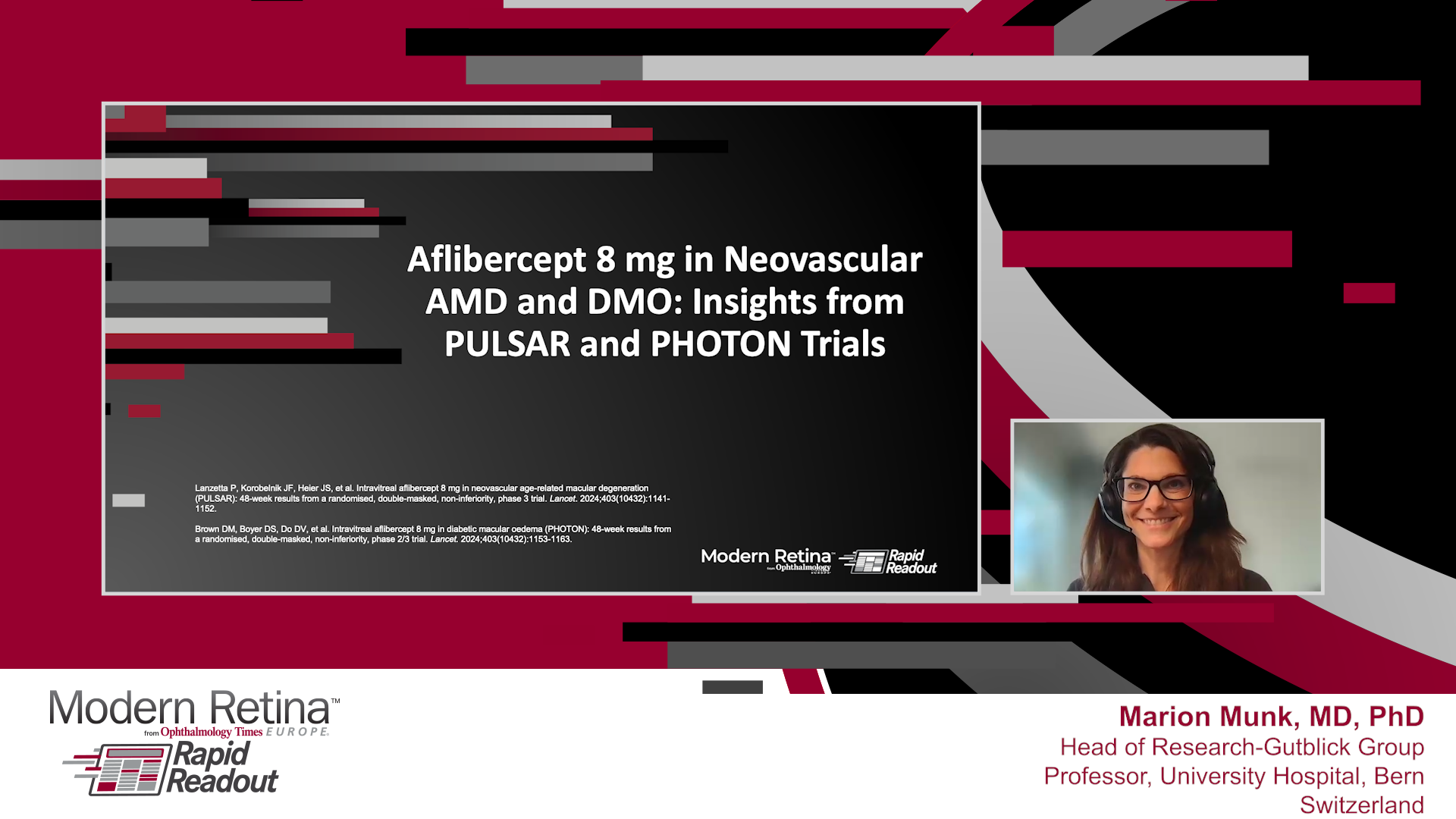
Experts discuss the efficacy and durability of newer therapies, focusing on faricimab and the high dose of aflibercept, highlighting the promising clinical trial results, maintaining comparable visual acuity efficacy while achieving longer durability

When we discuss trial participation with patients, we stress that the goal of these studies is to obtain better visual outcomes and ease the treatment burden.

Research indicates smoking increases risk of AMD, cataracts and glaucoma
Judy Kim, MD and Peter Kaiser, MD discuss the use of biosimilars and the potential introduction of biosimilar aflibercept for treating retinal diseases. Experts discuss their preferences for specific drugs and highlight the evolving landscape, anticipating challenges in drug selection and emphasizing the need for collaboration between retinal specialists and insurance companies to optimize patient care.
Advertisement
Advertisement
Trending on Eye Care Network - Ophthalmology Times
1
One day, three approvals: FDA expands options for ocular redness, thyroid eye disease, and presbyopia
2
Brepocitinib meets all Phase 3 end points in noninfectious uveitis
3
Diabetic macular edema: an inflammatory disease in focus
4
Matching artificial tears to dry eye phenotype: a Q&A with Omur Ucakhan, MD
5