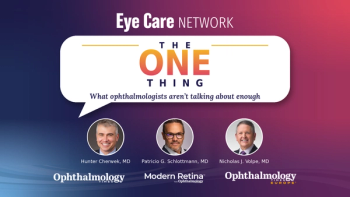
Patricio G. Schlottmann, MD, Nicholas J. Volpe, MD, and Hunter Cherwek, MD, point to retinopathy follow-up, missed diagnoses, and low-resource care.

Jay S. Duker, MD, Jayakrishna Ambati, MD, and Roger A. Goldberg, MD, MBA, give thanks for decades of advances, a path to phase 3, and the specialty itself.
Ophthalmology has changed a great deal in a single career, and the people closest to that change often have the clearest sense of what it means. For a special Thanksgiving edition of The One Thing, the Eye Care Network asked three retina specialists: “What are ophthalmologists most thankful for this year?” One looks back on four decades of progress in
Jay S. Duker, MD, professor of ophthalmology at Tufts University School of Medicine and a retina specialist at the New England Eye Center at Tufts Medical Center, Boston, Massachusetts, and president and chief executive officer of EyePoint Pharmaceuticals, says he has been in retina long enough to remember practice before optical coherence tomography (OCT) and anti-VEGF therapy. “At my age, having been in retina now for four decades, I remember the pre-OCT and the pre-anti-VEGF eras quite well.”
He says he is “really thankful that there are literally millions of patients that we now can help and help preserve their vision in the long term that four decades ago we were unable to help them at all.”
Jayakrishna Ambati, MD, DuPont Guerry III Professor of Ophthalmology and director of the Center for Advanced Vision Science at the University of Virginia, Charlottesville, and cofounder and board member of Inflammasome Therapeutics, points to the phase 2 program for kamuvudine-8 (K8), the company’s investigational therapy for GA. “We’re very grateful that our [K8] phase 2 program performed so stellar,” he says.
He is also grateful, he says, “that our end-of-phase 2 meeting with the FDA was a highly successful meeting where we had a clear path forward to our subsequent clinical development and phase 3 development.” He says he is looking forward to how the program unfolds over the next 1 to 2 years with its global phase 3 program.
Roger A. Goldberg, MD, MBA, a vitreoretinal surgeon at Bay Area Retina Associates, Walnut Creek, California, and cofounder of Emmetrope Ophthalmics, says, “Mostly I’m thankful that I became a retina specialist because we’re so fortunate to be able to help patients with what are otherwise blinding retinal diseases.”
Being able “to make such a positive impact in their quality of life and in their functional capabilities” is part of that, he says. “I just feel really fortunate to be in what’s a great field of medicine.”
Two of the answers look forward from where retina has been, and one comes back to the work itself, but all three tie gratitude to a growing ability to preserve sight in retinal diseases that once had few or no options. Duker measures that against a time before OCT and anti-VEGF therapy, Ambati looks to the next stage of drug development in GA, and Goldberg sees it in his daily work with patients.
The One Thing is an editorially independent KOL-voiced series from the Eye Care Network. This special Thanksgiving edition asked ophthalmologists what they are most thankful for. The views and perspectives are those of the ophthalmologists.