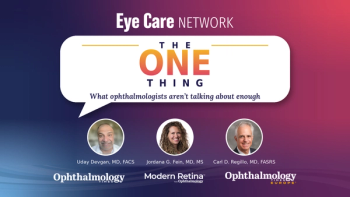
Uday Devgan, MD, FACS, Jordana G. Fein, MD, MS, and Carl D. Regillo, MD, FASRS, point to IOL education, emerging retina therapies, and treatment burden.

R. Ross Lakhanpal, MD, FACS, Anu Patel, MD, and Yasha S. Modi, MD, MHS, point to cell replacement in geographic atrophy, care burden, and glycemic control.
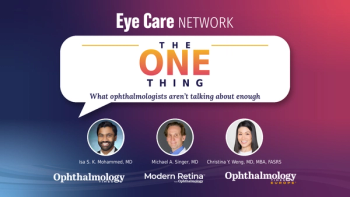
Retina specialists have made real progress against diseases that once routinely took sight, and that progress brings its own set of questions. For this episode of The One Thing, the Eye Care Network asked three ophthalmologists: “What aren’t ophthalmologists talking about enough?” One points to
R. Ross Lakhanpal, MD, FACS, of The Retina Care Center, says retina specialists have done “so much good work” against diabetic retinopathy,
“What we really need, honestly, is a way to repopulate,” he says, calling it “the last frontier.” He adds, “I think it’s just a matter of figuring out a way to deliver cells to the right area.”
Anu Patel, MD, of the Retina Institute of Michigan, says, “I still think that we’re not talking enough about … how the necessity for continued treatments impacts patients’ lives.” She adds, “It’s so wonderful that we have so many things that we can do that we sometimes forget how difficult it is to actually do them.”
She points to the newest treatments “that can get us out to 16 weeks and 20 weeks” and the relief that brings for patients, their families, and the medical system, with fewer visits and “more appointments available on a physician’s schedule.” Over the next 20 years, she says, “that’s gonna be a huge focus of what we do.”
Yasha S. Modi, MD, MHS, of Manhattan Eye, Ear & Throat Hospital/Northwell Health, says that in diabetes, meetings focus on new therapeutic targets but “sort of get away from the basics, which is the intensive glycemic control.” He notes “some data showing that fluctuations in glycemic control may precipitate worsening of microvascular disease.”
He would like the conversation to go beyond hemoglobin A1C to “really talking about how do we mitigate the fluctuations in glycemic control.” As he puts it, “I’d love a conversation on prevention rather than treatment.”
Each answer looks at what current care leaves unresolved: the cells GA has already destroyed, the visits that continued treatment still requires, and the systemic disease control that could keep eye disease from advancing. The One Thing is an editorially independent KOL-voiced series from the Eye Care Network that asks ophthalmologists to name the issue they believe deserves more attention. The views and perspectives are those of the ophthalmologists.