Retinal thickness fell by more than 100 µm within 8 weeks in each case

Industry leadership gave her a wider lens that she now brings to patient care.
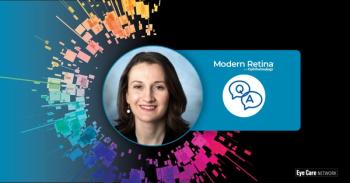
Eichenbaum catches up with Caroline R. Baumal, MD, FASRS, his former fellowship mentor and, until recently, chief medical officer (CMO) of Apellis Pharmaceuticals. The two trace her path from the early days of optical coherence tomography (OCT) and a busy surgical practice to the executive suite and back to patient care, and Baumal shares advice for young retina specialists on keeping a long career fresh.
Baumal trained in Toronto, Ontario, Canada, before completing a fellowship in medical retina and lasers at Tufts New England Eye Center in Boston, Massachusetts, where prototype OCT was being developed. This was followed by a fellowship in vitreoretinal diseases, surgery, and tumors at Wills Eye Hospital in Philadelphia, Pennsylvania. She spent much of her career as a professor of ophthalmology at Tufts Medical Center in Boston before joining Apellis Pharmaceuticals, until it was acquired by Biogen in 2026. She returned to patient care in mid-2026 at her private practice, Retina Specialists of Boston & Wellesley, affiliated with Mass General Brigham Community Physicians.
Note: This transcript has been edited for clarity and length.
Caroline R. Baumal, MD: David, when you describe what I’ve done, it sounds like a lot, but I feel like I’m just getting started, and that was solidified by my time at Apellis. I’m originally from Toronto. I studied biochemistry at McGill University, then went to medical school and completed ophthalmology residency in Toronto. I came to the US for 1 year to do a fellowship in medical retina and lasers at Tufts New England Eye Center.
I was so fortunate because, at that time, the prototype OCT was being developed. We had this machine in the clinic, and it was very exciting to work with the MIT [Massachusetts Institute of Technology] engineers and team to produce these early cross-sectional pictures of the retina. The goal at that time was for OCT imaging to produce an image analogous to the histopathology seen with retinal biopsy without having to take tissue.
We knew that OCT was going to revolutionize the field of retina, but I don’t think that everyone around us knew. Early in OCT commercialization, there were courses called “Is OCT Meaningful for Retina Physicians?” It took some time for development of spectral-domain OCT technology to give better images and for competition in the commercial devices to drive the price down. Of course, anti-VEGF therapy and OCT went hand in hand, and development of this treatment class made OCT explode.
It was an exciting time. During my fellowship at Tufts, I realized that I missed surgery, so I went to do another fellowship at Wills Eye Hospital. At that time, there were only 2 retina fellows per year and 18 attending physicians, adding to this unique experience and great fellowship.
Mentorship and teaching are very important to me. When I look back at my career, some of the most stressful attendings or experiences in the OR [operating room] taught me the most. We’re all going to have times in the OR when we encounter something new or unexpected, and those people in your training pressure-cook you and prepare you for those things.
It’s hard for me to pick only 3. Everyone at Wills and New England Eye Center was meaningful for my career, whether it was positive or less so. I worked extensively with Jay S. Duker, MD. I had the privilege of learning pediatric retina and retinopathy of prematurity (ROP) from William Tasman, MD. Also, William E. Benson, MD, and Carl D. Regillo, MD, played a role.
Baumal: I was fortunate that I was able to do it all. Being an executive at a company is a 24/7 job. Luckily, people have told me that I have boundless energy, which I think is a requirement for that. I was able to continue to see patients and continue to do some surgery to keep my hands in the game. I had a big referral practice, especially for diabetic retinopathy surgery.
We also did a lot of pediatric retina. Fortunately, we don’t have to do much surgery anymore for ROP, but pediatric retina makes you patient. I really feel like I’m still at the beginning of my career in so many ways. I recently transitioned to Mass General Brigham Community Physicians and opened a practice as part of Newton-Wellesley Hospital, which has been a lot of fun. David, I have learned so much. I’m part of many new-practitioner and solo-practitioner groups. There’s always something to learn in this field.
Baumal: First of all, you’re probably listening in your car, which is where I find many retina physicians do their listening. No. 1: Don’t forget that you are a retina doctor. You are skilled, you are well-trained, and there are so many things you can do. You’ve got it. You can figure it out, and if you can’t, there are so many people you can ask.
Second, I’ve been able to do so many different things while still maintaining my clinical practice. Of course, it helped that I had a very established practice. Apellis was acquired by Biogen, which is a great thing for patients and physicians, and now I’m consulting for other companies. You can consult for biotech or pharma companies, as it is important that they understand the physician and patient perspective. There’s so much artificial intelligence [AI] coming. There are always investors and imaging companies. All of these people want to learn from your clinical experience. You have a wealth of knowledge to add.
The last thing is to remember that you can always tailor your life, and it can change. There might be times when you want more time for yourself, or times when you want to do more things externally, and that’s OK. Think about what will best serve you at that time in your life.
Baumal: I was really inspired by working at Apellis. It was not just a geographic atrophy company; there were 3 systemic indications—2 in renal diseases and 1 in hematology. We are still physicians. We know more than the eye, and it will all come back if you ever need to know it. I was inspired by the pipeline and by the new ideas people had. It’s a great way to help a wide variety of patients. Of course, we help people in our office and do our best for them, but I really liked working at a company, so I will probably continue to consult in some way, as I’ve been doing.
I also think AI applications are going to open up new areas in retina that we haven’t even thought of yet. We’re going to have home OCT and unique ways to bring technology into our practices. I’m working a lot on efficiency in my practice. I have the OCT in the tech room, so patients have their vision checked and their OCT done in the same place. I’m trying to make things more efficient, so patients don’t have to move around very much and will have a better experience.