
At ESCRS 2026, Imane Tarib, MD discusses fostering inclusive ophthalmology workplaces and mentorship for early-career surgeons.

At ESCRS 2026, Imane Tarib, MD discusses fostering inclusive ophthalmology workplaces and mentorship for early-career surgeons.

ESCRS 2026 data: patient selection and education may be key to aceclidine (VIZZ; LENZ Therapeutics) persistence.

Alessandro Arrigo, MD, previews an ESCRS 2026 presentation on a patent-pending method that adapts blue light autofluorescence confocal imaging to grade cataracts objectively. The approach yielded reproducible numeric indices that correlated with both expert LOCS III scores and measurable loss of retinal image quality.

Adam Muzychuk, MD, discusses how AI like the Kane formula is improving outcomes, and why he still urges caution over relying on it for clinical decisions.

Hove explains how his own cataract surgery has changed the way he counsels patients about glare, halos, and near vision.

Jai Parekh, MD, MA, FAAO, says AI is poised to transform eye care—from retinal and glaucoma imaging to cataract surgery—without disrupting it.

Radhika Rampat, MBBS, FRCOphth, discusses how AI is already shaping intraocular lens selection and keratoconus screening, and where anterior segment imaging and patient-facing AI tools are headed next.

At the 44th Congress of the ESCRS in London, Mark Bullimore, PhD, MCOptom, said delaying myopia onset is more valuable than slowing its progression, and explained how to identify children most at risk.
At ESCRS 2026, Adam Muzychuk, MD, shares real-world data showing the enVista Envy IOL matches clinical trial outcomes, even in eyes with residual refractive error.

Two-year data presented at ESCRS 2026 show the ELIOS excimer laser procedure sustained IOP reduction and kept most glaucoma patients medication-free.
At ESCRS 2026, Zoltan Z. Nagy, MD, reported that femtosecond laser trabeculotomy (FLigHT) cut intraocular pressure by 27% at 48 months in open-angle glaucoma, with a stable, incision-free safety profile.
A prospective French study found intraoperative OCT most valuable for measuring key surgical distances in deep sclerectomy and MIGS procedures, and useful for training residents.
ESCRS 2026 real-world data: aceclidine (VIZZ; LENZ Therapeutics) drops show fast onset, high satisfaction for presbyopia.
Three-year ESCRS 2026 data show trans-epithelial PRK matches conventional PRK in refractive outcomes, safety, and pain, with faster surgical time.
A real-world study of an enhanced monofocal IOL found most patients achieved 20/20 distance vision and functional intermediate vision without glasses, according to Jai Parekh, MD, MA, FAAO, at ESCRS 2026.
New ESCRS 2026 data show corneal measurements shift meaningfully across the day, with early-morning readings potentially biased by overnight eyelid closure.
At ESCRS 2026 in London, Radhika Rampat, MBBS, FRCOphth, describes bringing low-level light therapy into her refractive practice, from dry eye care to chalazion treatment and pre-surgical ocular surface optimisation.

Suzana Konjevoda, MD, presents data at ESCRS 2026 showing citicoline eye drops aid corneal nerve recovery post-cataract surgery.

ESCRS 2026 study shows multifocal IOLs tie at distance, but reading speed plunges in dim light; focus curves predict laser touch-ups.
Real-world data show tear film and Schirmer improvements with two preservative-free dry eye drops at ESCRS 2026.
Suzana Konjevoda, MD, previews ESCRS 2026, highlighting new IOLs, presbyopia correction, AI in everyday practice, and advances in post-cataract surgery recovery and comfort.
Piotr A. Woźniak, MD, PhD, previews the ESCRS' growing focus on AI-assisted digital surgery and an expanding dry eye programme.
Real-world SPECTRUM data shows strong fluid resolution and vision gains by week 12, with low adverse events and no retinal vasculitis.
Real-world Spectrum data show aflibercept 8 mg boosts early vision and retinal anatomy in wet AMD, including switch patients.

Andy Chang and Mikhail Boukhny of BVI Medical discuss the company's new Experience Hub in Sant Cugat, Spain, a hands-on training facility built to gather surgeon feedback ahead of the Virtuoso platform's European launch.
Ectoine eye drops boost tear stability and ease redness and tired eyes, along with burning, foreign body and dryness sensations, offering fast, irritation-free relief for patients with dry eye disease.
Piotr Woźniak, MD, PhD, shares real-world evidence on Artelac Complete in dry eye disease from EuDEC 2026 in Milan, Italy, including improvements in tear break-up time and Schirmer scores, perioperative and contact lens use patterns, and high eye care practitioner satisfaction.
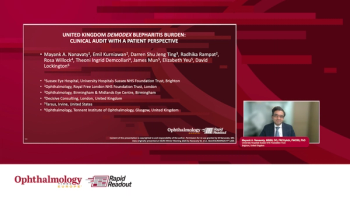
Prof. Nanavaty reviews UK treatment practices, emphasizing that the lack of Demodex-specific therapies leads to mismanagement, increased healthcare burden, and complications, while highlighting the need for better diagnosis and targeted treatment.
Prof. Nanavaty outlines Demodex blepharitis, highlights colorette counts as a measure of severity, and emphasizes that despite its high prevalence in patients, it is frequently overlooked and should be routinely assessed during eye exams.
Prof. Anat Loewenstein questioned whether treat-and-extend will remain the preferred strategy as longer-acting therapies emerge.