





Inherited Retinal Diseases
Latest News
Advertisement
Video Series







Shorts

0:54
Could bedside OCT spot neurodevelopmental risk in infants before symptoms?
3 months ago
by
Cytnthia Toth, MD(+2 more)
0:41
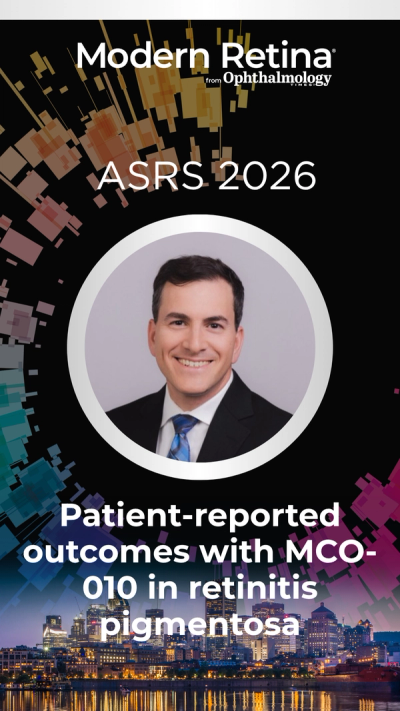
Patient-reported outcomes with MCO-010 in retinitis pigmentosa
3 months ago
by
Benjamin Bakall, MD, PhD(+2 more)
0:57
Retina as a window to the brain: a biomarker approach to ROP
3 months ago
by
Cytnthia Toth, MD(+2 more)
0:31
1-year RESTORE and 3-year RETAIN visual acuity outcomes
3 months ago
by
Benjamin Bakall, MD, PhD(+2 more)
CME Content



Advertisement

Jordi Monés, MD, PhD, explains why RP and Stargardt data support testing son-vec to restore vision in advanced GA.

Jacque Duncan, MD, reviews phase 3 DRAGON data on oral tinlarebant for Stargardt disease and its mechanism-related visual effects.

Key takeaways on gene therapy, GA, sustained delivery and AI in Vienna

Michel Michaelides, MD, discusses phase 3 DRAGON results showing that oral tinlarebant slowed atrophic lesion growth by about 36% in adolescents with Stargardt disease.

Three researchers share the prize for discovering channelrhodopsin, a light-sensitive protein now being tested to restore vision in retinal disease.
Ester Carreño, MD, PhD, explains how to tell retinitis pigmentosa from uveitis and why genetic confirmation now matters more.

Japan's filing covers IRDs broadly, supported by RESTORE and open-label Stargardt data.

Inherited metabolic diseases affect the retina even before the systemic diagnosis is established.

An industry symposium on intravitreal 4D-150 and a course on subretinal delivery lead gene therapy content at EURETINA 2026, alongside IRD courses and trial readouts.

Topline data from the phase 2/3 study show that both dose levels of the subretinal gene therapy produced significant gains in low luminance visual acuity versus untreated control at 12 months.

The FDA has accepted Nanoscope's BLA for sonpiretigene isteparvovec in retinitis pigmentosa, backed by RESTORE and REMAIN trial data.

Benjamin Bakall, MD, PhD, weighs the RESTORE efficacy and safety data, the practical realities of in-office delivery, and how genotype-independent treatment reshapes candidacy and patient counseling.

The authors of a review of 16 gene therapy trials for inherited retinal diseases explain why the pediatric evidence base remains thin and argue that individual-level, age-stratified reporting is the change most needed before CRISPR-based editing reaches children.

Opus Genetics announced positive 3- and 6-month results OPGx-BEST1 in BEST1-related retinal diseases.

The FDA accepted Nanoscope's BLA for MOGENRY (sonpiretigene isteparvovec, MC-010), a gene therapy for retinitis pigmentosa with severe vision loss, supported by RESTORE trial data showing sustained BCVA improvement.

Scaling telemedicine-based screening for retinopathy of prematurity in sub-Saharan Africa
ByArthur R. Brant, MD,Sarthak V. Shah, MD,Akwasi Ahmed, MD, MBA,Imoro Braimah, MD,Naana Wireko Brobby, MD,Kwabena Onwona-Agyeman, MD,Dominic Masonuo Bagbio, MD,Gilbert Bonsaana, MD,Samuel Bondzie, MD,Jacquelyn Adu, MD,Muniratu Alhassan, BS,Sadik T. Sherief, MD,Asrat Demptse, MD,Eyerusalem Haregewoyn, MD,Celina Mhina, MD,Martha Mkony, MD,Ahmad Al-Moujahed, MD, PhD,Ahmad Kunbaz, MD,Celine Chaaya, MD, MSc,Cindy S. Zhao, MD, MBA,Geoffrey C. Tabin, MD,Nimesh A. Patel, MD,Darius M. Moshfeghi, MD
Zero Blind Babies uses wide-field retinal imaging and telemedicine to expand ROP screening across Ghana, Ethiopia, Tanzania, and Syria—screening 400 infants weekly at $56 per QALY—while stressing that local staff and complete-pathway systems remain essential.

Japan designated gildeuretinol an orphan drug for Stargardt disease as the oral therapy enters phase 3 evaluation in the NORTHSTAR trial.

Byron Lam, MD, and Benjamin Bakall, MD, PhD, discuss what an FDA approval of tinlarebant could mean for the Stargardt disease type 1 standard of care.
Patient enrollment is complete in a phase 3 registrational, or pivotal, trial to evaluate OPGx-LCA5, a gene therapy that is under investigation for treating Leber congenital amaurosis type 5-associated inherited retinal disease.
Advertisement
Advertisement
Trending on Eye Care Network - Ophthalmology Times
1
FLORetina-ICOOR 2026: An eye to the future
2
Dry eye and Sjögren disease: Esen Akpek, MD, on screening and referral
3
Beyond the eye: The future of retinal imaging in medicine
4
BL1332 misses primary end point in phase 2 post-PRK ocular pain study
5